Function and Flow
The Hidden Wet Bar Is a Cabinet Until 6 P.M.
The best hidden wet bars disappear into the room when closed and earn the reveal when open. Concealment only works if doors, plumbing, traffic, storage, and daily life have been designed with equal care.
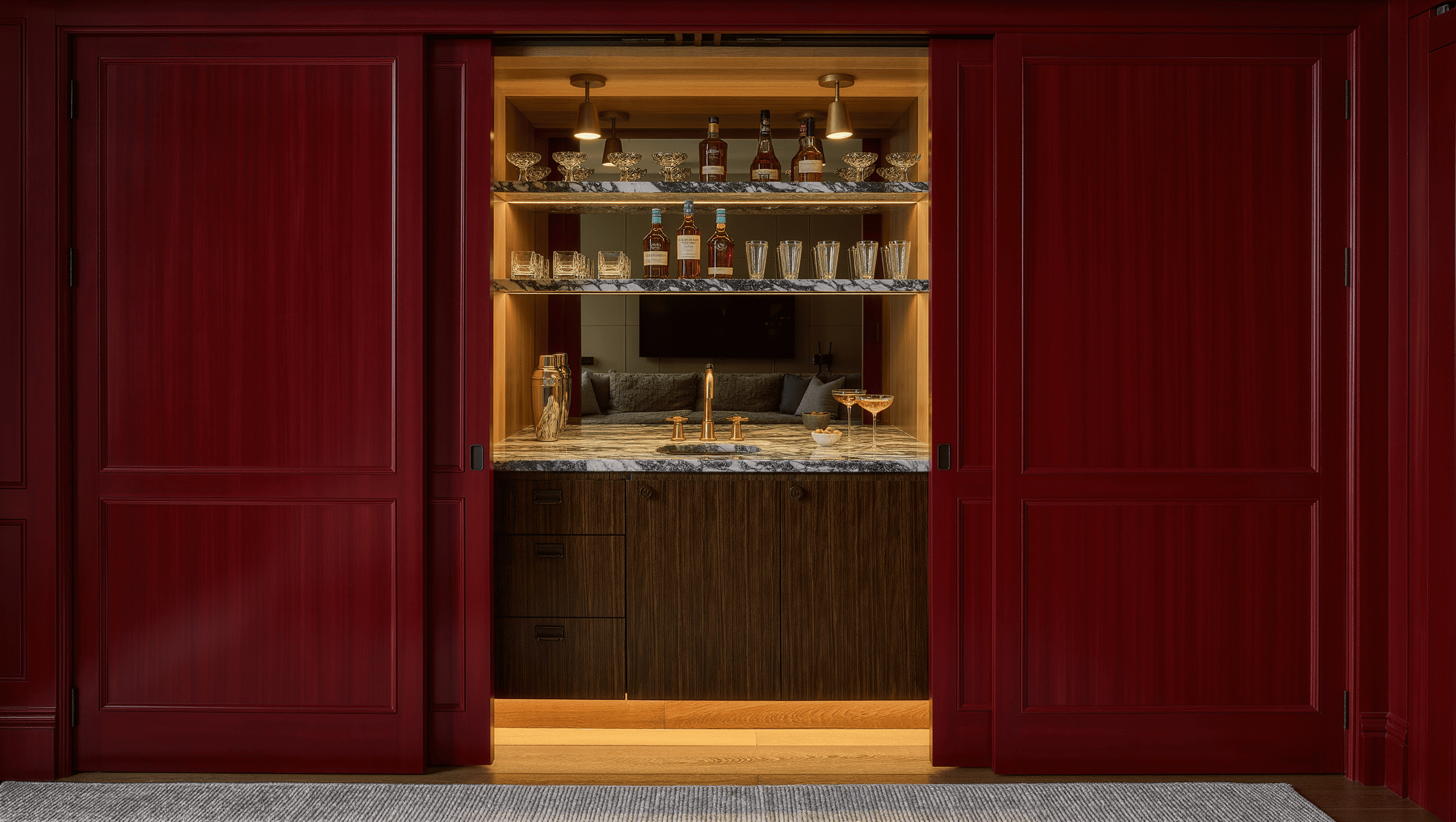
The hidden wet bar is not interesting because it disappears. It is interesting because the room gets to stop looking like it is waiting for Friday.
Concealed bars are having a very specific moment: paneled doors, pocket doors, cabinet fronts that match the surrounding millwork, then a darker or glossier interior when the whole thing opens. The appeal is obvious. You get the usefulness of a beverage station without asking the living room to stare at bottles all day.
The danger is equally obvious. A hidden bar can become a gorgeous, expensive cabinet that is irritating to open, awkward to stand in front of, and somehow still sends everyone back to the kitchen for ice.
Hide the bar only if the room benefits from the disappearing act
Concealment is useful in rooms with more than one identity: a living room that hosts but also reads quiet during the week, a dining room that needs visual calm, a study that becomes a drinks room after dark. If the bar is used constantly and the doors will live open forever, the mechanism is theater.
Start with the same question as any other bar: what problem is this solving? If the answer is only that hidden bars look expensive, keep the cabinetry simpler and spend the complexity somewhere you will actually use it.
The closed view has to belong to the room

When the doors are shut, the bar should read as part of the architecture or furniture around it. Matching panel rhythm matters more than matching every finish perfectly. So does proportion. One mysterious cabinet that is deeper, taller, shinier, and more heavily detailed than everything beside it is not concealed. It is wearing a disguise with its name tag still on.
Use the surrounding wall, built-ins, or freestanding furniture as the visual reference. The bar can be dramatic inside. Outside, restraint is doing the work.
The reveal gets one strong move
This is where the jewel-box idea earns its keep. Lacquer. A saturated green. Smoked mirror. Veined stone. A small field of wallpaper. Warm metal. Good light on glass.
Not all of them at once.
The open cabinet is already a reveal. Give the eye one clear reason to enjoy it, then leave enough quiet surface to make a drink without relocating six decorative objects.
Doors are part of the floor plan
Pocket, retracting, sliding, bifold, and conventional hinged doors all solve different problems. The right one is the one that can stay open during use without narrowing the main route or trapping the person making a drink.
Stand in front of the proposed cabinet and mark the open-door footprint with painter’s tape. Then walk past it carrying a tray. If the door turns the bar into a toll booth, change the hardware or the location before ordering millwork.
For the lower-commitment versions, Cart, Closet, Niche, Under-Stairs: Four Bar Architectures covers the basic relationships between concealment and space.
A wet bar still has wet-bar consequences
A sink changes plumbing, drainage, cabinet construction, maintenance, and the installation path. Refrigeration changes ventilation and electrical planning. Lighting inside cabinetry needs a safe, serviceable solution. A beautiful closed front does not erase the systems behind it.
Building boundary: permanent plumbing and electrical changes should be planned and installed to suit the building, equipment requirements, and applicable local rules. Hidden is not a synonym for inaccessible.
Keep the service route shorter than the reveal is clever
A concealed bar belongs near the social zone, but it still needs a sensible relationship to ice, clean glassware, water, waste, and the kitchen. If restocking requires crossing the room every ten minutes, the cabinet has won the photograph and lost the evening.
The traffic test in Get the Drinks Out of the Kitchen is still the right test. A hidden bar should reduce movement, not make it prettier.
Give the cabinet a daytime job
The current version of the home bar is less alcohol-specific than the old one. Coffee, sparkling water, tea, glassware, and non-alcoholic mixers can give the station a real daily rhythm. That does not mean cramming every beverage category into one cupboard. It means the square footage should have a reason to exist when nobody is hosting.
A concealed bar that opens every morning and again at night is easier to justify than one that spends eleven months looking expensive and mysterious.
Do the open-close test before the cabinetry becomes permanent
Mock the width with tape or cardboard. Put a temporary surface at the planned height. Pretend the doors are open. Make two drinks. Put the tools away. Close the imaginary front. Do it again the next morning.
If the sequence feels annoying in plywood and painter’s tape, it will not become charming in walnut.
Trend source line: Architectural Digest’s 2026 entertaining forecast highlights hidden wet bars and speakeasy-style entertaining; Houzz’s 2026 bar roundup shows slide-away doors and cabinetry that blends into the room; Houzz’s summer search report found searches for “speakeasy” up 75% year over year. Sources: Architectural Digest, Houzz home bars, Houzz trend report.


