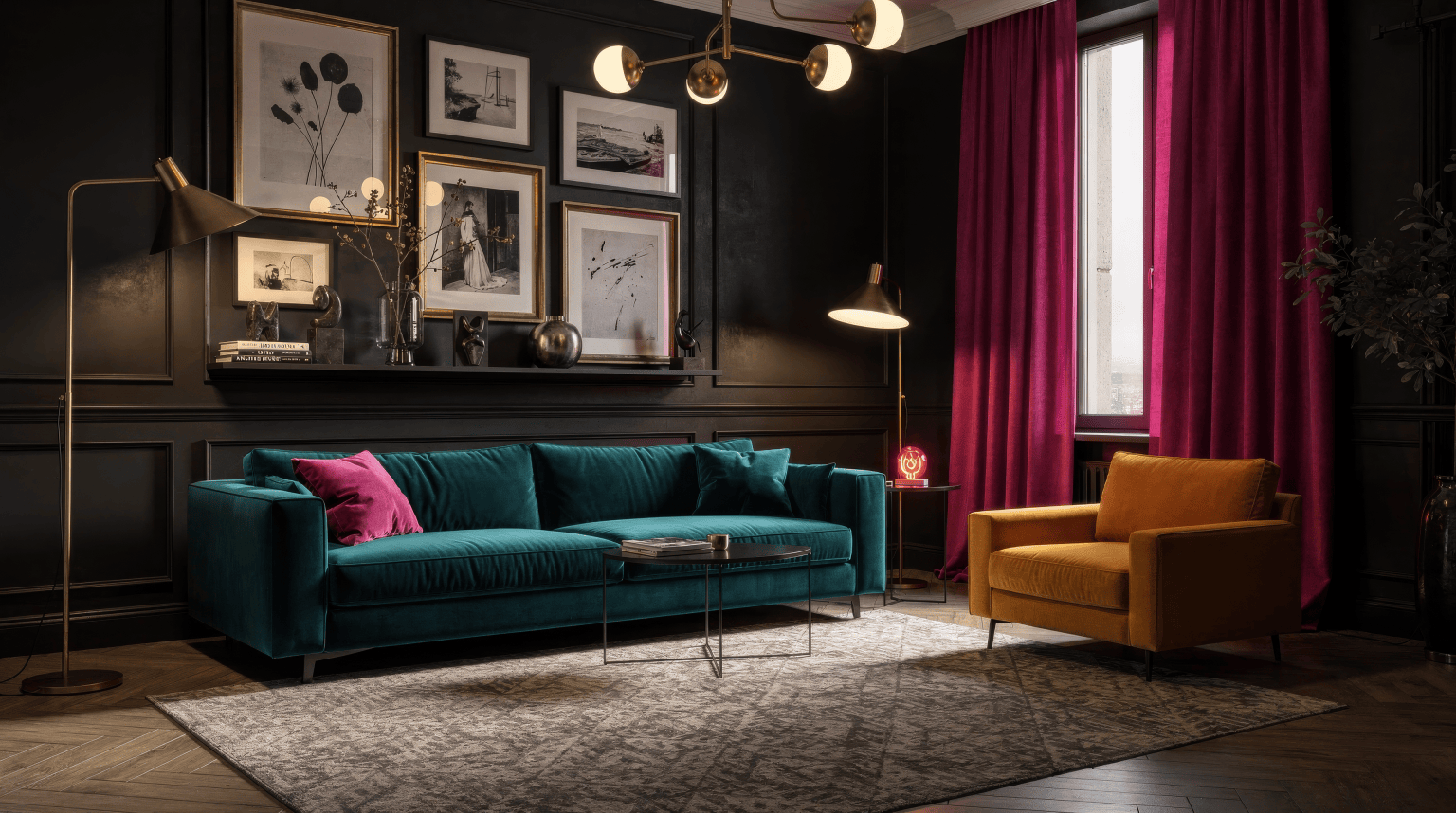
The Room for Drama Method
Diagnose first.
Buy last.
This is the method underneath all the opinions: look at the room before you diagnose it from a catalogue, form one decent theory, try the cheapest reversible version, and let real life tell you whether the permanent idea deserves the money. Then come back and check. Rooms are very good at correcting confident people.
Not a style formula
The room is not a blank canvas. It already has evidence.
Start with ordinary life: where people stop, what gets piled somewhere inconvenient, which seat nobody chooses, where the light collapses, which route clips furniture, and who has to perform the reset every night.
The point is not to make every room cautious. It is to remove the friction that is stealing attention so the drama can be deliberate rather than compensatory.
Six stages · in order
Read → Diagnose → Test → Verify → Commit → Learn.
The reading tells us what is actually misbehaving. Lab is where the theory has to survive the room. Atmosphere, Zones, and Paths only show up when they have a reason to be there; nobody gets a prize for using every tool.
Watch the room before you fix it: note the evidence, the room’s real job, and the baseline already in the Room Record.
02DiagnoseRead the room and let it rank the friction. Eight conditions get scored, one of them is loudest, and anything the room has not told you stays unknown rather than guessed.
03TestChange one reversible thing and let ordinary use—not a reveal photograph—argue back.
04VerifyRead the same room again against its own before. Drift is the proof; feeling good about it on a Saturday is an opinion.
05CommitOnly now does money enter. Spec what the successful test proved you need — size, material, clearance, performance — then price that version, its upkeep, and the cost of getting it wrong.
06LearnKeep the outcome with the room: what worked, what failed, what you talked yourself out of. The next decision starts further along than this one did.
The same six, drawn
A list of stages is a sequence. A method is what happens when a stage answers no.
Same room · same story · one continuous record
Keep the evidence with the room.
A room should not have to introduce itself again every time you come back to it. The reading starts the record; the testing keeps it going. What bothered you, what you tried, what it cost, what survived Tuesday night, and what you changed your mind about all belong to the same room.
Keep the whole room story together. Otherwise the diagnosis lives in one place, the experiment in another, the receipt somewhere else, and later everybody remembers a different version of what was supposed to improve.
- 01 Room name What you call it, not what the floor plan calls it.
- 02 Goal What you want to be able to do in here that you cannot do yet.
- 03 Baseline What it is like now, in plain words, before anything moves.
- 04 Diagnosis Which condition is loudest. There are usually three. One is loudest.
- 05 Experiments One reversible change at a time, and what ordinary use did to it.
- 06 Budget What the version that worked costs to buy, and to keep.
- 07 Objects considered Including the ones you talked yourself out of, and why.
- 08 Decision What you committed to, in a sentence you would defend later.
- 09 Recheck The same reading again, after the room has had time to argue.
- 10 Outcome What worked, what failed, and what you were wrong about.
What the reading covers
Eight different things can be making the room worse. Keep them separate.
Movement: can people get where they need to go without negotiating furniture or one another?
Light: does the room work in its real daylight, glare, task, and after-dark conditions?
Comfort: does posture, reach, acoustics, temperature, and duration support actual use?
Character: does the room have an intelligible point of view once the practical problems stop shouting?
Function: does the room support the job people actually ask it to perform?
Reset: can the room return to usable without becoming a second job?
Zone conflict: are different jobs, people, routes, or surfaces competing for the same territory?
Maintenance load: how much recurring human effort is required to keep the arrangement functioning as designed?
Where the method is applied
Every one of those eight is a collection, not an abstraction.
A reading that names the wrong thing sends you to the wrong shelf. These are the shelves.
The long form of the method: the assignment, the friction you actually watched, what is fixed, one hypothesis, one reversible test.
02Room FunctionWhat the room is for, which is the question every other question on this page depends on.
03Layout and FlowMovement and zone conflict: routes that compete, and the furniture standing in them.
04LightingLight as three jobs rather than one fitting, and what the room is willing to do after dark.
05Furniture Scale CheckComfort and clearance, in numbers you take yourself rather than numbers out of a rule book.
06Space IntelligenceTwenty-three conditions a room can be in, and what each one changes about the answer.
Scale the intervention, not the logic
The same method should survive a rental, a small budget, a weird corner, or a full renovation.
Small move: rearrange what you own, change one light source, tape a footprint, clear one route, borrow a piece, or change one mode of use.
Bigger move: specify the piece, built-in, finish, electrical work, architectural lighting, or renovation only after a smaller test has established what the permanent decision needs to solve.
The cost can change. The evidence standard should not.
Rules that protect the decision
Good rooms are not built by panic-shopping.
These are what keep the publication, Lab, Room Cases, and Before & After speaking the same language.
If we do not know what is actually wrong, nobody gets to prescribe a purchase.
02No-buy before buyIf you can try the idea without drilling, ordering, or regretting the receipt, do that first.
03Make the hypothesis visibleSay why you think the change will help before you know whether it did. Otherwise the story gets suspiciously clever after the fact.
04The result is not the photographResult is what ordinary life did to the idea. What changed is the decision we made differently because of it.
05Keep one Room RecordKeep the before, the theory, the experiment, the money, the almost-buys, and the verdict attached to the same room.
06Recheck or do not claim proofIf you never compared it with the before, you made a change. You did not prove an improvement.
Keep the unknowns honest
A blank is better than a confident guess.
If the room has not told you something, leave it unknown. Do not turn an assumption into a measurement because the empty field feels untidy.
Record what would settle the question, then keep moving with the parts of the decision the evidence can actually support.