Furniture and Scale
Your Large Room Does Not Need a Rug Archipelago
Several small rugs can make a huge room feel chopped into unrelated islands. Use rug scale and placement to define zones without fragmenting the floor plan.
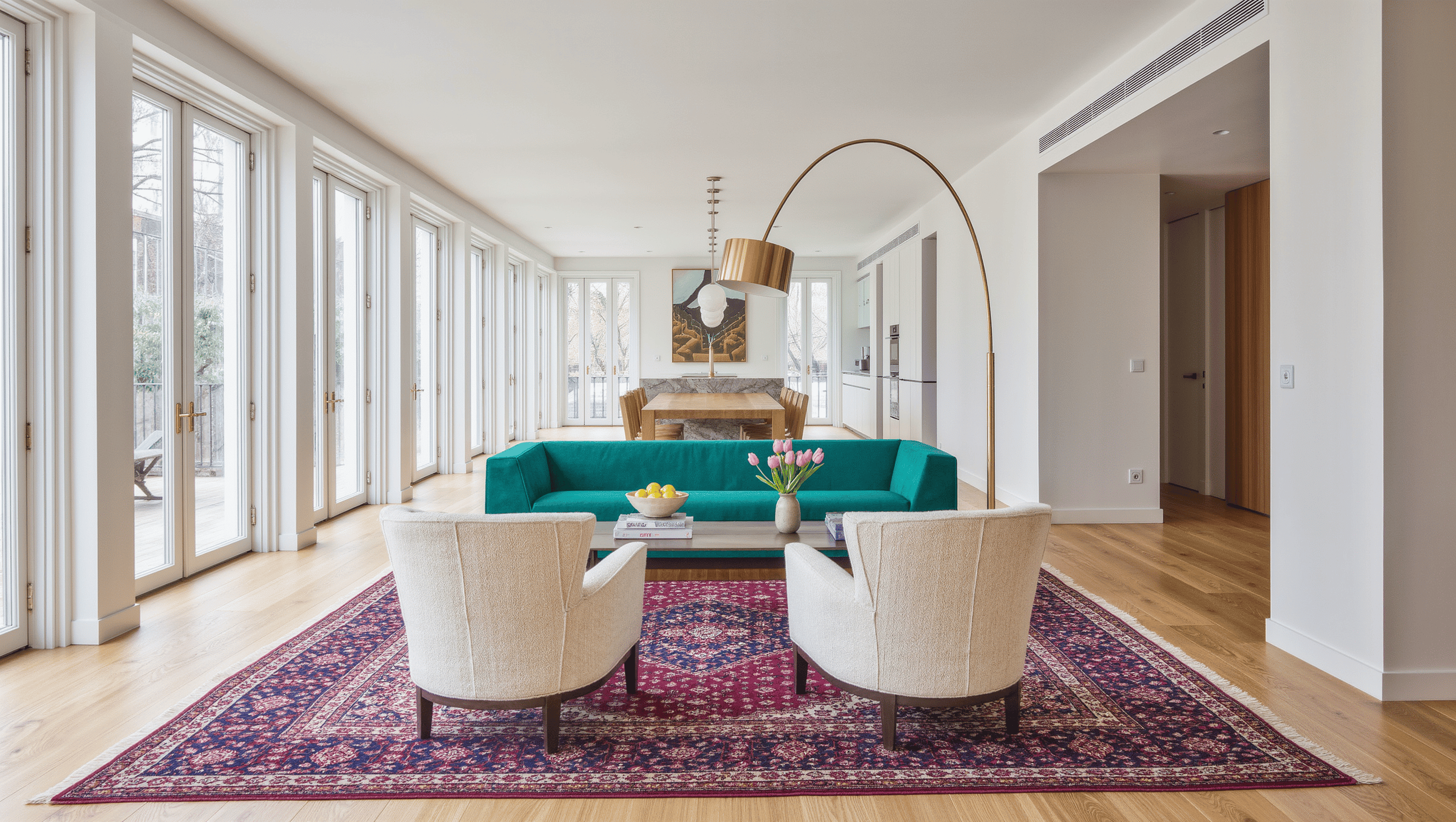
A large room often gets several rugs because several zones seem to require several visual labels. The intention is reasonable. The result can look like a map of small countries that have recently stopped speaking to one another.
Rugs are excellent zoning tools, but only when their size, spacing, and relationship to the furniture make the room more coherent.
Start with the furniture group, not the rug catalog
A rug should support a real grouping. In a living zone, that usually means the sofa and chairs read as belonging to the same field. In a dining zone, the rug has to account for chairs moving in and out rather than only the table footprint.
A too-small rug can break proportion and make the furniture feel disconnected, while a properly scaled rug gives the group a visual field and adds softness underfoot. In a large room, that principle matters even more because the floor around a tiny rug keeps announcing how undersized it is.
Decide whether you need one large field or several zones

If the room has one dominant furniture grouping, one large rug is usually the cleaner answer. Let it create the primary room within the room.
If the space genuinely contains separate functions, such as living and dining, multiple rugs can work. They should not be identical twins, but they should share enough language that the floor still belongs to one home: related color temperature, compatible texture, similar visual weight, or a clear material relationship.
Two unrelated statement rugs fighting across an open plan rarely make the zoning clearer. They make the argument louder.
Give each rug enough territory
The rug should extend beyond the exact center of the furniture group. A postage-stamp rug beneath only a coffee table creates a decorative island while the seating floats outside it.
In a generous room, bigger often looks calmer because it lets the furniture sit inside one visual field. That does not mean carpeting the entire floor by default. It means choosing a rug large enough to hold the group it is responsible for.
If standard sizes leave an awkward twelve- or eighteen-inch strip that ruins the composition, consider whether the room actually needs a custom or bound broadloom solution rather than trying to solve architectural scale with three retail rugs.
Use exposed floor as the seam
When you use more than one rug, the floor between them becomes part of the zoning system. Give that seam enough breathing room to read as circulation or transition.
Two rugs nearly touching can look like a sizing mistake. Two rugs separated by a clear path can make the movement between zones obvious.
The exact distance depends on the room and furniture, but the principle is stable: the gap should look intentional from the main sightlines.
Let material changes do some of the work
Not every zone needs a rug. A dining area on wood may already be defined by a pendant and table. A reading corner may be held by a floor lamp, chair pair, and window. A game table can sit on the same floor as the rest of the room and still read separately if the ceiling light and furniture orientation are clear.
This matters because too many rugs can create maintenance problems, trip edges, and visual noise. Zoning is a system, not a rug quota.
Watch the pile, not just the pattern
A thick rug under a dining table may look generous and behave terribly when chairs have to drag across it. A very plush rug in a high-traffic path can become a vacuuming and wear problem. A delicate flat weave in a room with pets or heavy hosting may demand more attention than the space is willing to give it.
Texture changes atmosphere, but maintenance is part of the design.
Run the tape test before ordering the large size
Use painter’s tape to mark the rug perimeter. Then place the furniture where it will actually sit. Walk around the group. Pull the dining chairs out. Look from the entry and from the far side of the room.
If the furniture appears to shrink away from the rug, the rug is probably too small. If the rug swallows several unrelated functions, it may be too large or the zone may be poorly defined.
A large room does not need a collection of decorative islands. It needs a floor plan with readable territories. Use rugs where they make a furniture group stronger, let exposed floor create transition, and stop adding rugs once the room already knows where one zone ends and the next begins.


