Materials, Color & Finish
The Powder Room Is the Only Room You Can Afford to Be Reckless In
No shower means no steam, and no steam means the materials that fail in every other bathroom are fine here. Add forty square feet of wall and the expensive thing costs almost nothing. Clearances first, then be as bold as you like.
On this page
5
Most people decorate the powder room last, in the same pale neutral as the hall, on the reasoning that it is small and unimportant. The useful counterargument is that a small room can carry a concentrated idea without asking the entire house to carry it. That is a much smaller claim than spectacle in every powder room.
A powder room typically has a lower moisture load than a full bathroom because there is no shower or tub generating sustained bathing humidity. That difference can widen the finish choices, but it does not mean the room has no moisture, no ventilation requirements, or that every material unsuitable for a full bathroom is automatically safe here. There is still a basin, cleaning, occasional condensation, plumbing and the actual product installation requirements.
It is also a small room that guests often occupy alone, which makes every surface unusually visible. That is a good argument for one deliberate move rather than a good argument for ignoring the technical parts.
The clearances come first, because a room this small has no slack
Half baths are often carved out of leftovers — under a stair, off a hall, out of the end of a utility — and the leftover is frequently just barely enough. Check the fixture and door geometry before finishes.
The 2024 International Plumbing Code model provision in Section 405.3.1 requires a water closet, lavatory or bidet to be at least 15 inches from its centerline to a side wall, partition, vanity or other obstruction, and provides at least 21 inches of clearance in front of those fixtures. Those are model-code measurements, not decorating preferences; your adopted local code governs and accessible bathrooms can require substantially more space.
That 15-inch centerline rule implies 30 inches between two side obstructions around a toilet, but 36 inches as a “more comfortable” width and 24 inches in front as a preference are design heuristics, not code upgrades. Test the actual fixture, door and users instead of turning comfort into a fake standard.
The door deserves the same attention. An inward swing is not automatically wrong; it is wrong when it collides with required fixture clearances or makes use awkward. An outward swing, pocket door or appropriate slider may solve a tight plan, but each option has its own wall, hardware, privacy, egress and accessibility implications.
Site boundary: Minimum fixture clearances, door relationships, ventilation and accessible dimensions are governed by the adopted local codes. Moving a soil stack or adding a fixture is plumbing/construction work with its own requirements.
No shower changes the moisture load, not the laws of materials
A powder room generally sees less sustained humidity than a shower bathroom, so wallpaper, wood paneling, framed art and other finishes may be easier to use successfully. But suitability still depends on the specific product, substrate, ventilation, sink splash, cleaning and maintenance. Grasscloth two feet from a faucet is a bet, and it is worth knowing the odds before placing it.
Protect the immediate splash zone according to the material and fixture requirements. If the room has recurring condensation, leaks or poor ventilation, solve that condition instead of treating the absence of a shower as permission to ignore it.
The small area can make expensive finishes more plausible
The economics are real even though the exact quantities are not universal. A small room may need far less wallpaper, stone, tile or specialty finish than a bedroom or large bath, which can make remnants, offcuts and short production runs practical.
Do not assume “one or two rolls” without measuring the walls and accounting for roll width, pattern repeat, trimming and waste. The useful point is simply that concentrated material is cheaper than spreading the same material over a much larger room.
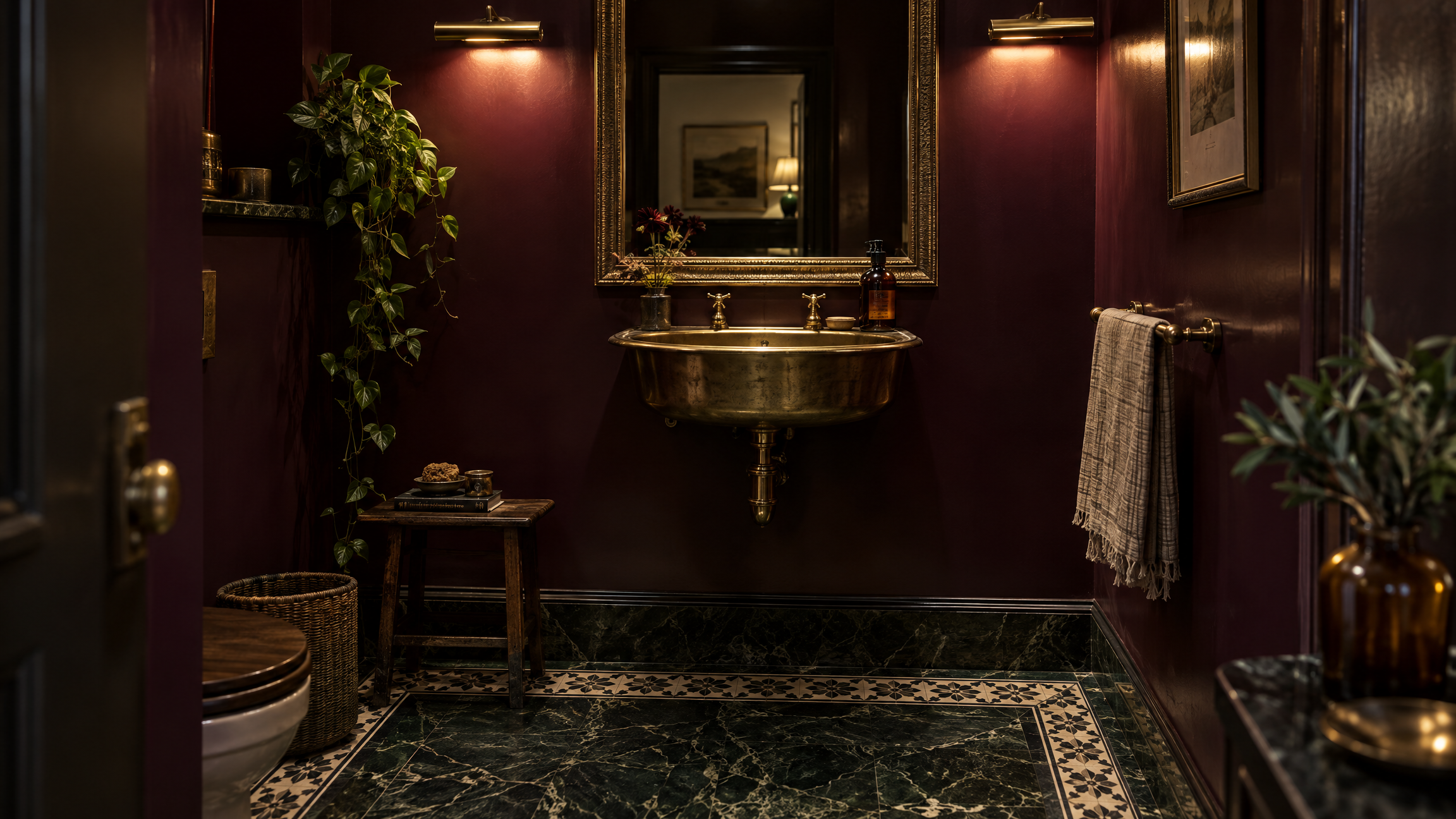
That is how a powder room ends up wearing the hand-printed paper, the offcut of green marble or the lacquered ceiling the dining room could never justify. Nobody stays in there long, which is exactly why it can afford to be the most opinionated few square feet in the house.
Commit to one thing completely
Small bold rooms rarely fail from too much nerve. They fail when four bold things shout at the same volume and nobody has been told to lead.
So pick one: paper the room, color-drench it, use one strong mirror or make the light the event. Then let the fixtures, route and usable surfaces stay legible. The exact decorating move is taste; the clearances and wet-location requirements are not.
Light it like a room, not like a closet
Some powder rooms have windows and some do not. Either way, one central downlight is not the only option. Mirror light, ambient light and low-output evening light can be layered according to the actual room, with fixtures and electrical work suitable for the location.
Ventilation requirements also vary by jurisdiction and room configuration. If an exhaust fan is part of the system, size and operate it according to the adopted code, the equipment and the room rather than assuming the lack of a shower makes ventilation irrelevant.
So measure the model-code fixture clearances, verify the local rules and sort out the door. After that, the room can be as restrained or theatrical as you want. The advantage of the powder room is concentrated consequence, not immunity from moisture or code.
Correction — September 7, 2026: An earlier version said that no shower meant no steam and that materials that fail in other bathrooms would be “perfectly happy” in a powder room. It also blurred model-code fixture clearances with preferred comfort dimensions. The moisture claim has been corrected; the 15-inch/21-inch model-code measurements now link to ICC; and comfort ranges are explicitly identified as heuristics rather than requirements.
Same problem, elsewhere in the house
Room notes
Keep the room on the record.
One useful note at a time: what to test, what to ignore, and what changed when the room got another vote.