Practice
The Handoff Is Part of the Design
If a contractor, fabricator or installer has to guess which dimensions, interfaces or finish conditions matter, the design record is not finished yet.
On this page
9
A design can be completely clear to the person who made it and strangely vague to the person expected to build it.
That is where the handoff starts.
The project has already made decisions. The layout is settled. The finish was chosen. The custom piece has a drawing. Everybody who has been staring at the room for weeks knows what matters.
Then the work moves to someone who was not in those conversations.
If the record does not explain the governing conditions, the next person has to reverse-engineer the intent from dimensions, images, notes and whatever question they know to ask. Sometimes they guess correctly. Sometimes the finished work is technically faithful to the document and still wrong for the room.
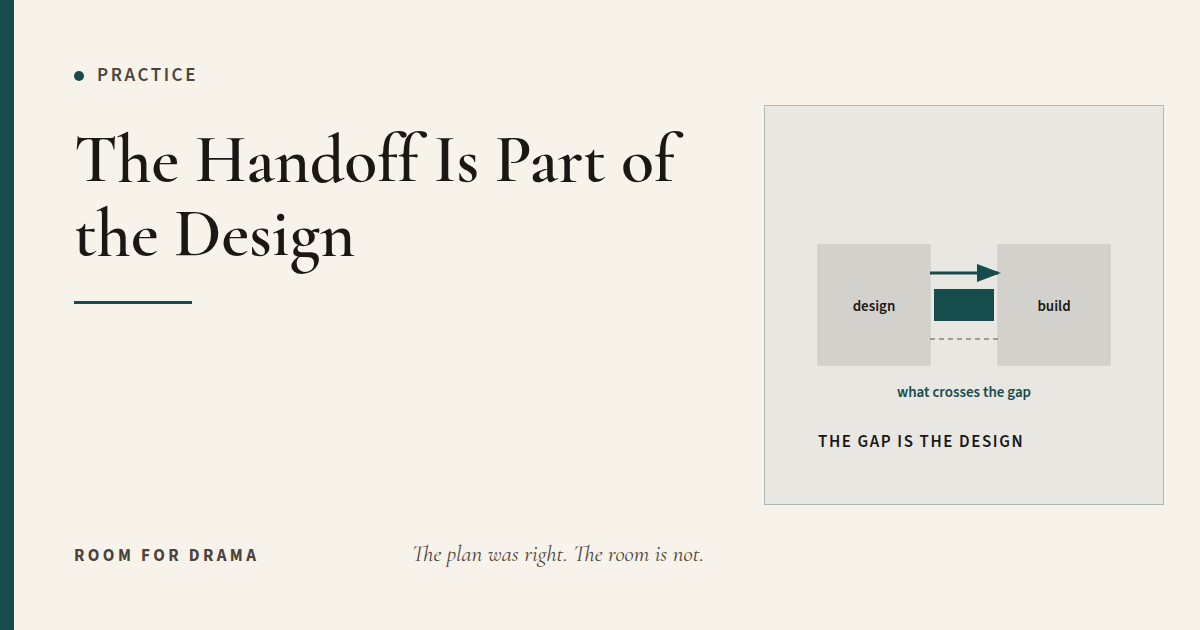
Practice treats the handoff as part of the design because the design has to survive another person’s interpretation.
Drawings show geometry. They do not always show priority.
A dimension can appear on a drawing without revealing why it matters.
Maybe the cabinet depth is protecting a circulation route. Maybe the bench height is tied to an existing sill. Maybe the low back of a banquette preserves a sightline. Maybe the centerline is visually important while the exact end condition has room to adjust in the field.
Those are different kinds of information.
The handoff should identify the dimensions and relationships that are carrying the design so they do not look interchangeable with every other number on the page.
This does not mean annotating every line with an essay. It means making the critical condition legible enough that a substitution, field adjustment or fabrication question does not accidentally sacrifice the reason the detail existed.
Interfaces are where clean drawings meet messy rooms
Custom work rarely exists by itself.
It meets walls that may not be straight, floors that may not be level, outlets, trim, switches, radiators, existing millwork, stone, tile, drapery, appliances, doors, other trades and tolerances nobody can see in a rendering.
The handoff should call out the interfaces that can change the result.
If a built-in depends on an exact field condition, say that the condition must be verified before fabrication. If a finish transition is visually important, show where it occurs and who controls the adjacent material. If hardware clearance depends on another item arriving first, keep that dependency in the record.
A clean detail can still contain a dirty dependency. The handoff is where it should be exposed.
Separate design intent from professional determination
There is a useful sentence Room for Drama keeps returning to: preserve the question without pretending to own the answer.
A design record can say that the intended light location matters to the room. It cannot establish that the electrical condition is safe. It can show the desired opening in a wall. It cannot determine structural adequacy. It can document an accessibility concern. It cannot declare compliance.
The handoff should make those boundaries clear enough that the applicable qualified professional knows what the design is trying to achieve and what still requires their determination.
That is better than either extreme: vague notes that make the professional guess at the intent, or design documentation that wanders into technical authority it does not have.
Give substitutions somewhere to land
Fabrication and installation produce reality, and reality occasionally refuses the specified answer.
A material is unavailable. A profile cannot be produced at the assumed dimension. A hidden condition changes the detail. A lead time makes the original piece unreasonable. A field measurement does not match the early record.
The handoff should preserve enough of the original decision criteria to evaluate the change.
If the important properties are recorded, the substitute can be judged against them. If the record only shows the selected object or detail, a substitution tends to chase visual resemblance.
This is why the FF&E record needs performance logic and why rejected options are worth keeping. The project should know which parts of the answer are flexible and which parts reopen the design.
Write the unresolved question down
Professional work becomes surprisingly fragile when everybody knows there is an open issue but nobody puts it in the handoff.
Confirm wall condition. Verify exact outlet location. Finalize seam placement after slab selection. Coordinate the drapery pocket with the ceiling condition. Confirm whether the existing substrate can receive the proposed finish.
An unresolved question is not a defect in the record. An invisible unresolved question is.
Practice should let an open item remain open without allowing it to look resolved simply because the rest of the package is ready.
Include the room around the object
A fabricator may be making one piece. An installer may be touching one surface. The design still belongs to a room.
A useful handoff gives enough surrounding context to understand what the piece is negotiating.
The bench is narrow because it protects the route. The cabinet stops short because the return wall carries a switch. The mirror is offset because the lighting relationship matters more than geometric centering. The shelf depth is limited because the door has to clear.
Context turns an odd-looking dimension into an intentional one.
Without it, the person doing the work may reasonably “correct” the detail into something more conventional and less useful.
Photos can carry information drawings miss
Field photographs belong in the handoff when they establish a condition that matters to execution.
Show the actual corner. Show the trim profile. Show the opening fully operating. Show the existing finish meeting the new work. Annotate the relevant condition instead of sending a folder of forty images and hoping the right one announces itself.
The field survey should already contain this evidence. The handoff simply selects the pieces another person needs.
Good documentation is often less about adding information than about refusing to make the recipient search for the important part.
The handoff needs a return route
A package sent downstream without a way back is incomplete.
Questions will surface. Conditions will change. A proposed adjustment may affect the design. The record should preserve what changed, who raised the question, what decision followed and whether the change needs renewed approval.
This does not require a separate bureaucracy. It requires the Room Record to remain alive after the drawing leaves the designer’s screen.
The design keeps thinking after the handoff. It just has to do its thinking in somebody else’s head now, which is a good reason to write it down legibly.
What a successful handoff leaves behind
The person receiving it should be able to understand the intended result, the critical dimensions and relationships, the interfaces that need coordination, the open conditions that still require verification, the substitutions that would reopen the decision, and the professional determinations that belong to somebody else.
Then the work can move forward without forcing every downstream person to become an archaeologist.
Carry the final decisions from Approval Needs a Sentence into the Practice Room Record, and leave enough context for the next stage: installation, punch and recheck.
Same problem, elsewhere in the house
Room notes
Keep the room on the record.
One useful note at a time: what to test, what to ignore, and what changed when the room got another vote.