Function and Flow
Too Styled to Put Down a Glass
A room can photograph as complete and still fail everyday life. Test what happens when one surface is allowed to be useful again.

On this page
5
A room can be finished past the point of usefulness. Every table has a stack. Every shelf has a composition. The ottoman has a tray, the tray has a vase, the vase has a branch, and the person carrying tea has apparently been asked to hover until the styling team returns.
This is not an argument for empty rooms. Room for Drama is not going to become frightened of objects at this late date. The problem is different: the decorative layer has occupied the surfaces that daily life also needs. The room looks complete because there is nowhere left for anything unscheduled to happen.
Where does the mug go?
Watch what happens when somebody enters the room with something in hand. A book. A glass. Keys. A laptop. A plate. A half-finished school project. If the object moves through three temporary locations because every obvious surface is already spoken for, the room has a landing problem.
The useful clue is not mess. Mess can be a symptom, but a pristine room can have the same failure. The clue is displacement. Things that belong to the activity cannot land where the activity happens, so they migrate to the floor, the arm of the sofa, the dining table in the next room, or the one chair nobody is allowed to sit on anymore because it has become emergency storage.
Do not declutter the whole house
That would make it impossible to learn anything. Pick one surface in one room and clear only enough of it to restore a job. The side table should be able to take a drink and a book. The console by the door should be able to receive the things that actually arrive through the door. The coffee table should have a usable patch without somebody dismantling a small museum first.
Leave the rest of the room exactly as it is for several days. This is a test, not a purge. If the cleared surface immediately becomes useful and the migration elsewhere slows down, the decorative load was competing with the room. If nothing changes, the problem may be location rather than styling: the surface is simply not where the habit occurs.
The photograph gets one vote
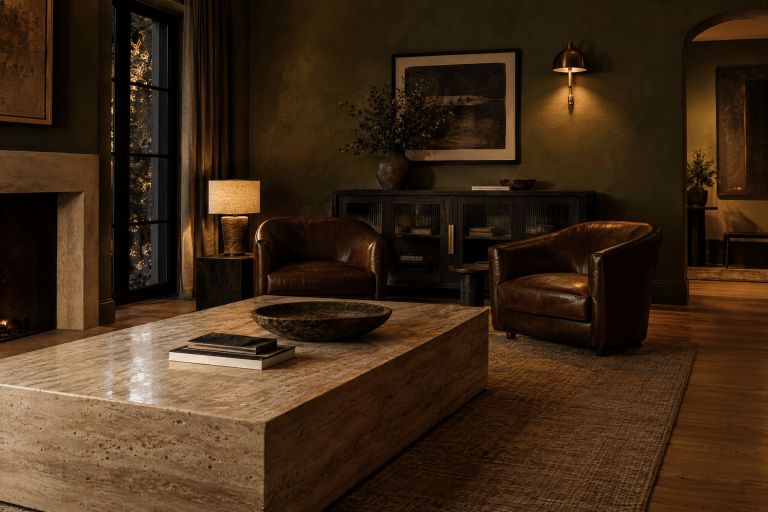
Styled photographs reward density in a very particular way. A foreground object gives depth. A stack of books gives height. A throw creates movement. A tray gathers small things into one shape. Those are useful visual devices, but the room has more jobs than the photograph does.
A coffee table seen from the doorway may look better with three objects than with one. A coffee table used every evening may work better when half of it stays open. Neither answer is automatically more sophisticated. The stronger room is the one that knows which surface can carry drama and which one needs to keep its hands free.
Keep the hierarchy, lose the inventory
When a room is over-styled, removing objects at random often makes it merely thinner. Keep the governing idea. If the room is built around deep green, brass and strange botanical forms, it can stay deep green, brass and strange. Swapping character for tasteful emptiness would be a surrender dressed as restraint. Let fewer things do more work, and let them be the loud ones.
Choose the object that establishes scale, the one that carries the strongest material or color, and the one that has a reason to be touched. Let those remain. Move duplicates, tiny fillers and anything whose only job is to stop a surface from looking empty. Empty is not a design emergency. Sometimes it is where the person goes.
The room has to survive an ordinary evening
Do not judge the edit ten minutes after making it. Live through the ordinary sequence that used to fail. Put down the mug. Open the laptop. Bring in the mail. Have people sit. Notice whether objects still migrate, whether the room resets faster, and whether the reduced surface actually stays useful without constant policing.
Then look at the room again. If it suddenly feels anonymous, the decorative hierarchy was cut too far; restore one strong thing, not the entire population. If it still feels like itself and daily life has stopped trespassing on the floor, the room has learned an important distinction: visual fullness and functional fullness are not the same measurement.
The final test is pleasantly rude. Can somebody arrive with a glass of water and put it down without asking permission? If the answer is yes and the room still has its nerve, the edit held. If the answer is no, it is not finished. It is occupied.
One more useful check comes the next morning. Look at what had to be moved back out of the way. If the styling migrated onto the usable surface again, the room has not learned anything; it is simply being reset for photographs. Give the displaced objects a real home, reduce the decorative count, or move the display to a surface that does not carry daily work. A room should not require a nightly stage crew to remain functional.
Same problem, elsewhere in the house
Room notes
Keep the room on the record.
One useful note at a time: what to test, what to ignore, and what changed when the room got another vote.