Function and Flow
The Bathroom Light Is Behind You, Which Is Why You Look Like That
Almost every bathroom is lit by one fixture in the ceiling, which casts every shadow downward onto the face standing at the mirror. The fix is a light beside the mirror, not a brighter one above it.
On this page
6
You do not necessarily look tired. You may simply be lit from above and slightly behind, by one fixture in the middle of the ceiling, with the shadows falling straight down your face. Change nothing about yourself. Change where the light is standing.
A common bathroom lighting failure is asking one central ceiling fixture to do every job at once. Light from above can create pronounced shadows under the brow, nose and chin at the mirror, especially when the source sits behind the person at the sink. The mirror task needs its own angle.
Test the direction before you buy anything
Turn the room light on as usual, then use a small portable light at roughly face height and move it to the side of the mirror. You are not testing an exact future fixture; you are testing what happens when light reaches the face from a different direction. If the shadows soften, the room has given you useful evidence before you spend anything.
Light beside the mirror when the room allows it
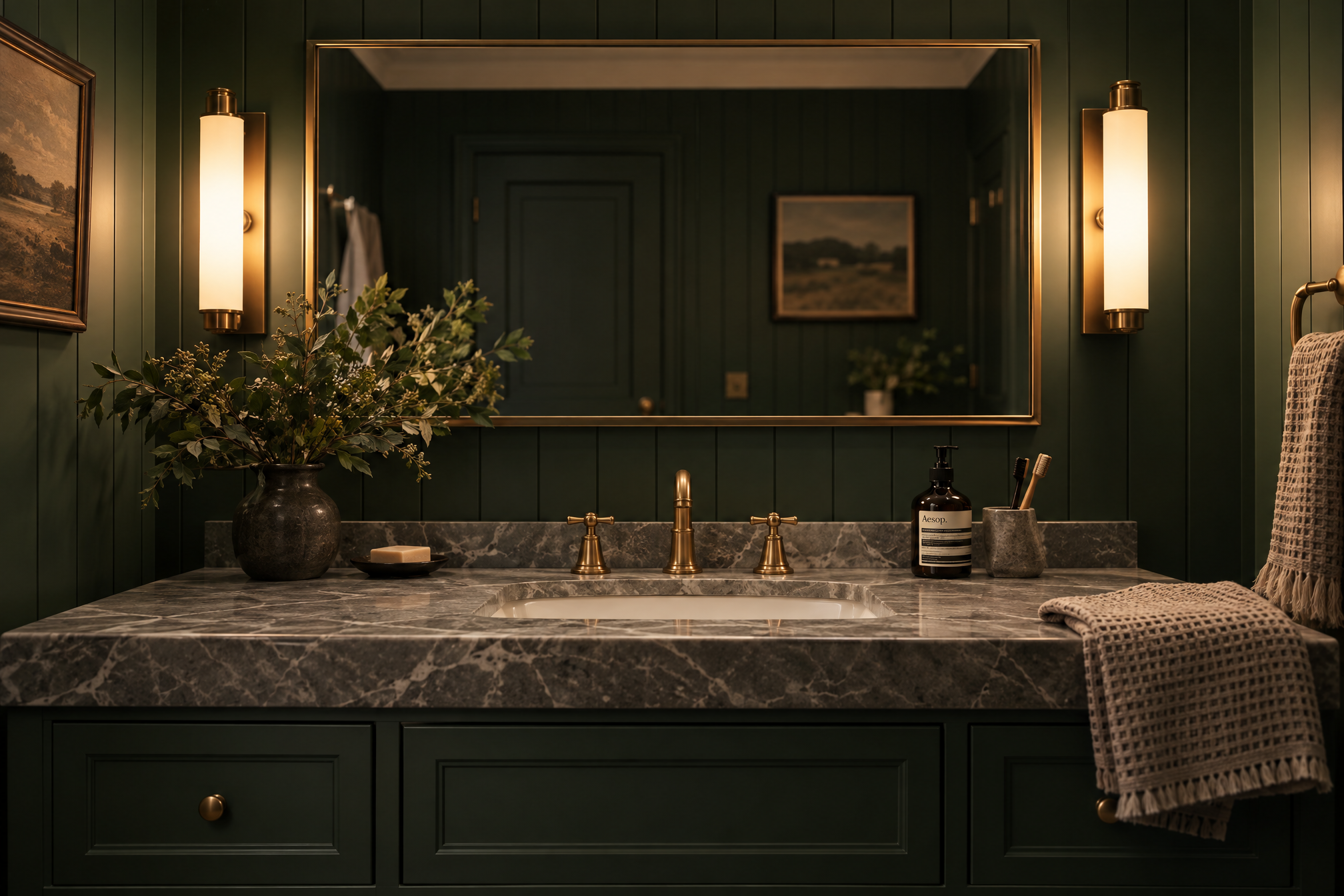
Two diffuse sources flanking the mirror can light both sides of the face more evenly than a single overhead source. The often-quoted mounting ranges — roughly 60 to 66 inches to fixture center and about 36 to 40 inches between fixtures — are decorating and lighting-layout heuristics, not code or universal ergonomic dimensions. Mirror width, fixture size, user height, glare, accessibility, electrical zones and the beam pattern all change the right placement.
If two side fixtures are not possible, a broad diffused fixture above the mirror can work well. Heights such as 75 to 80 inches are also starting ranges, not standards. Mock the light at the actual face position and make sure the source is not visible as a harsh glare point in the mirror.
The ceiling fixture still has a job
General light helps with cleaning, safe movement, finding objects and seeing the floor. The mistake is asking it to perform the mirror task by itself and then simply increasing output when the direction is still poor. A brighter bad angle remains a bad angle.
Separate controls can be useful so mirror/task light, general light and night light do not always arrive together. Whether separate circuits, dimming or integrated controls are appropriate depends on the actual electrical system and local requirements.
Color quality matters, and CRI 90 is a target rather than a verdict
Correlated color temperature is a preference and task decision, not a bathroom law. Warm sources around 2700K to 3000K can feel relaxed; somewhat cooler sources may be preferred for grooming or color comparison. The useful move is to compare the light against skin, finishes and any daylight the room actually receives rather than declaring one kelvin value universally “honest.” A bulb box that promises “daylight” is making roughly the same kind of claim as a candle labeled “cashmere”: evocative, and no help at all in predicting what your face will look like at 6:40 on a Tuesday morning.
For color fidelity, the U.S. Department of Energy says a minimum CRI of about 80 is generally recommended for interior lighting and that CRI 90 or higher indicates excellent color fidelity. DOE also notes that CRI is an imperfect metric, especially for saturated reds, and points to R9 and TM-30 metrics for a more complete picture. For a vanity, CRI 90+ is a very good target when available, but it should not be described as the threshold below which skin necessarily looks gray or colors become unusable.
Likewise, output ranges such as 1,500 to 2,000 lumens across a vanity are design starting points, not universal illuminance standards. Fixture distribution, distance to the face, room reflectance, mirror size, age and visual needs can all change the required light. Choose output by the task at the actual mirror and use dimming where compatible.
Site boundary: Bathroom wiring is governed by rules about wet locations, proximity to water, switching and protective devices, and those rules differ by jurisdiction. New fixtures, switch drops and circuits require the appropriate qualified electrical work.
The free version, the reversible version, the wired one
The free version is a better lamp or bulb with good color quality, plus a portable light moved beside the mirror to see whether direction is the actual problem. The reversible version costs a little more: a plug-in sconce, integrated-light mirror or portable task light can test the side-lighting idea before permanent wiring, provided the product and placement are suitable for a bathroom environment.
Wired work comes last. If the test succeeds, design the permanent fixtures around the actual mirror, users and electrical conditions rather than copying a published height blindly.
Then look at the surfaces, because they are part of the light
A bathroom is a small box of reflective and absorptive materials. Pale matte surfaces can return diffuse light; dark or glossy surfaces can absorb more light or produce sharper reflections depending on finish and geometry. The surface palette and the fixture layout should be designed together.
So start at the mirror and work outward. If a better lamp does not fix the shadow, change the angle. If a better angle works, measure the real wall, mock the fixture positions, and let the room rather than a generic dimension decide where permanent light belongs.
Correction — September 7, 2026: An earlier version overstated how universal the one-ceiling-light condition is, presented fixture heights, spacing and lumen output too much like standards, and described CRI below 90 as inherently poor. Those dimensions are now identified as planning heuristics, and the color-rendering section now follows DOE guidance: CRI 80 is generally acceptable for interiors, 90+ is an excellent target, and CRI alone does not fully describe color fidelity.
The mirror test is one lighting problem inside a very small room. Continue with Lighting for the larger task-and-atmosphere system, or with bathrooms when the fixture has to coexist with wet-location, storage and circulation constraints.
Same problem, elsewhere in the house
Room notes
Keep the room on the record.
One useful note at a time: what to test, what to ignore, and what changed when the room got another vote.