Function and Flow
Before You Buy Another Speaker, Move the Chair
Before replacing speakers or policing the volume, read the room: distance, hard surfaces, competing jobs and where sound is being asked to stop.
On this page
6
The argument starts with the remote control because the remote control is visible. Somebody turns the television up. Somebody else turns it down. A third person announces that the television is not the problem and then leaves the room.
Sometimes the television is too loud. Sometimes the room has simply made moderate sound travel badly. The difference matters because buying a new soundbar will not fix a hard, open room where the person listening is too far away, a conversation is happening in the same acoustic field, and every large surface is helping the noise stay awake.
Follow the sound, not the remote
Start with bodies and distance, not equipment. Where is the screen? Where are the people who need to hear it? Is the main seat close enough that normal listening feels normal, or is the room relying on volume to bridge a large gap? Is somebody cooking, working or talking along the same line?
A large open room can make one sound source serve several incompatible zones. The person watching wants clarity. The person at the table wants conversation. The person at the kitchen counter is technically in another activity but acoustically standing inside both. That is a zoning problem before it is an electronics problem.
Listen for what keeps answering back
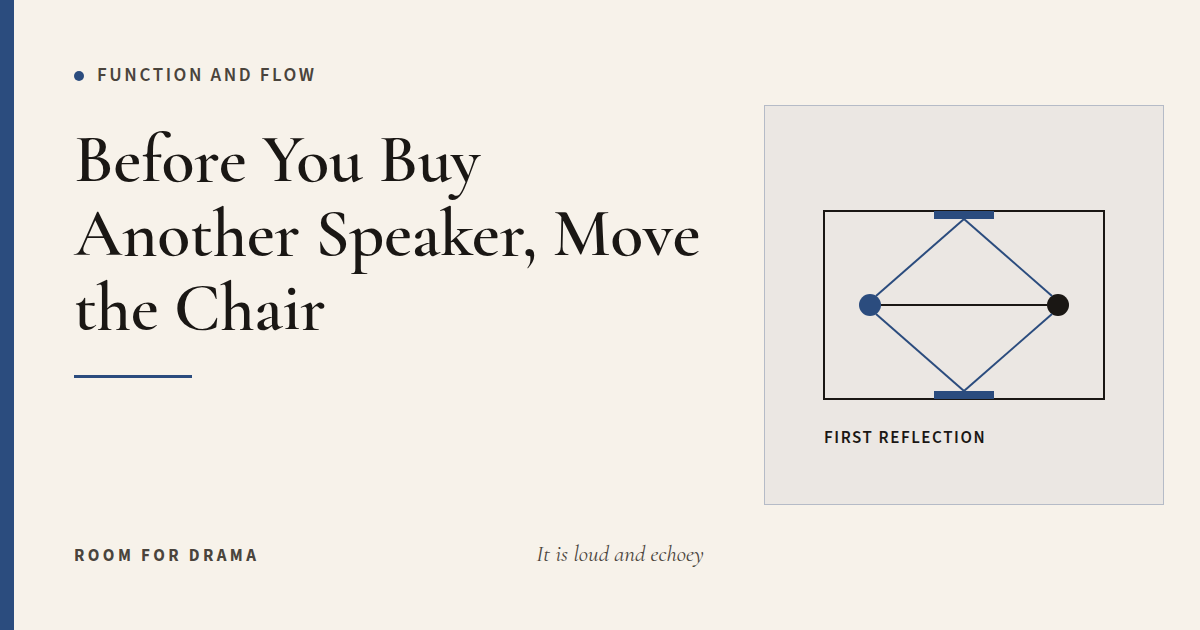
Hard rooms do not need to look empty to behave hard. Glass, plaster, wood, stone, tile, large bare tables and tall ceilings can all keep reflected sound in circulation. You do not need a meter to notice the ordinary evidence. Clap once and listen to what follows. Speak from the usual seat and notice whether words feel crisp or smeared. Pay attention to whether voices get louder as more people arrive.
Nobody is pretending this is a laboratory acoustic test. Call it a room read, done with ears and a little suspicion. If speech becomes tiring, if the television needs another notch every time dinner starts, or if a quiet conversation carries everywhere, the space is telling you that sound has too few boundaries.
Change one soft thing in the right place
The usual advice is to add rugs, curtains and upholstery until the room becomes acoustically polite. That can work, but it is too vague to teach you anything. Choose one intervention that sits in the path of the problem and test it alone.
If the room has a large bare floor between the television and seating, borrow or relocate a substantial rug and listen again. If a wall of glass sits beside the listening zone, close existing curtains or hang a temporary heavy textile for an evening. If the seats are far from the source, move one chair closer before buying a speaker. If the television and conversation occupy the same undivided field, rotate one zone or create a temporary edge with a bookcase, screen or curtain and see whether the two activities stop competing.
Do not confuse quieter with better
A dead room is not the goal. Music should still have life. Conversation should not feel padded into silence. The test is whether useful sound becomes easier to understand at a lower effort while unwanted sound becomes less intrusive elsewhere.
That distinction is why the one-change test matters. If you throw a thick rug, new curtains, wall panels and three upholstered chairs at the room in one weekend, the room may improve but you will not know which move earned the improvement. You also will not know what to undo if it becomes dull.
Measure behavior, not decibels you cannot verify
For an ordinary home diagnosis, keep the evidence close to the problem. At the same television setting, can the person in the main seat follow dialogue without strain? Can two people at the adjacent table talk without raising their voices? Does somebody in the next zone still hear every word? Does the room settle faster after a sharp sound?
If you have proper measurement tools and know how to use them, measurements can add useful evidence. If you do not, do not invent precision from a phone number and pretend it is a building-acoustics study. The behavioral comparison before and after one reversible change is already enough to decide whether the room moved in the right direction.
Now the equipment gets a vote
If moving the listening position, adding absorption in the actual reflection path or separating competing zones solves the problem, stop. The room needed a spatial correction. If the room is now calmer but dialogue is still unclear at the main seat, the source, speaker arrangement or hearing needs may deserve a more specific look.
That is the order that protects the budget. Fix the distance and competition you can see. Test the surface behavior you can change. Recheck at the same everyday moment. Only then ask hardware to solve what remains.
The remote control is allowed back into the argument at the end. By then, at least, it is no longer being blamed for the architecture.
Record the listening position and the change that worked. When the furniture moves or another job enters the room, recheck from the same place. Sound problems have a habit of returning when the spatial arrangement drifts.
Same problem, elsewhere in the house
Room notes
Keep the room on the record.
One useful note at a time: what to test, what to ignore, and what changed when the room got another vote.