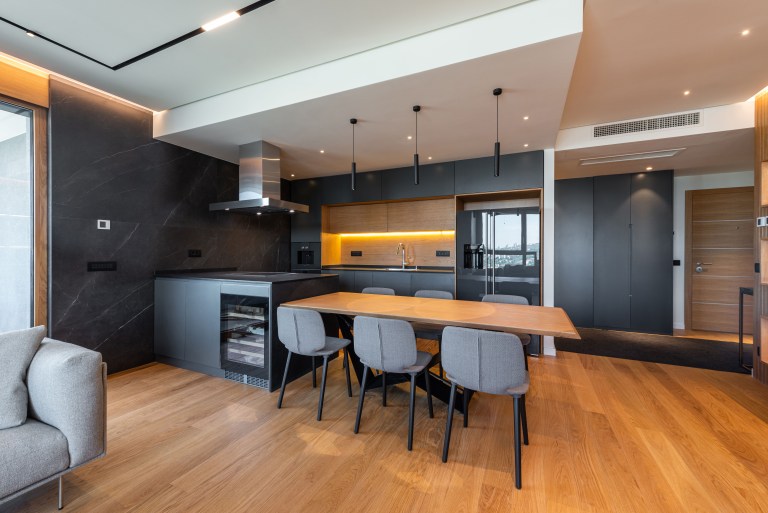
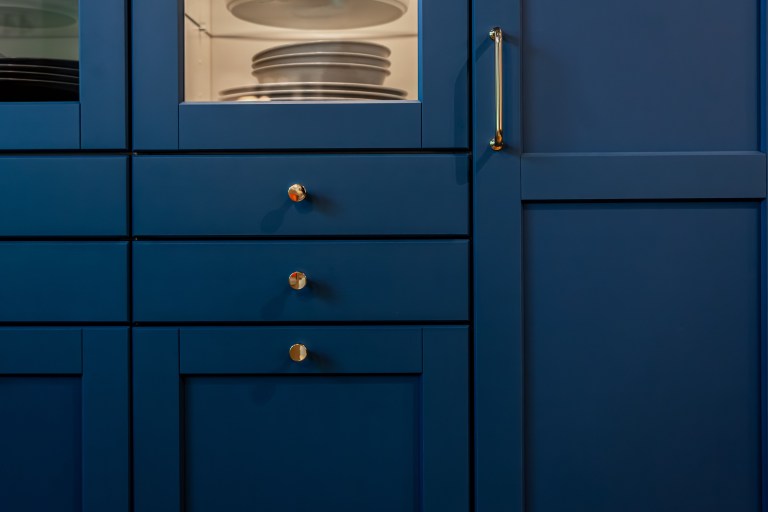
Materials, Color & Finish
A Ceiling With Nerve Can Rebalance the Entire Room
Use a bold ceiling to rebalance a room with color, pattern, gloss, wood, or texture—after checking height, light, architecture, and the practical demands of the surface.

A ceiling with nerve can rebalance an entire room.
It is one of the largest uninterrupted surfaces in the space, which makes the default white ceiling a surprisingly expensive amount of visual silence. Sometimes that silence is useful. Sometimes it is the reason the room feels bottom-heavy, unfinished, or oddly disconnected from everything below eye level.
The ceiling does not need decoration by default. It needs a job.
Name the imbalance before you name a color
A room can feel visually heavy at the floor because the sofa, rug, cabinetry, and dark furniture all sit low. It can feel too tall because the upper volume is empty. It can feel chopped up because crown molding, beams, and wall color disagree.
Name the condition first. The ceiling move should answer that condition rather than merely add surprise.
Color can lower or unify the room
A deeper ceiling color can make a tall room feel more contained, especially when the walls are lighter or the ceiling already has strong architectural definition.
Carrying wall color overhead can remove a hard line and make a small room feel more enveloping rather than smaller.
Test large samples on the ceiling itself. Color overhead receives light differently from color on the wall.
Contrast can emphasize architecture
Beams, coffers, trim, or ceiling planes may deserve contrast if the architecture is genuinely worth noticing.
Use contrast with restraint. If every beam, border, recess, and molding line receives its own color, the ceiling can become a diagram of itself.
Choose the feature that matters and let the rest support it. Pick all of them and the ceiling ends up looking like it was colored in by somebody who had been told not to go over the lines.
Wallpaper can turn the ceiling into a field
Pattern overhead can be dramatic without consuming floor area or competing with furniture circulation. It works particularly well in powder rooms, bedrooms, dining rooms, or compact spaces where the ceiling can become the main decorative event.
Choose pattern scale from the room’s dimensions and viewing distance. Tiny detail may disappear from below; very large motifs may need enough ceiling area to repeat convincingly.
Professional installation may be appropriate depending on material, ceiling condition, height, and complexity.
Wood and texture change acoustics and warmth
Timber, paneling, beams, plaster texture, or other material treatments can make the ceiling feel more substantial and connected to the architecture.
They also change how light is reflected and how the room sounds. A heavily textured or absorptive surface may feel warmer and less echoing than a hard smooth plane.
Material weight, attachment, fire performance, and building conditions need appropriate professional review where relevant.
A dark ceiling needs a lighting plan
Deep color overhead can create atmosphere and also absorb light. If the room depends on reflected ceiling light, the change may affect brightness substantially.
Test the evening lighting before committing. Add wall, table, or floor sources where needed so the room does not become visually top-heavy and functionally dim.
Use Lighting to build layers rather than compensating with one brighter bulb.
Use the ceiling to change proportion
A painted band, border, beam treatment, or change in finish can visually widen, shorten, or define a room.
Long narrow rooms may benefit from a ceiling treatment that interrupts the tunnel effect. Open-plan rooms can sometimes use ceiling material or color to define a zone without placing anything on the floor.
The ceiling can be part of spatial planning. Decoration is only one of its jobs.
Let the fixture and ceiling negotiate
A strong chandelier, pendant, or sculptural light already occupies visual territory overhead. The ceiling treatment should either support it or deliberately contrast with it.
A highly patterned ceiling plus an elaborate fixture can be excellent if the hierarchy is clear. If both demand equal attention, the room may feel busy above and timid below.
Do not forget vents, detectors, and real life
Ceilings contain practical elements: smoke detectors, sprinklers, vents, speakers, access panels, and wiring.
Do not paint, cover, relocate, or interfere with safety or building systems improperly. Treat necessary devices as part of the composition and use qualified professionals where changes are involved.
Why sheen is not a taste question
A reflective ceiling bounces light, color, and movement back into the room. It also reveals every surface imperfection you have, plus a few you did not know about. High-sheen finishes demand excellent preparation and careful lighting; test a sample large enough to see how reflections behave from the main seats, not from the middle of the floor where nobody actually sits.
Matte does the opposite job. It makes a strong ceiling color feel integrated rather than decorative, reduces glare, and lets the hue read as a plane instead of a shiny feature. Old plaster in a room meant for sitting in usually wants matte, because gloss on a poor surface is an expensive way to advertise the ceiling’s history. A small dark room over a well-prepared surface is where gloss is worth the preparation bill.
Choose finish based on the room’s use, surface condition, maintenance, and product guidance rather than a blanket rule.
Use the ceiling when the walls are already busy
A room with doors, windows, built-ins, and art may have very little uninterrupted wall area. The ceiling may be the cleanest place for one decisive visual move.
This is especially useful in small rooms where adding more furniture or wall objects would create clutter.
Know when to leave it quiet
If the room already has strong architecture, dramatic art, layered pattern, and a clear upper hierarchy, the ceiling may be doing exactly what it should by staying quiet.
Nerve is not mandatory contrast. Sometimes the confident move is refusing another idea.
The fifth wall has to change the balance
Correcting proportion, creating enclosure, supporting the architecture, carrying one strong upper-plane idea — those are the reasons to touch a ceiling at all. Decoration that does none of them is only evidence that you remembered the ceiling was up there, which nobody was asking for.
Look up, and then look down again and name what is actually wrong below. The ceiling only deserves the scaffolding when it is answering that. Otherwise leave it white on purpose and spend the money at eye level, where people are actually looking.
Same problem, elsewhere in the house
Room notes
Keep the room on the record.
One useful note at a time: what to test, what to ignore, and what changed when the room got another vote.