Furniture and Scale
Heidi Caillier: Traditional Rooms Feel Better When They Stop Behaving Perfectly
Heidi Caillier is useful to study because her traditional rooms gain authority from real age, patina, pattern hierarchy, low light, intimacy, and deliberate imperfection rather than nostalgic styling.
Weathered oak against glazed tile shouldn’t work in a brand-new kitchen, and that’s exactly why it does. Heidi Caillier’s rooms are full of the ingredients that usually make traditional interiors feel stiff — patterned fabric, old furniture, decorative trim, classic forms — and somehow the better ones feel relaxed instead. There is no secret formula, only a willingness to let age, texture, mismatch, and low light interrupt the perfection of a newly finished room. A room can become more polished by becoming slightly less perfect.
One antique fractures the timeline

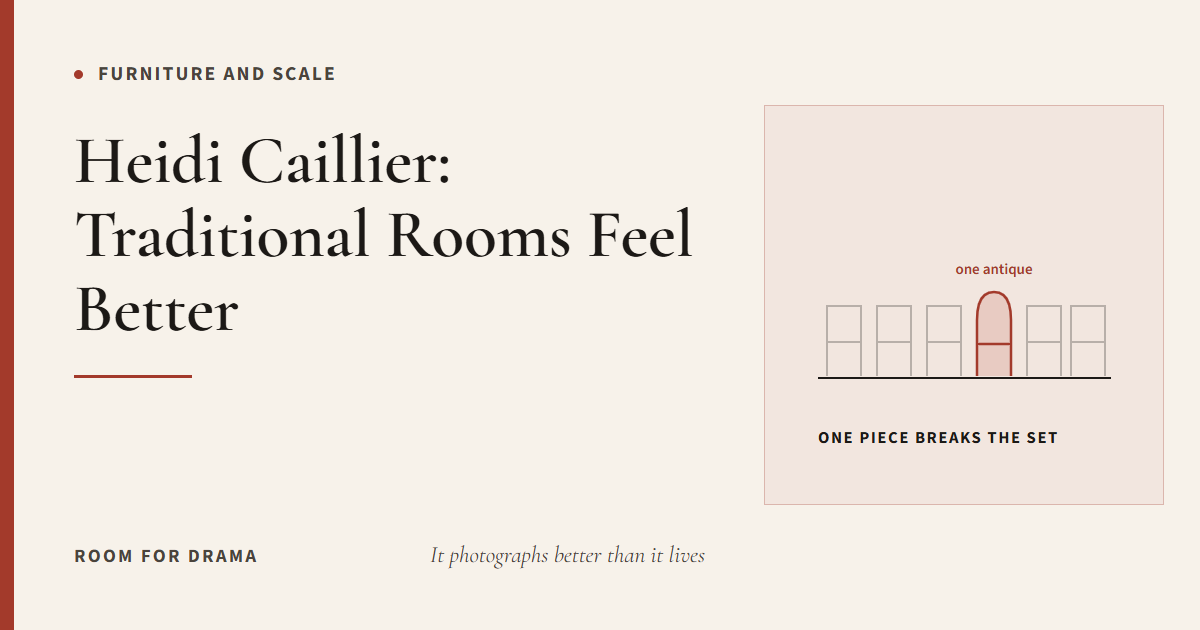
A strong antique changes how a whole room reads — its construction and wear introduce a date that doesn’t match the renovation date, which keeps the space from feeling installed in one sweep. That’s more convincing than filling a room with newly manufactured pieces designed to look old, which usually just creates a theme: a brand-new room wearing a carefully purchased past. It doesn’t take a room full of valuable antiques. One older table, chair, or cabinet with actual age does meaningful work, and worn wood, handmade tile, and visible patina add depth that factory-perfect surfaces often lack. That’s not a defense of damage for its own sake — a broken chair is still a broken chair — but perfection isn’t the same thing as finish.
What she did not learn is doing some of the work
Her own studio makes a point of this: Caillier has no formal training, and the site presents that as a vantage point rather than a gap. I am usually skeptical of that framing, because untrained often means somebody’s client is quietly funding an education. Here I think the claim earns itself, for one narrow reason. Formal training installs a reflex to resolve things — align the tile, relate the trim, make every element answer to every other element in the room. The reflex is genuinely useful and it is also precisely what turns a traditional room into a showroom after closing. She never acquired it, so she has never had to argue herself out of it.
Nobody should read that as a reason to skip the education. Read it as a reason to know which of your instincts are yours and which were issued to you. The version you can act on tonight: find the decision you are about to make because it would be tidier, and ask what tidier is doing for the room beyond relieving your own discomfort. Sometimes the answer is a great deal. Often it is nothing, and you were about to spend money on it.
Pattern and light build intimacy
Wallpaper, curtains, and smaller pattern repeats reduce the sense of an exposed architectural shell, and can make a large room feel more enclosed. The important part is scale — several patterns at the same size and contrast feel busy, while a large floral, a smaller check, and a textured rug can coexist because they’re operating at different visual frequencies. Don’t coordinate every pattern perfectly. Give them a hierarchy instead.
Lamps make territories; one overhead makes a meeting room
Lamps and sconces create smaller human territories inside larger houses, and they reveal texture more convincingly than bright, even overhead light — worn wood and old metal look flatter lit like a meeting hall. A traditional room still needs useful task light; it just doesn’t need every square foot illuminated with equal enthusiasm. Generous upholstery and one or two human-scale furniture moments matter for the same reason: don’t fill the perimeter and call the center spacious. Build a place where people can actually sit and have a drink without feeling they have wandered into the good room by mistake.
Distressing is not patina
“Grandma chic” becomes a shopping list remarkably fast — floral fabric, a skirted table, one brass lamp, and a basket nearby to certify domestic charm. Artificial distressing is not patina, and random mismatch is not character; the useful version of imperfection comes from material truth, age, or a deliberate refusal to over-coordinate. Heirlooms and pieces with actual relevance to the person living there matter more than any of it — the room shouldn’t need to discard every existing object to achieve coherence. If the room already has enough age and irregularity, adding more nostalgia just turns depth into costume.
Source: Heidi Caillier Design’s studio site, project index and press archive — the studio works out of Seattle and San Francisco and states plainly that Caillier has no formal design training; her book “Memories of Home: Interiors” (Rizzoli); Architectural Digest’s designer profile and its feature on the studio’s Mountain Home project.
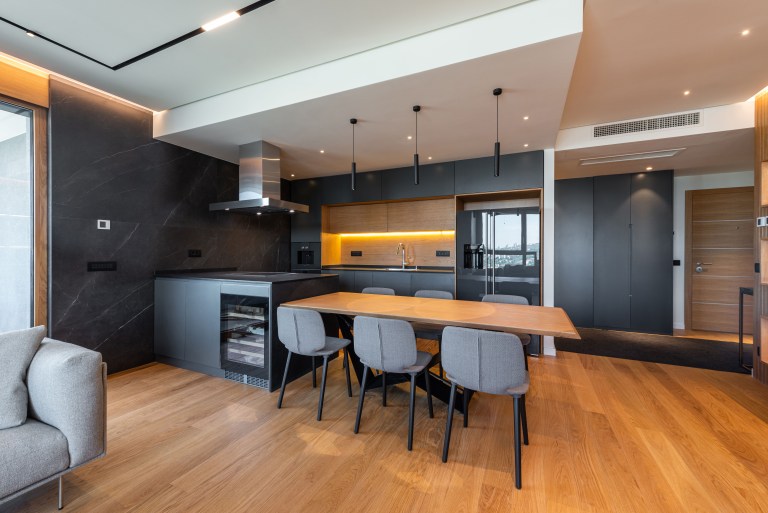
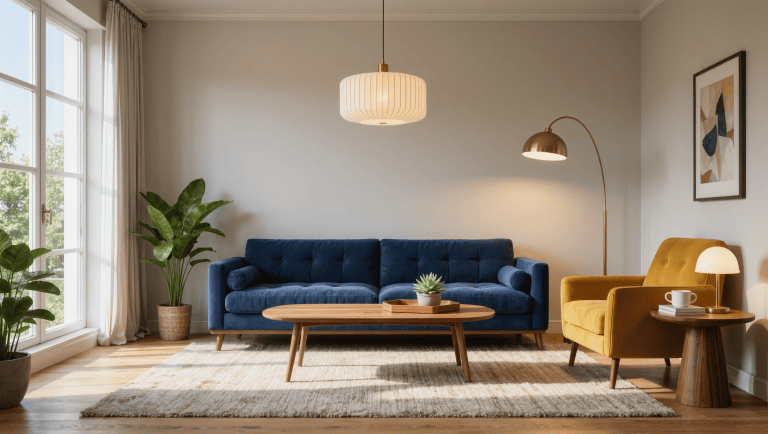
Designer study. This concise study is part of Designers Worth Studying, the deeper Room for Drama index for what to borrow, what not to copy, and how each idea survives an actual room. Photographs in this series are Room for Drama’s own illustrative images, not photographs of the designer’s projects.
Same problem, elsewhere in the house
Room notes
Keep the room on the record.
One useful note at a time: what to test, what to ignore, and what changed when the room got another vote.