Room Edits · Free Study · Unused SpaceRFD-RE-CLOSET-OFF-SCRIPT
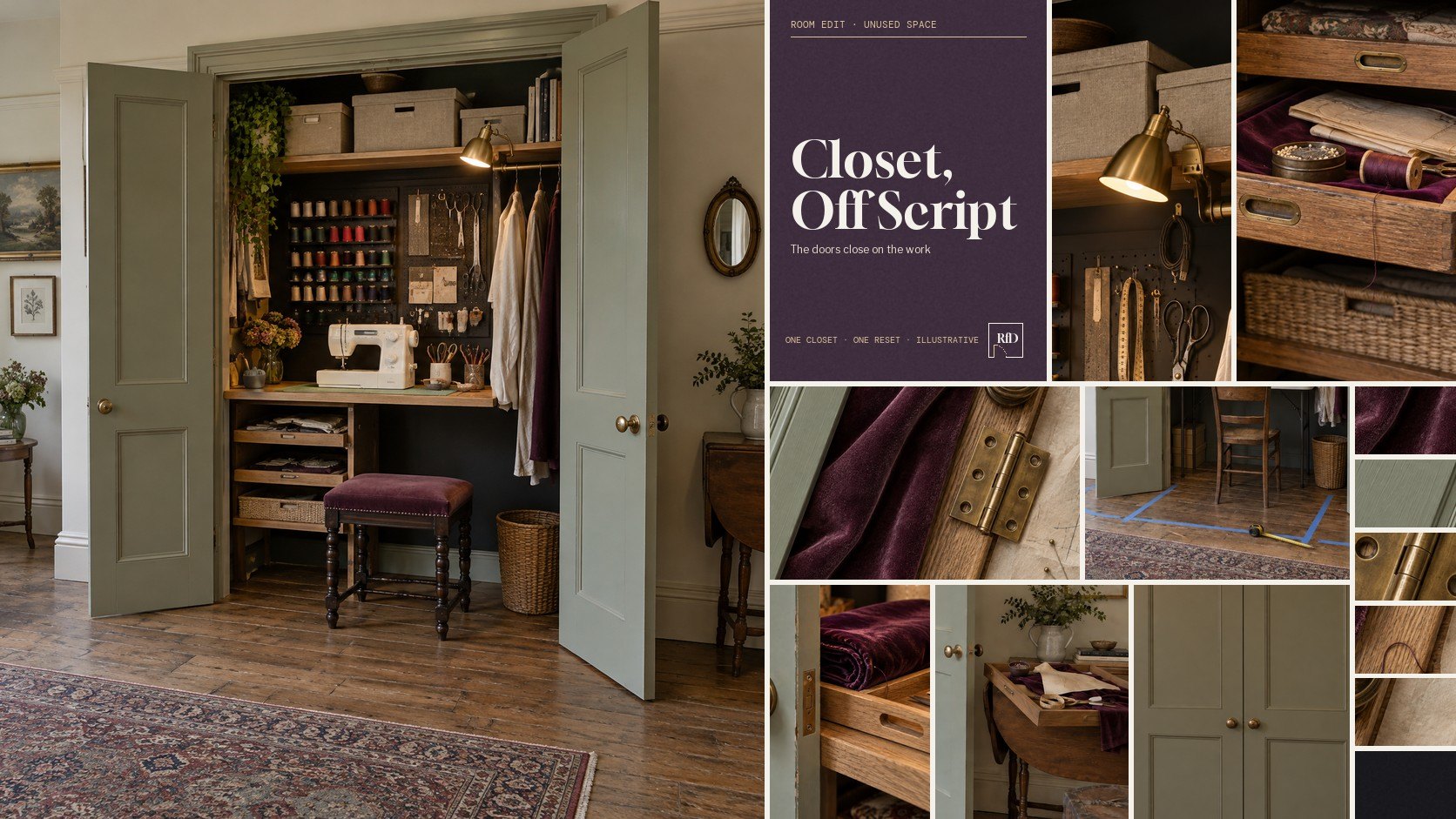
Closet, Off Script
ONE CLOSET · ONE RESET · ILLUSTRATIVE
A free Room Edit Study: find out whether your closet can hold your making — and still shut — before you clear it out.
Your closet has the one thing a craft corner never gets: a door.
Somewhere in the house there is a sewing machine still in its case, a bag of yarn, a folder of paper and a project that lives on the dining table until someone needs to eat. Every session starts by unpacking onto the bed or the table and ends by packing it all away again — or not, and then it stays out for a month.
Meanwhile, in the spare room, there is a reach-in closet with a pair of doors, a shelf, a closet rod and a lot of coats nobody has worn since the move.

Before you clear a corner or wish for a craft room, try a narrower question.
The closet is not a room you go into
The Edit has four parts, and the fourth is the one that makes it work.
Work at the opening. The door frame is the front edge of the workstation. Light reaches it, knees and elbows fit there, and you can turn around to a table behind you. The depth of the closet — dark, far, awkward — becomes storage for whatever you reach for least.
One practice. Sewing, or paper, or beads. Not all three. A closet that holds every hobby in the house is a junk closet with a traffic problem.
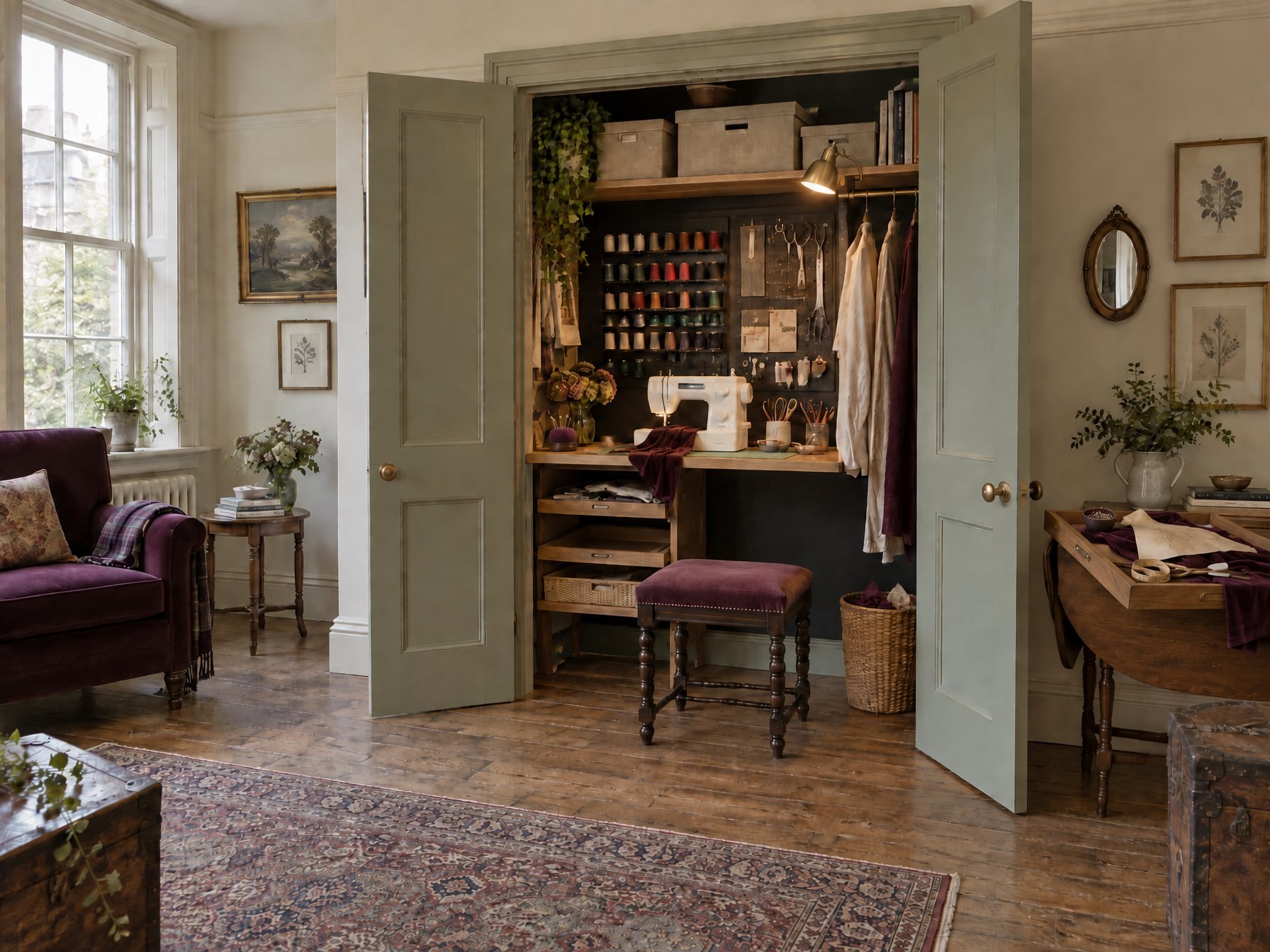
Trays carry the project. One project per tray. The tray comes out in one movement, goes to a bigger table, comes back to the same place, and nothing in it has to be packed up.
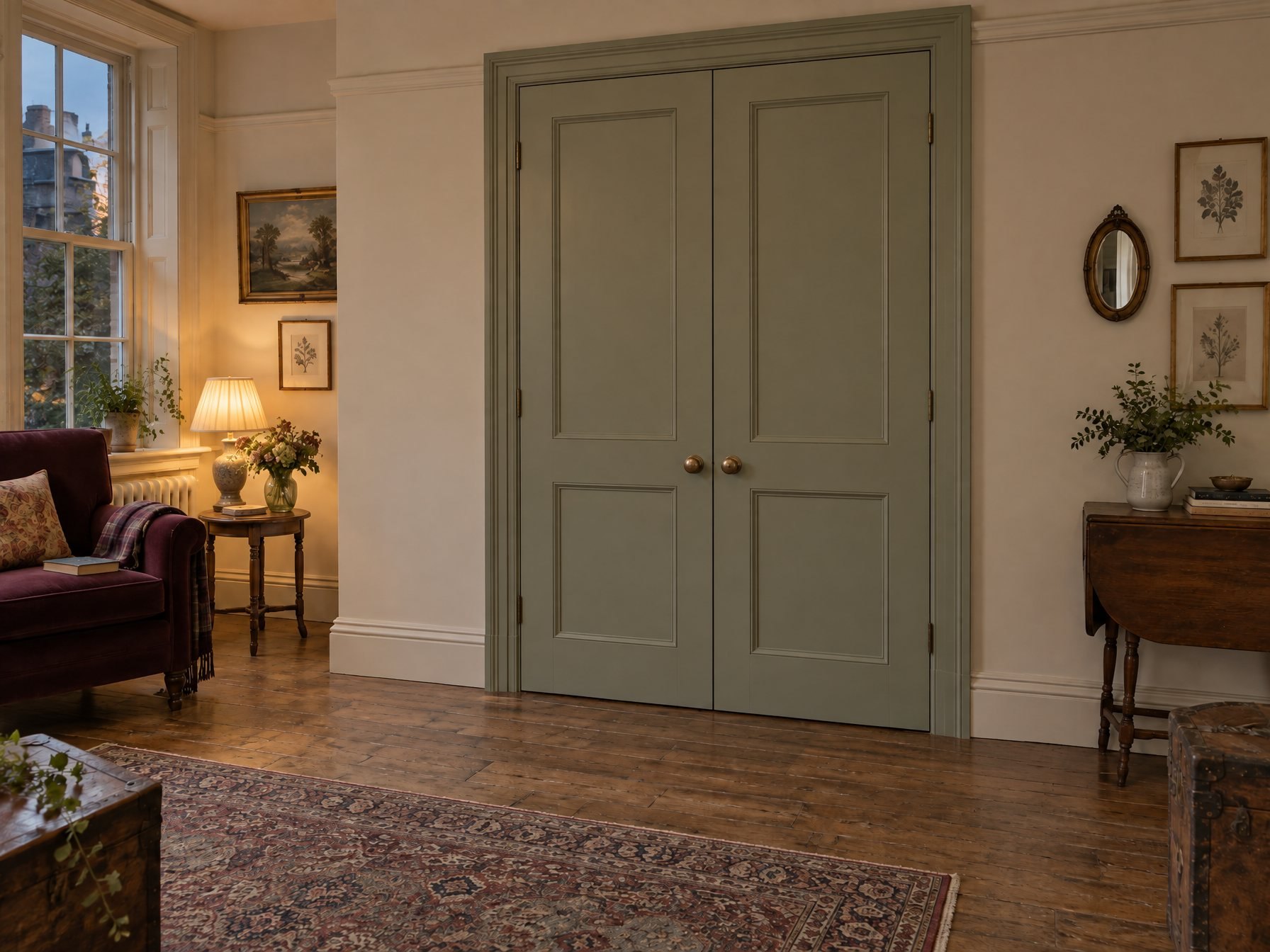
The doors close on it. Every closet has an invisible line where its doors sit when shut. At the end of a session everything — machine, lamp head, stool, draped fabric — lives behind that line, and the doors close flush with the work still in progress. If they don’t, it isn’t a station yet.
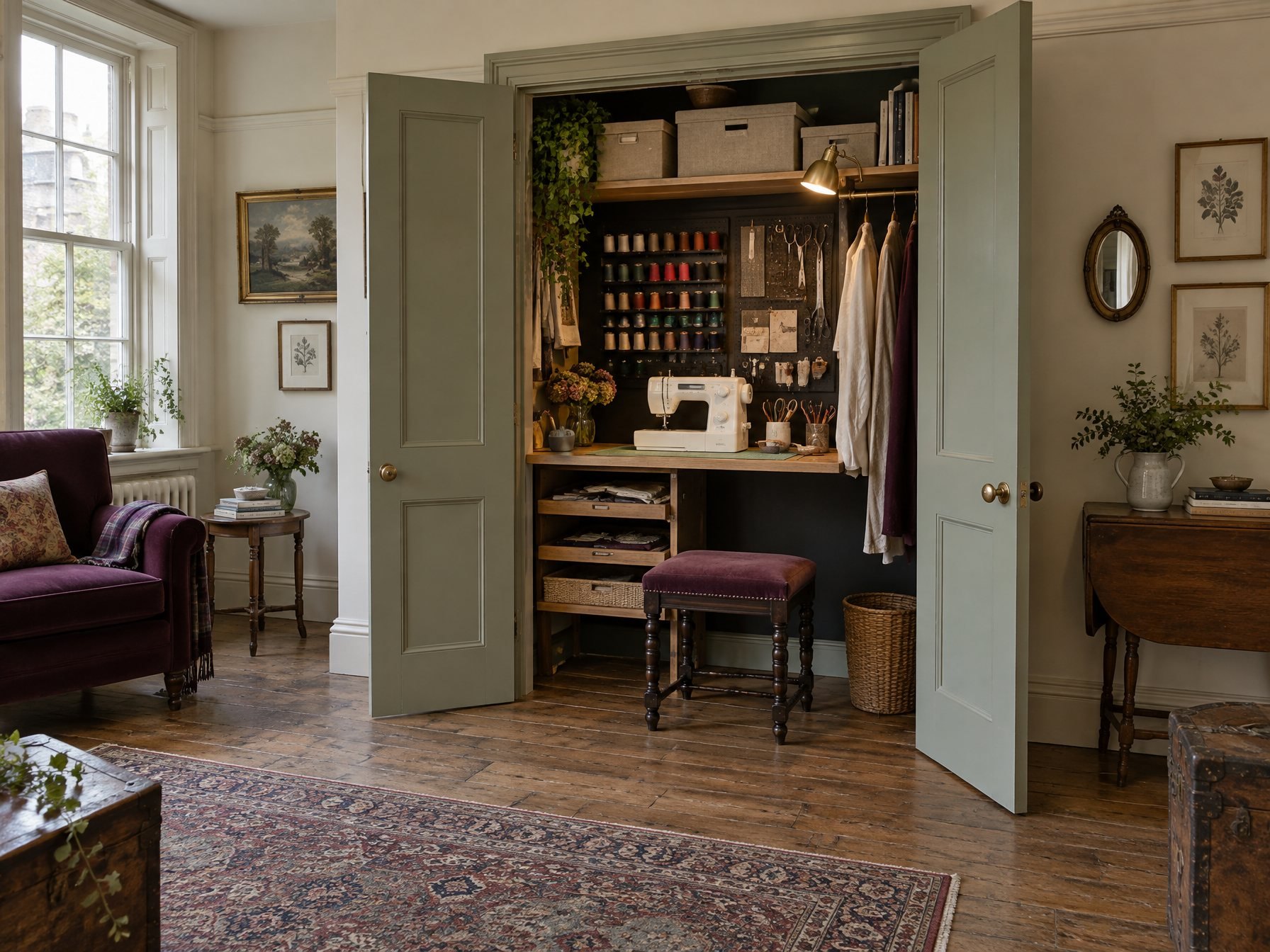
The clothes go first
The weak version moves the coats onto a chair and calls the closet converted. Give every group that leaves the closet a named home before anything else happens — another closet or dresser, lidded under-bed storage, donation, a hall closet. Not the bed. Not “for now.” If the clothes have nowhere to go, the house is short of storage, not short of a craft room, and the closet should stay a closet.
The doors swing into the room
Hinged closet doors stand open on either side of you while you work. Tape both door arcs on the floor, then tape where you will stand or sit. If a door hits the bed, or the only route through the room runs through your working zone, find that out with tape, not with a purchase.
Is this your closet?
Decide this before you empty anything. If a poor fit below describes your closet, stopping here is a useful answer.
Good fits
- a reach-in closet with doors, in a spare room, guest room or bedroom;
- one repeated, portable practice — machine sewing, paper and cards, beads, drawing, water-based model work;
- a maker who loses sessions to setup and packing away;
- contents that can be edited or moved to a real home;
- a table nearby that a tray can travel to;
- renters who need a freestanding, no-drill version.
Poor fits
Heat stays outside the box
A shut closet is a small enclosed space full of fabric and paper. That is what makes it a good reset, and what makes it the wrong place for heat and fumes. Irons, glue guns and heat tools are used at a table or ironing board in the room, cooled there, and stored cold.
Light without new wiring
A rechargeable clip lamp on the shelf edge, aimed down at the work, needs no outlet and parks behind the door line. If a machine or lamp does plug in, run its cord from an outlet in the room along the hinge side of the opening — not across the middle, where the closing doors will pinch it — and unplug it at the end of the session.
Run the three-session test
A closet station always looks right with the doors open. The only useful question is whether they close on it after a real, messy, unfinished session.

The door-plane test
With the station loaded the way you work — machine in place, lamp parked, tray in, stool wherever it will live — close the doors slowly and note the first thing each one touches. Step the table back until they close. Then do it again at the end of a real session, with the real mess, because that is when it counts.
Record, each session
- how long setup and packing away took, compared with before;
- whether you worked at the opening, or leaned and stepped in;
- how the tray traveled — too big, too heavy, overhanging the table?
- where the heat tool cooled;
- whether the doors closed flush, and what had to move first;
- whether the closet smelled of glue, oil or mildew the next morning;
- whether the clothes stayed where you sent them.
What success looks like
Sessions start by opening two doors, not by unpacking. The project waits in its tray, not in a pile. At the end of every session the doors close flush on the station with nothing moved to the bed, and the room goes back to being a bedroom or a living room.
Let the alternatives win
A Room Edit that can only recommend itself is not much use.
| Alternative | Choose it when |
|---|---|
| Keep the closet for clothes | The contents have nowhere else to go. |
| A rolling cart that parks inside | A table is reliably free when you make, and a fixed work surface would rarely be used. |
| Trays on the existing shelf only | The making happens in a chair or at the table anyway. |
| A corner with a screen or cabinet | The room can spare floor, and the opening is too narrow for the work. |
| Take the practice elsewhere | It needs heat, fumes, size or noise a closable box cannot handle. |
Three complete stopping points
Test It. Existing shelf, borrowed table, box lids, clip light, tape — and the clothes in their homes. If the doors close every time, you can stop. Plenty of good closets are a folding table and a row of shoe-box lids behind a nice pair of doors.
Make It Work. Buy only what the test proved: a freestanding insert that passes through the opening and sits behind the door line, purpose-made trays sized to the shelf, the table and your two hands, and a better light. Nothing drilled.
Build It In. A built-in work surface and runners at the tested position, or task lighting, only when a proven station gets materially better from it — and only with a qualified electrician for any wiring and the consent your home or lease requires. Building into the closet makes it slower to give back to clothes. Count that as a cost.
The recheck
A closet station can pass for a month and fail in a season. Recheck when the doors stop closing flush, a second hobby moves in, trays start living on the table, the clothes come back, a warm tool or cord turns up behind the doors, or the closet starts to smell. Then choose: Keep, Refine, Reverse or Escalate — and write down why.
What the paid Edition adds
This guide is complete enough to try the Edit, or to decide it is not for your closet. The Complete Edition ($15.00) is for when you want to carry the decision further:
- the door plane, door swing and working zone drawn in plan, and reach zones in section (illustrative, no dimensions);
- setting the work surface back, standing versus seated posture, jambs, elbows and the header’s shadow;
- tray sizing against runner, table and carry, and why the tray count is a limit;
- light and power without new wiring, and the heat, fume and moisture boundaries kept explicit;
- six practice patterns — sewing, paper, yarn, drawing and water-based painting, beads, models — and where each fails;
- door branches: pairs, single doors, bi-folds, bypass sliders and curtains;
- the renter route: original-condition records, tension rods, freestanding stability and reinstatement;
- retained assets, specification after proof, a substitution rule and budget without false precision;
- failure corrections and a Practice handoff for built-in work;
- the Working Set: fit verdict, closet and door survey, relocation ledger, practice and posture, door-plane and reach test, tray plan, session and closing log, light, power and heat record, original condition, alternatives and phase, specification and recheck.
If your real problem is paid work that never switches off, Off-Duty Office is the closer Edit. Take your actual room into Room Lab at lab.dramaroom.blog — the Room Edit supplies the hypothesis; your Room Record supplies the truth.
Evidence note. Every photograph in this guide is a concept visual of one authored spare room, not a real client room, a measured site or a field-test result. Some continuity is imperfect — the closed doors render slightly differently from the open ones — and no frame proves that a particular station fits behind closed doors. This guide makes no electrical, ventilation, appliance-safety, structural, anchoring, accessibility or code determination.
Room for Drama · Room Edit Study · RFD-RE-CLOSET-OFF-SCRIPT · Free to read, print and share unaltered.
Room Edit Edition · $15.00
The Complete Edition
- Complete Edition · Print Letter PDF38 pages
- Working Set · Working Sheets PDF15 pages
Everything above, carried through to execution: the adaptation drawn out, the worked examples, the failure corrections, the budget and phasing records, and the working sheets you take to the actual room.
Fourteen days, no reason required. And if this free Study already solves your room, you do not need the Edition — that is a real answer, and the one we would rather you reached.