Room Edits · Free Study · Spare RoomRFD-RE-ROOM-THAT-KEEPS-YOUR-PLACE
The Room That Keeps Your Place
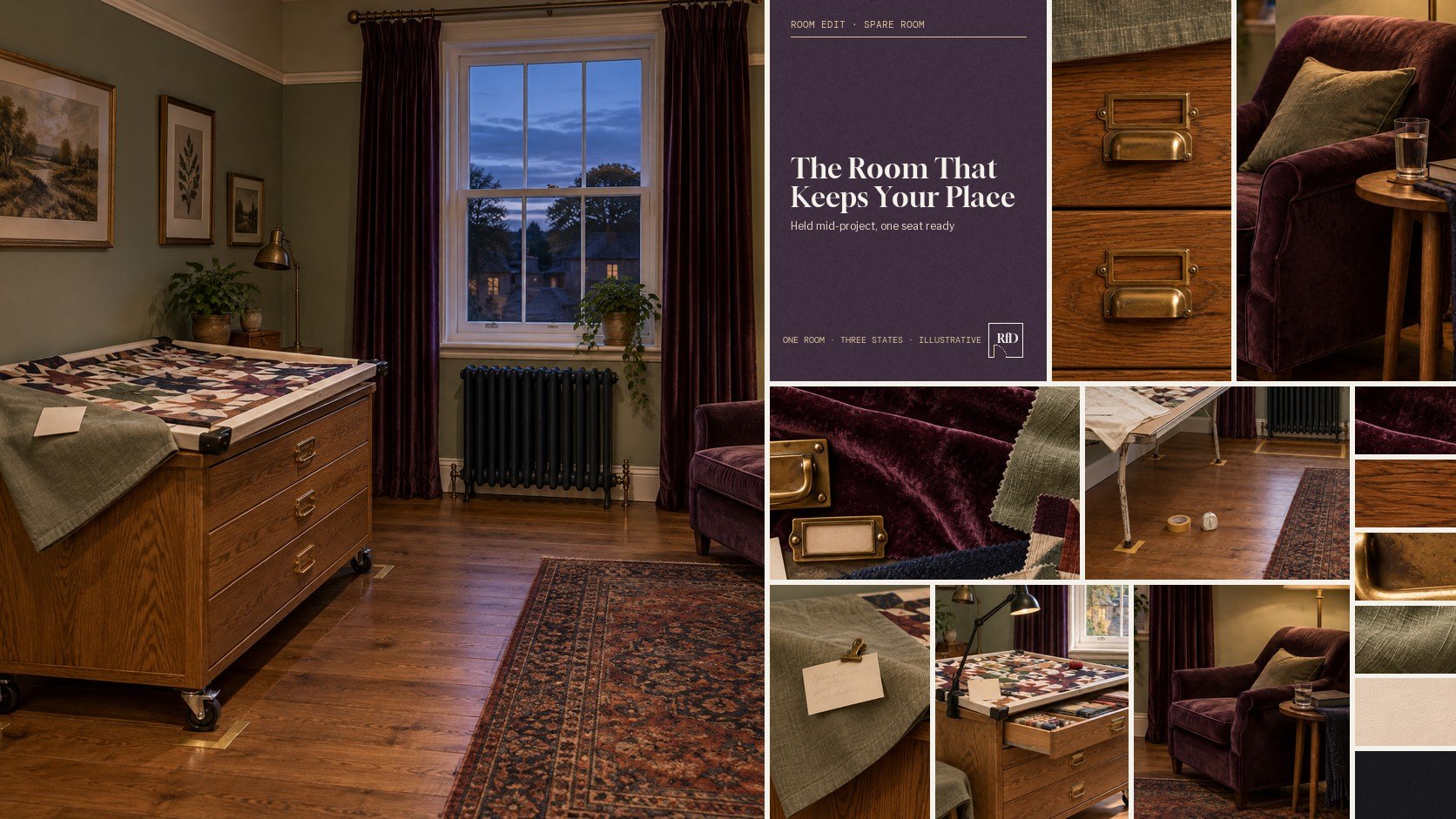
ONE ROOM · THREE STATES · ILLUSTRATIVE
A free Room Edit Study: let a spare room keep a long project's place without losing its one good chair.
A long project doesn’t need putting away. It needs a parking space, a note — and one chair it is never allowed to borrow.
The spare room is where the quilt lives, or the model, or the boxes of family photographs, or the jigsaw that outgrew the dining table. It is also where a guest goes. So one of two things happens. The project spreads to every surface, including the armchair, and nobody can sit in the room for a month. Or it gets packed into boxes after every session, and every session starts with twenty minutes of unpacking and trying to remember which row was next. The second one looks tidier. It is usually the one that kills the project.
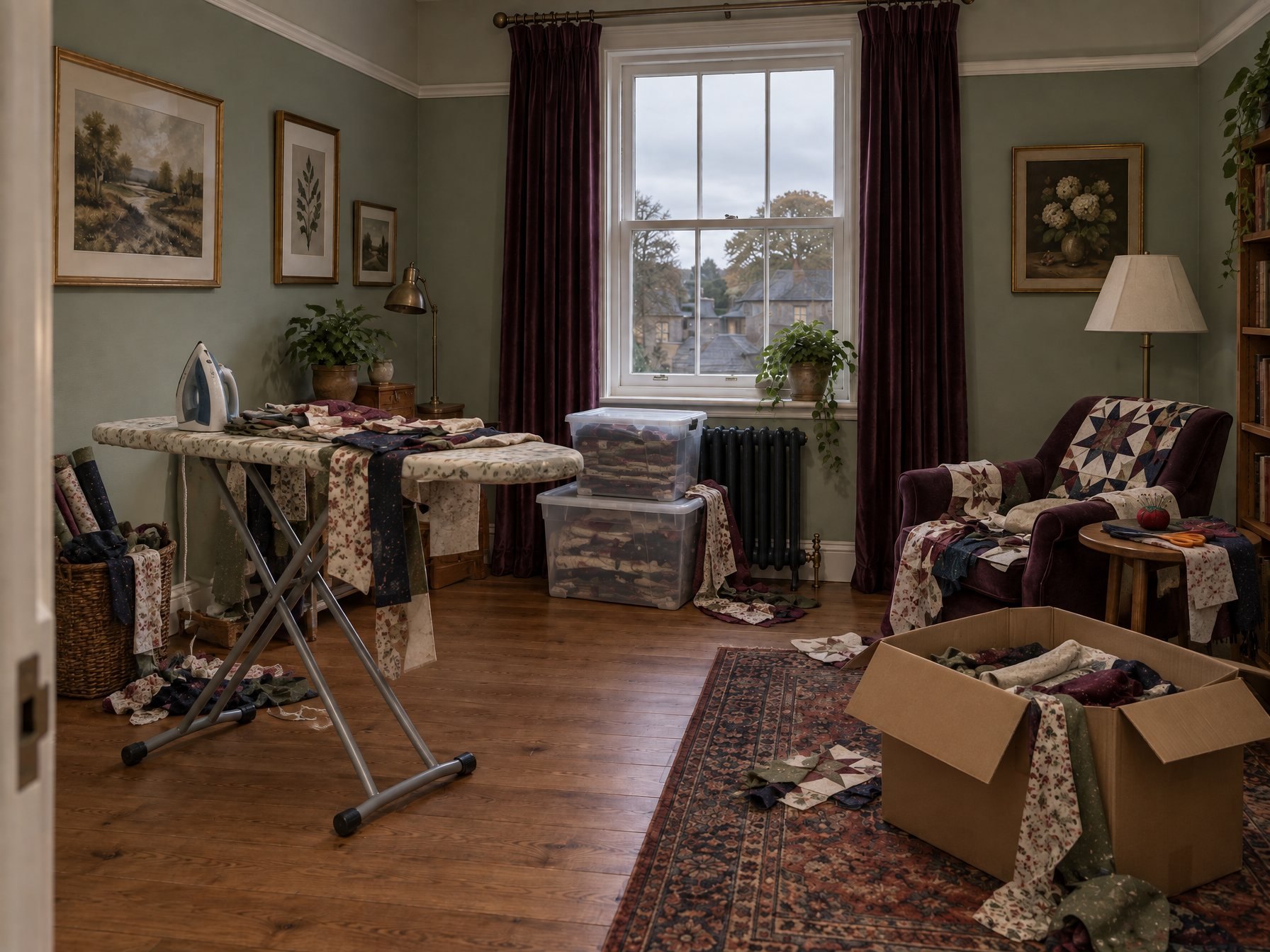
Before buying a craft cabinet, be exact about what the room has to do.
Three states, not two
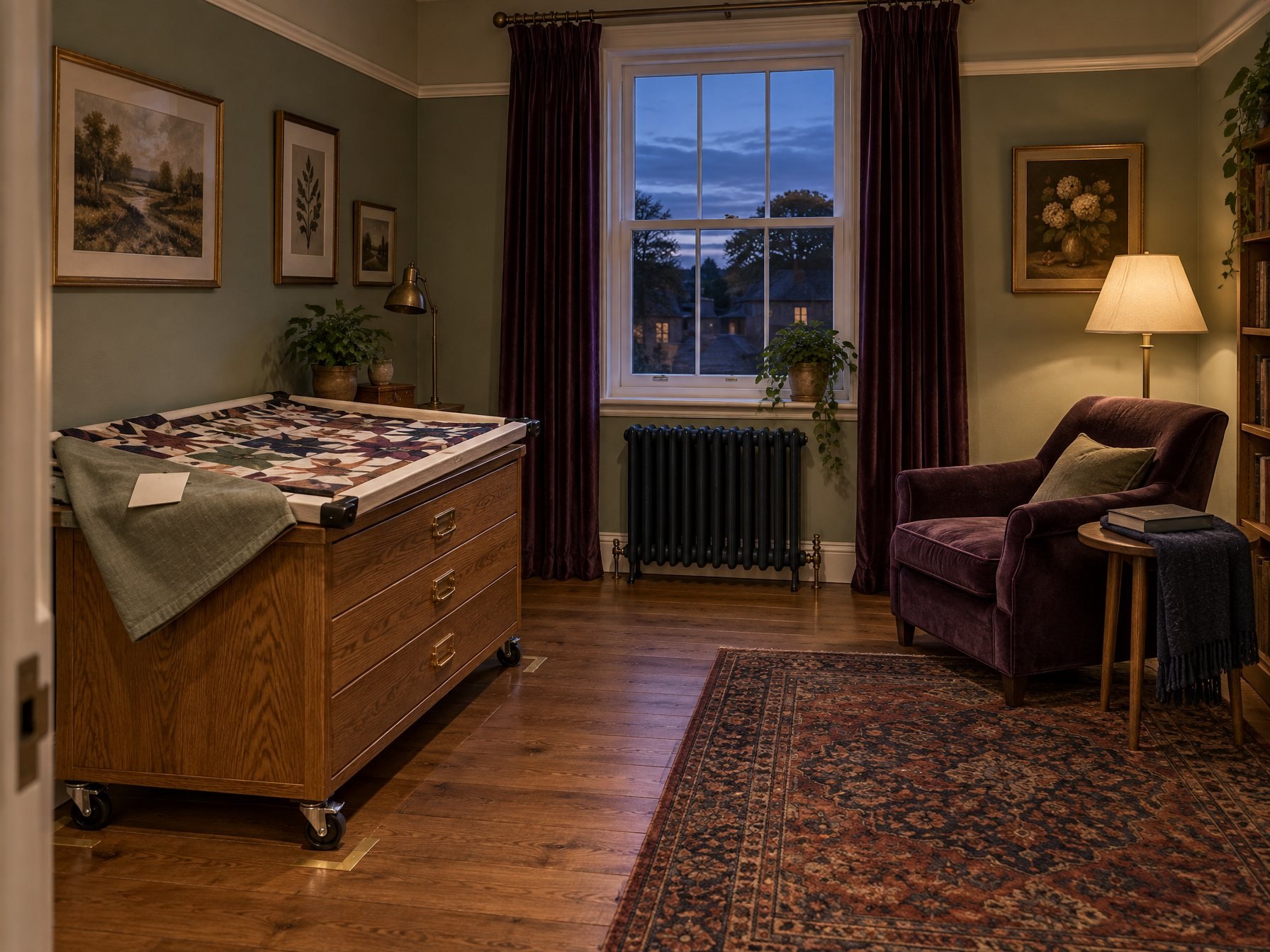
In theater a performance can be held: the stage stays exactly as it was until the cue. Nobody strikes the set at intermission. Most spare rooms have only two states — out everywhere, or packed away — and are missing the one in the middle.
| State | The project | The chair | Light |
|---|---|---|---|
| Working | Out, uncovered, trays open | Untouched | At the project |
| Held | On its marks, covered, next move written on top | Ready | Off |
| House | Held, nothing on the cover, tools closed | Given to a reader or guest | At the chair |
The whole Edit is about making held quick to get into, quick to get out of, and good enough to live with for weeks.
Tape three things first
Tape these on the floor before deciding where the project goes, and keep the project, its table or unit, and its cover outside them.
- The door. Its swing, and the route from it to the chair and to the window.
- The heater. The space in front of and above it, and its controls. The heater’s maker sets the clearance for fabric, paper and surfaces, not a number from this page.
- The window. Reach to the catches, any inward swing, blind cords.
The parking place
Choose a wall run clear of all three zones, away from the door and out of the route to the chair. Check where sun lands on it through the day — many fabrics, papers and photographs are harmed by sustained sun. Then tape its four corners on the floor. In a theater these are spike marks: they tell the crew exactly where a piece of set goes back. They will tell you, weeks later, whether the project has crept.
If the project needs to come out into the light to be worked, tape its working position too, and keep the line between the two short and clear of every route.
Hold the state, not the parts
A box holds parts. A held project keeps its order — which blocks go in which row, which sub-assembly is drying, which pile is the 1950s. So:
- Move it as one unit, or not at all. A rigid board for a layout; a base for a build; a stack of trays for sorting. If parking it means picking up pieces, it is being packed.
- Label trays by order, not contents: NEXT, IN HAND, DONE, SPARES. The tray on top is always the next job.
- Close a TOOLS tray — pins, blades, needles, glue — every time the project is held. The room is also a sitting room.
The where-I-stopped card
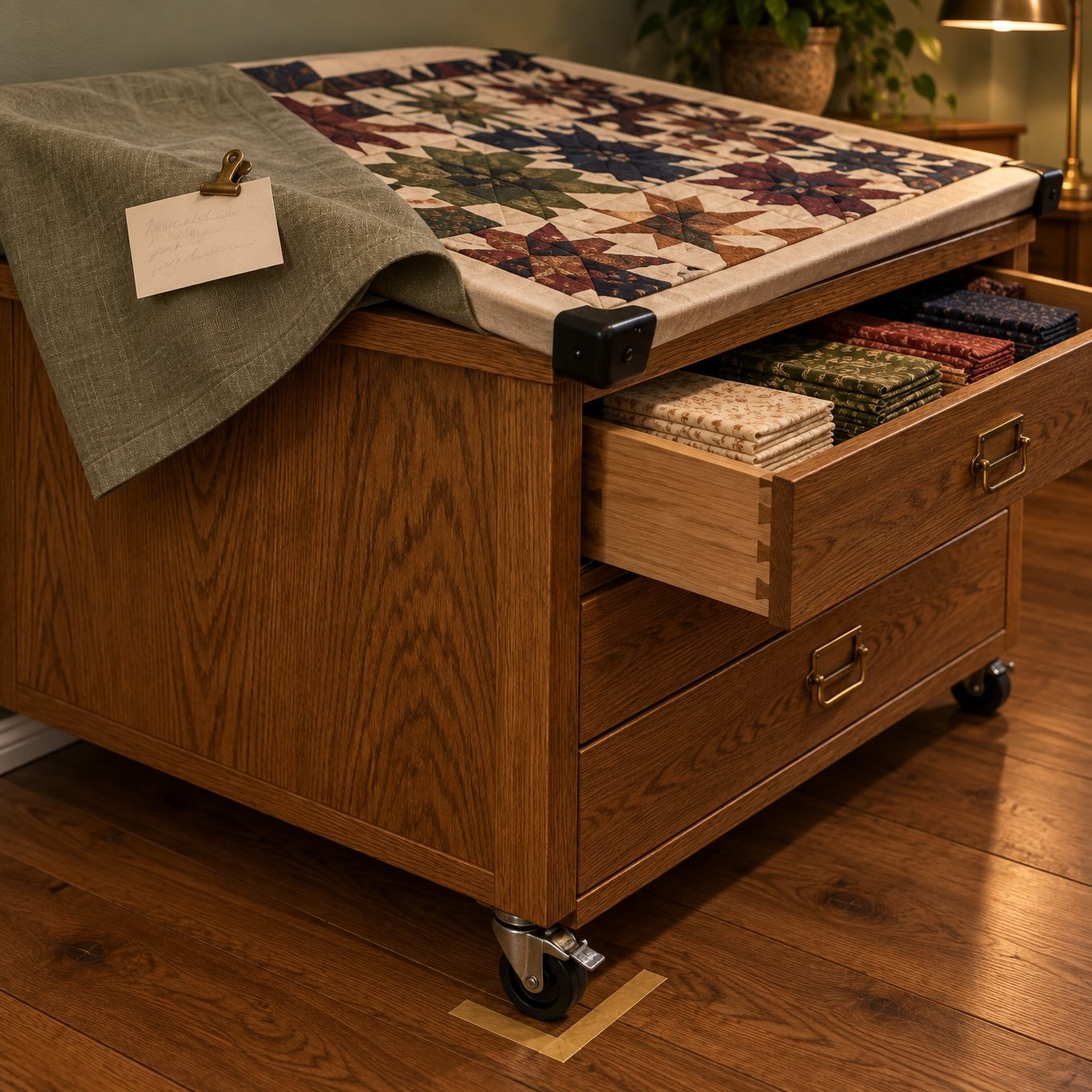
At the end of every session, before the cover goes on, write three lines and the date on a card, and put it on top of the cover:
- Last thing done.
- Next physical move — what your hands will do first.
- Watch for — the problem you noticed and didn’t solve.
“Finish the quilt top” is a goal, and you will still have to work out where you were. A move is one short sentence a stranger could follow:
- “Next: sew the blue strip to the left edge of the fourth square, pins already in.”
- “Next: fit the pale sky pieces, already sorted into the box lid, along the top edge from the left corner.”
- “Next: glue the left wing to the body; the right wing is already on and drying.”
- “Next: open the brown envelope at the front of the top drawer and lay its photographs out, oldest on the left.”
That difference is most of the method.
The cover
Cloth rather than plastic over fabric, paper or drying work, unless a material’s maker says otherwise. It should lift off in one move without dragging pieces, stop at the edge of the table rather than trailing to the floor or the heater, and wash. A cover keeps dust and sun off and makes a held project look like furniture. It is not a barrier: it will not stop a cat, a curious child or a guest’s coffee cup.
The house seat
In a theater, house seats are held back for whoever matters. Here the house seat is one chair, its own small table and its own lamp, in the corner furthest from the project, ready at all times.
This is the rule that keeps the reset short. The armchair is the nearest soft surface to lay fabric on and the side table is the nearest place for pins, so they are what a project takes first — and once it has, the room can’t receive anyone without a clear-out.
Light the project at the project and the chair at the chair, each switched where it is. When the project is held, it is unlit.
The ten-minute reset
Before a visitor or a reader, take the room to its house state: tools closed, trays in order, card written, project on its marks, cover on with the card on top, project light off, chair checked, chair lamp on, routes clear. Aim for about ten minutes, alone.
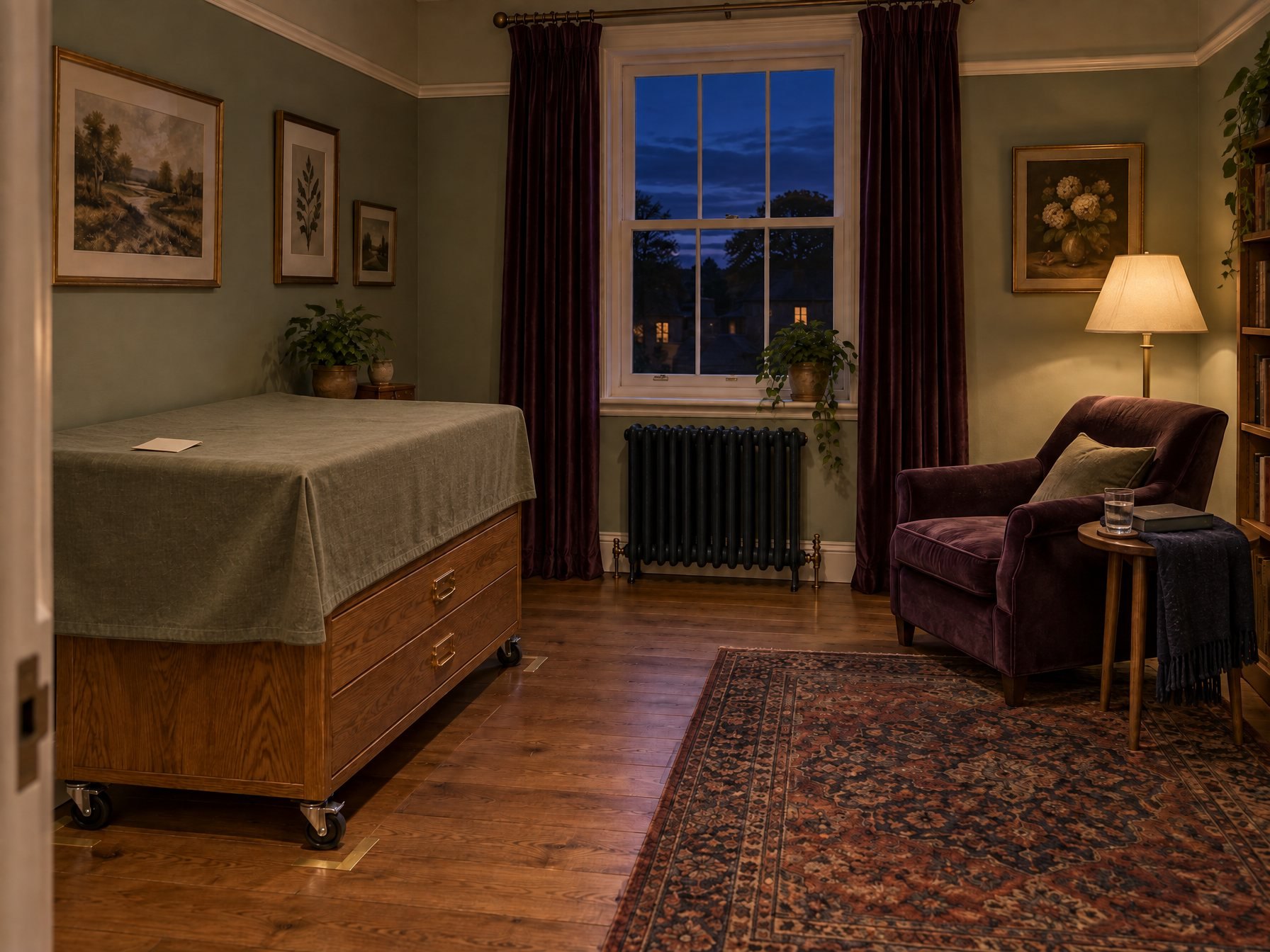
Ten minutes is a target to time in your own room, not a promise. Start a timer and note the slowest step. If the slowest step was clearing the chair, the chair was borrowed, and that is the thing to fix — not the size of the storage.
Is this your room?
Good fits
- a spare room, box room or second living room with one long project in it;
- projects that can sit safely mid-state: quilting and sewing layouts, jigsaws, hand-tool model-making, water-based painting left to dry per its instructions, family archives, scrapbooks;
- sessions days or weeks apart;
- occasional readers, visitors or overnight guests;
- a wall run clear of the door, heater and window;
- renters using freestanding tables, rolling units and plug-in lamps.
Poor fits
If the project fits a closet whose doors can shut on it mid-stream, Closet, Off Script gives you a door instead of a cover. If the surface is the dining table, Dinner, Then Games is about getting a game off it before dinner. If it’s paid work that won’t switch off, that is Off-Duty Office.
The three-week test

Each session, note:
- how long from lifting the cover to the first real move, and what you searched for;
- what the card said, and whether it was a goal or a move;
- anything that landed outside the parking place;
- whether the chair, its table or the floor near it held anything of the project;
- for each visit, how long the reset took and which step was slowest;
- dust, sun or damp on the held project;
- whether the door, heater and window stayed clear.
Let the alternatives win
| Alternative | Choose it when |
|---|---|
| Pack it away properly | It packs and unpacks in a minute, or the room is needed daily for something else. One labeled box and a photo of where you stopped is a finished answer. |
| A closet with doors | The project and its kit fit, and the doors close on it. |
| Give the room to the project | Nobody else used the room in three weeks. |
| A table in another room | A genuinely spare surface exists that isn’t for meals or work. |
| A workshop or ventilated space | The materials or tools need ventilation, heat or water. A different project. |
Three complete stopping points
Test It. Tape, a borrowed table or board, shoeboxes, cards, a sheet, a chair left alone, a timer. If it works, you can stop: a folding table under a good cloth, with its marks and its card, can hold a quilt for a year.
Make It Work. Buy only what the test proved: a table or rolling unit sized to the project’s real footprint, with locking casters and loads kept low if it rolls; a rigid board; trays; a fitted cloth cover; a task lamp and a chair lamp each switched where they are. No fixings.
Build It In. A built cabinet with a front that closes on the held project, a fold-down worksurface, task lighting switched where your hand already is — only when a proven arrangement gets materially better, and only with permission and qualified people for fixings and electrics.
The recheck
Look again when the project changes phase or ends, when a new project arrives, when the card stops being written, when something lands on the chair, when the reset gets long or skipped, when the room is slept in more often, when a child starts crawling, and at the start of the heating season. Then choose: Keep — held, restarting from the card, chair never borrowed. Refine — right idea, wrong wall, surface, trays, card or lamp. Reverse — the project can’t be held safely, the room is a bedroom, or the chair keeps being taken. Escalate — the borrowed version proved itself and a proper unit would remove a real compromise.
What the paid Edition adds
This guide is complete enough to try the Edit, or to decide it isn’t for your room. The Complete Edition ($15.00) is for carrying the decision further:
- keep-clear zones, parking place, working position, travel line and house seat worked through in plan, and the three states as a strip (illustrative, no dimensions);
- how to hold flat layouts, upright builds, many-part sorting, frames and stands, and projects bigger than any movable board;
- rolling units: casters, loading, floors and when a plain table is better;
- the order-labeled trays, the TOOLS tray and the overflow place;
- the card method in full, the cover, and a covered project in a sitting room;
- placing the house seat, its side table, a reader while the maker works, and two lights switched at their own places;
- the reset sequence step by step, with what each slow step usually means;
- readers, evening visitors, visiting children and occasional overnight guests;
- room branches: box rooms, second living rooms with a sofa, former dining rooms, a shared single window, guest rooms with a bed, oversized rooms, attic rooms and rented rooms;
- a renter route, retained assets, specification after proof, a substitution rule, budget without false precision, care and seasons, the end of a project, failure corrections and a Practice handoff;
- the Working Set: fit verdict, room and project survey, parking place and house seat plan, where-I-stopped cards, three-week log and reset timer, alternatives and phase, specification and sourcing, decision and recheck.
Take your actual room into Room Lab at lab.dramaroom.blog — the Room Edit supplies the hypothesis; your Room Record supplies the truth.
Evidence note. The photographs in this guide are generated concept visuals of one authored room, not a real client room, a measured site or a field-test result, and no reset time, clearance or safety information should be read from them. The ten-minute reset is a target for you to time, not a measured figure. This guide makes no ventilation, fire, electrical, load, tip, child-safety or building determination.
Room for Drama · Room Edit Study · RFD-RE-ROOM-THAT-KEEPS-YOUR-PLACE · Free to read, print and share unaltered.
Room Edit Edition · $15.00
The Complete Edition
- Complete Edition · Print Letter PDF38 pages
- Working Set · Working Sheets PDF13 pages
Everything above, carried through to execution: the adaptation drawn out, the worked examples, the failure corrections, the budget and phasing records, and the working sheets you take to the actual room.
Fourteen days, no reason required. And if this free Study already solves your room, you do not need the Edition — that is a real answer, and the one we would rather you reached.