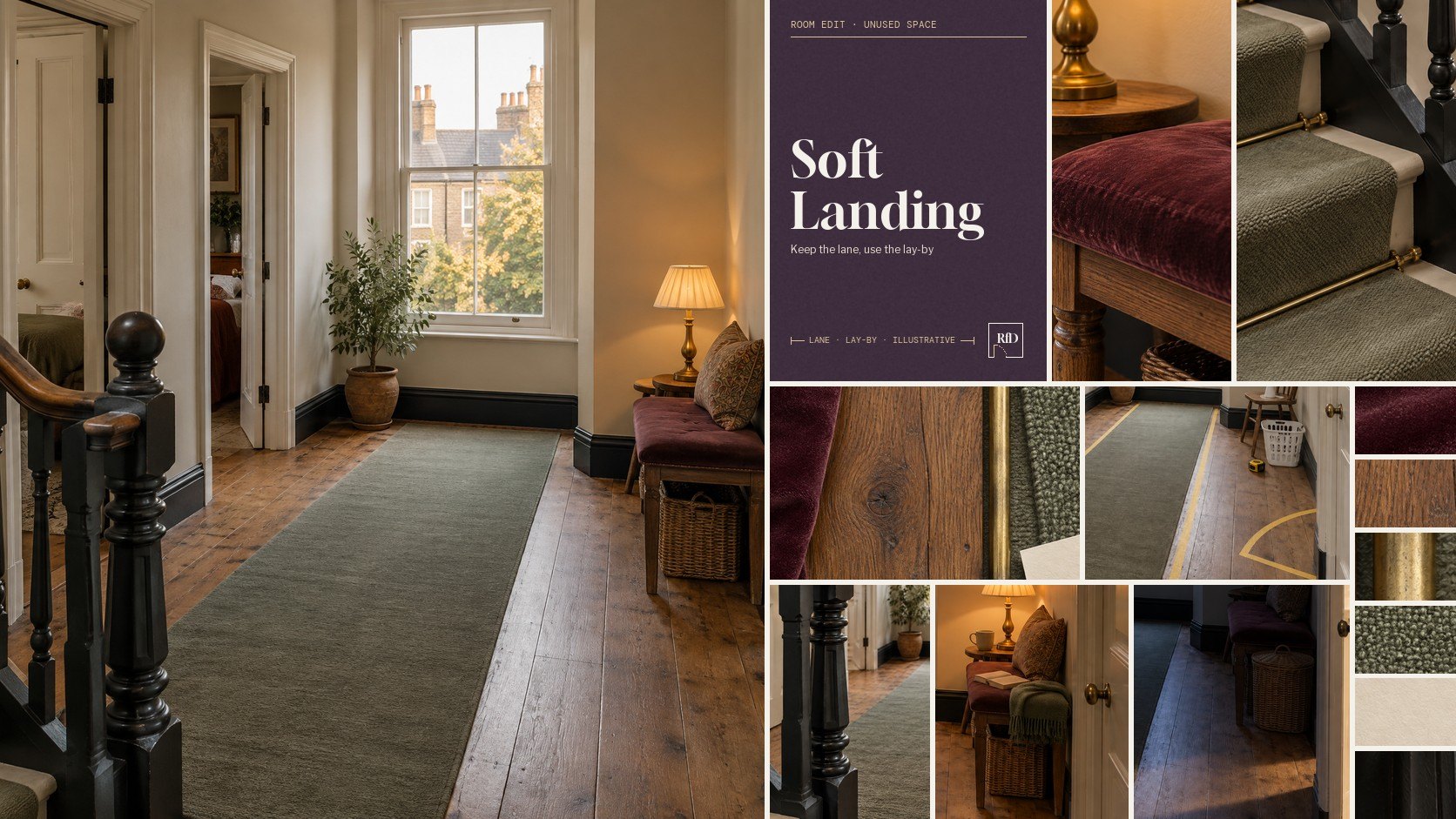
Room Edits · Free Study · Unused SpaceRFD-RE-SOFT-LANDING
Soft Landing
LANE · LAY-BY · ILLUSTRATIVE
A free Room Edit Study: turn a genuinely surplus landing edge into a place to pause and collect, without giving away the route or the top of the stairs.
Everyone crosses the landing. Nobody stops there. So things stop there instead.
The upstairs landing is the most-walked floor in the house that nobody furnishes on purpose. It gets furnished anyway. The laundry basket waits on the top step for the next trip down. Shoes collect by the newel post. A cardigan lives on the banister. A chair that was meant for reading holds a pile in the middle of the route, and a phone cable crosses the boards from the only outlet.
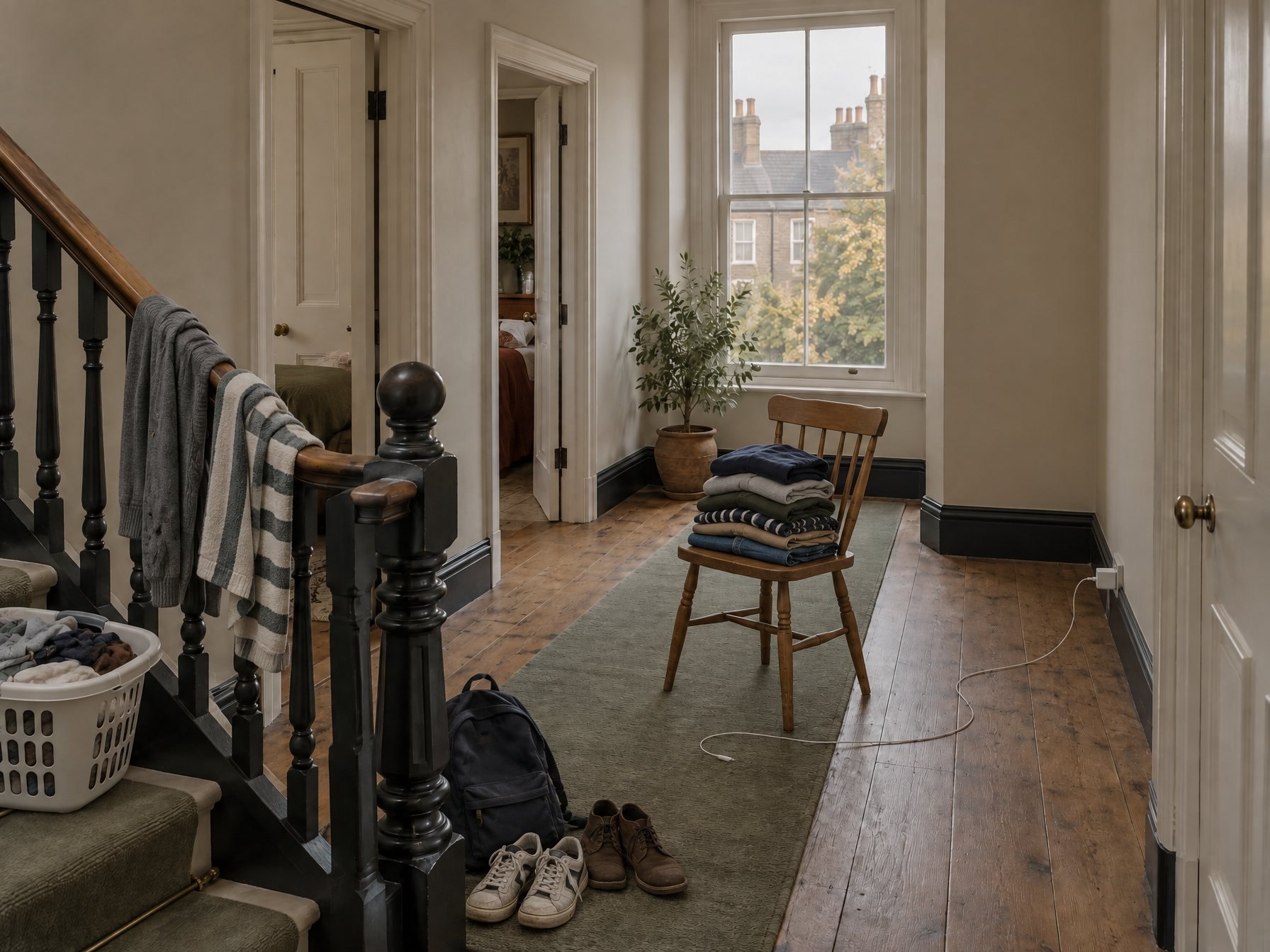
That is not a storage problem. It is things in transit with no waiting place, settling in exactly the spots a body needs clear — including at three in the morning, on the way to the bathroom, with the lights off.
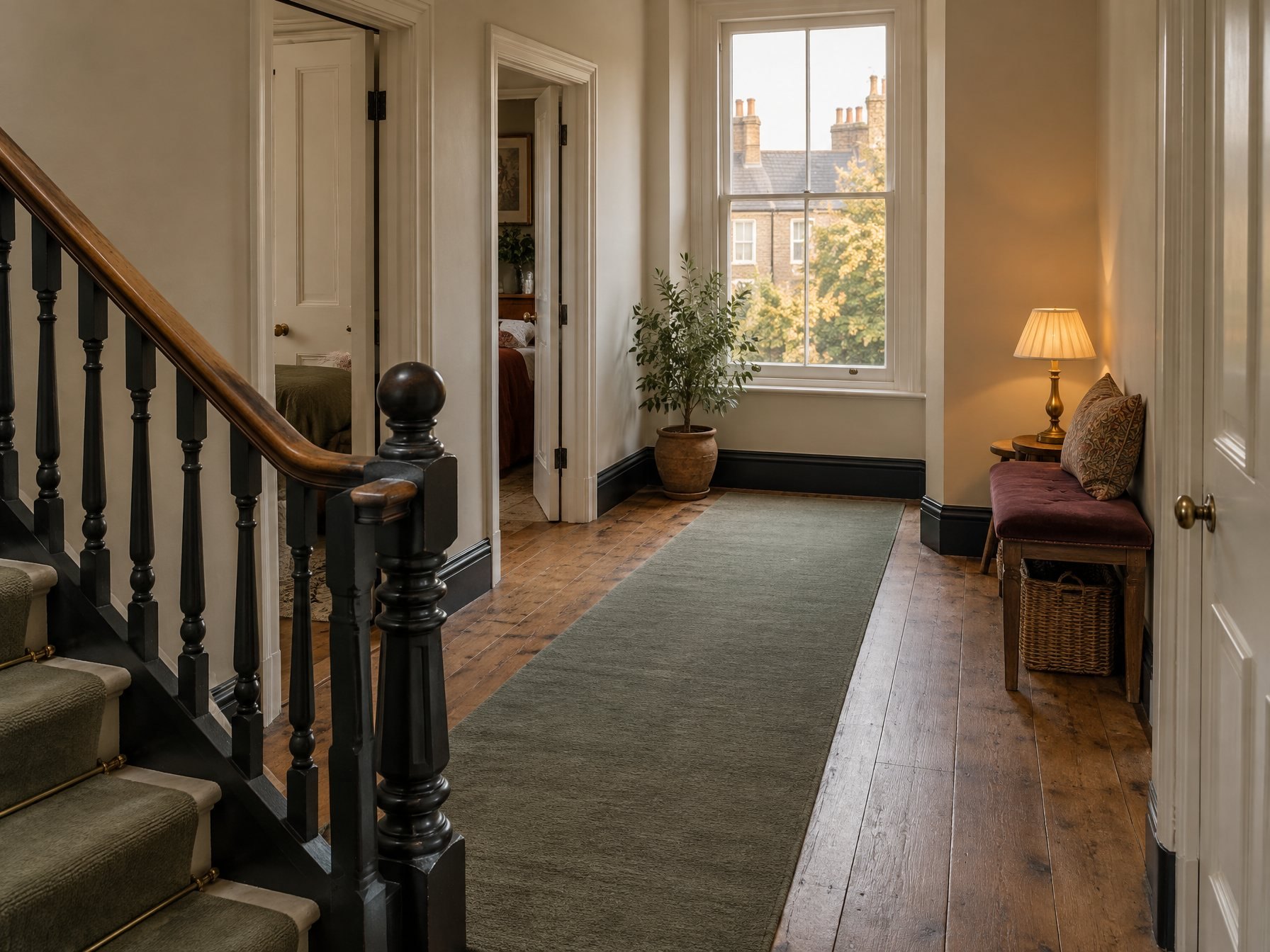
This Study turns a genuinely surplus edge of the landing — if there is one — into a small niche to pause and to collect, without narrowing the route anyone needs.
Three kinds of floor
Before deciding what the landing could do, sort its floor.
| Floor | What it is | Rule |
|---|---|---|
| The stair head | The top step, the floor you stand on to step down, the end of the handrail | Never. Nothing is put down here, including “just for now”. |
| The lane | Where people actually walk from the stair to every door — including door swings, and a full laundry basket | Always clear, and walkable in the dark. |
| The lay-by | Whatever floor is left outside both | The only place a job may go. One job. |
Tape the stair head
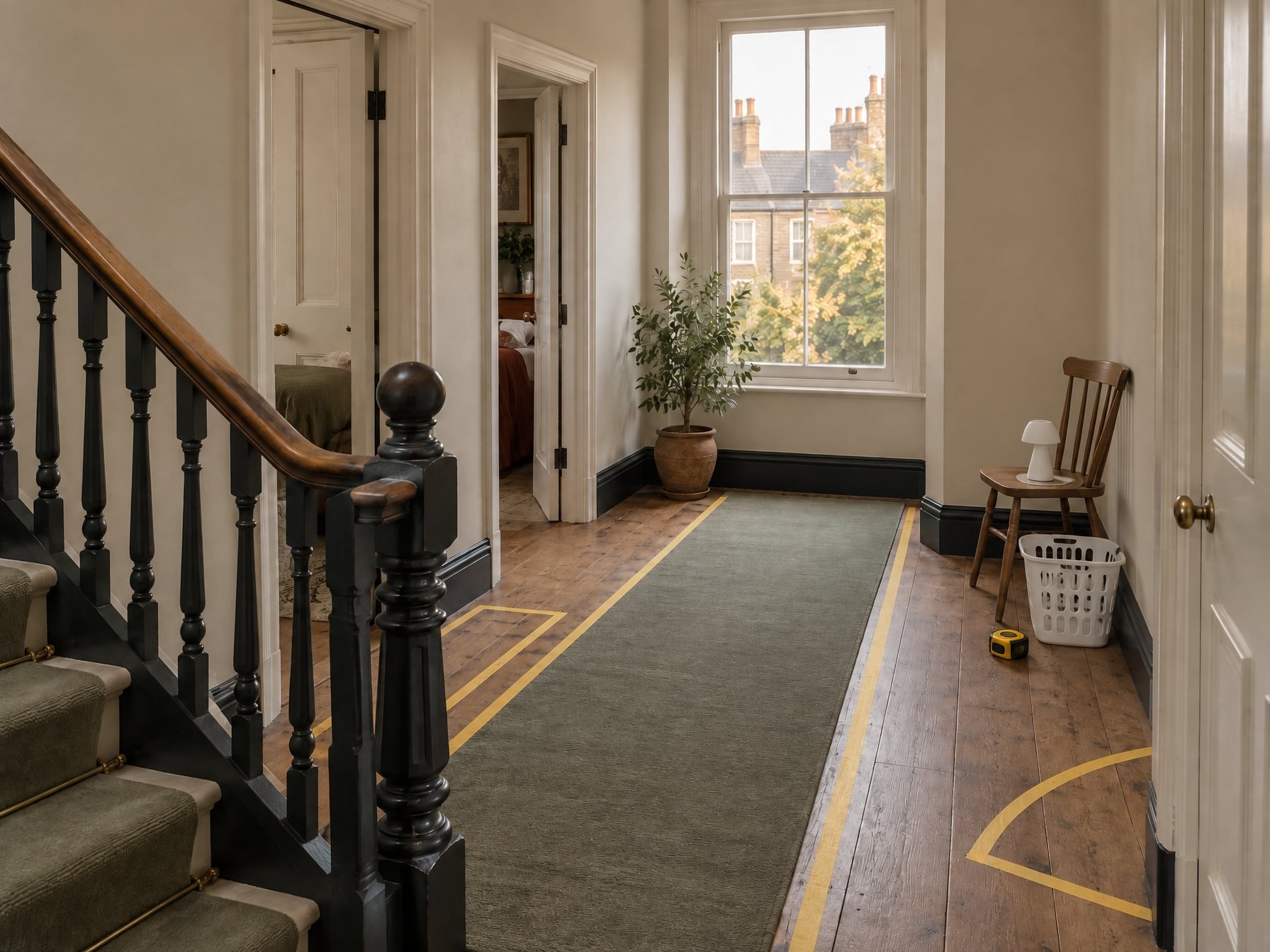
Stand at the top of the stair, turn the way you turn to go down, reach for the rail, and tape around where you stood. Then do it again carrying a full laundry basket. You will stand somewhere slightly different, and see less of the step.
Walk the lane, then tape it
Walk from the farthest bedroom to the stair at ordinary speed and tape the edges of the floor you used. Walk it again with the basket. Open every door onto the landing fully. Add the swing of any door that opens onto the landing, the route to an attic hatch, and the closing path of any fire door. The taped lane is nearly always wider than people guess. That is why you tape it.
Walk it as the household’s most demanding user moves, not the quickest: with a cane or a walker, holding a child’s hand, steadying on the wall. If anyone uses the landing with a mobility aid, or may soon, that width is the lane — and what width a particular person needs is theirs to establish, with an occupational therapist where relevant, not a number from this guide.
What’s left is the lay-by
A genuinely surplus edge: a window bay, a bulge where the landing widens away from the stair, the dead end of a hallway beyond the last door. Floor that only looks spare with the doors shut and nobody carrying anything is not surplus. It must be outside both tapes, and it must not be beside the balustrade or the stairwell edge — that floor is spare, but anything placed there is a step. If nothing is left, the landing has no lay-by. That is an answer, not a failure.
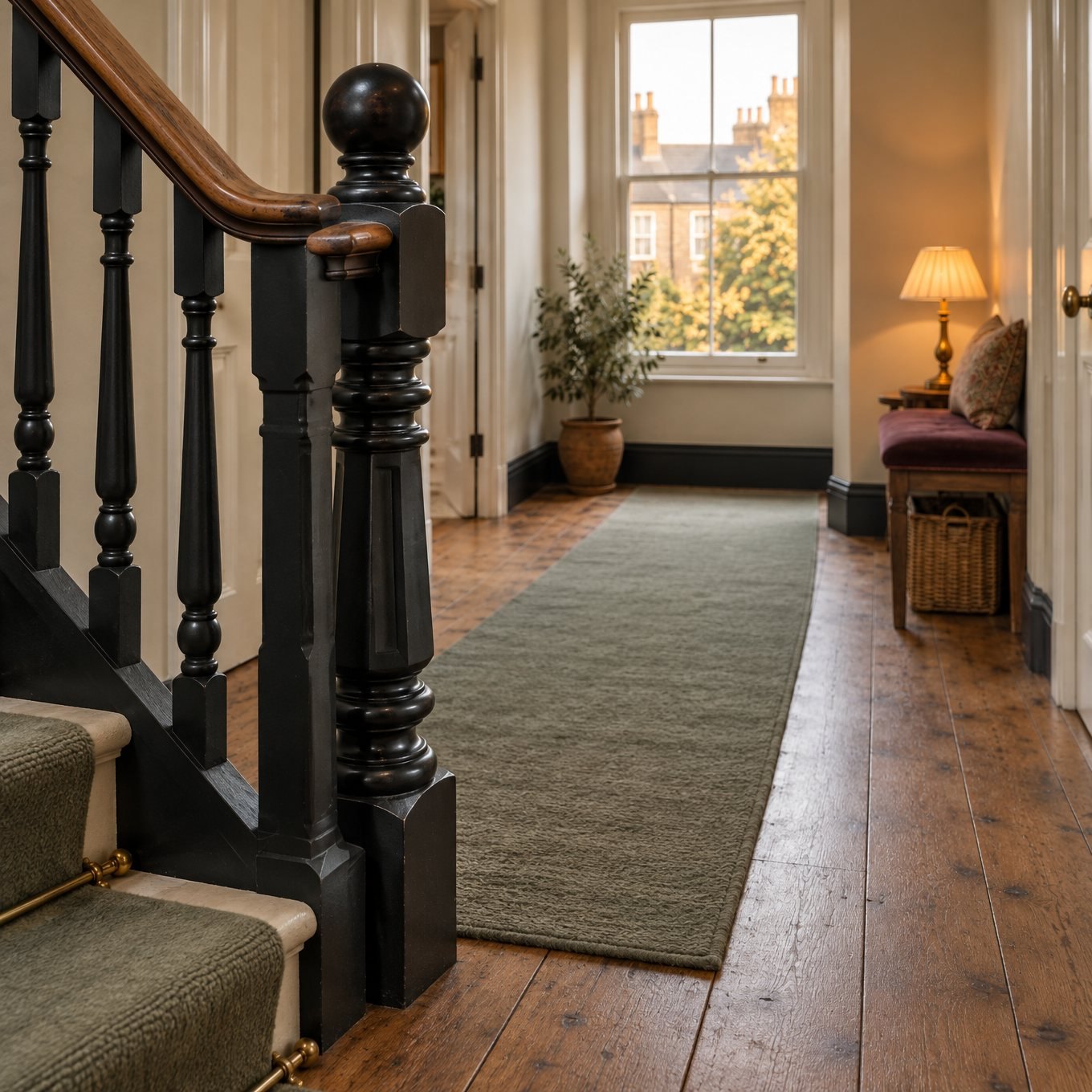
A pause, a collection point, chosen from evidence
For three ordinary days, write down what is at the stair head and on the banister at bedtime, what gets carried through, and who stops on the landing and why. The best niche does something that already happens badly in the wrong place. It gets at most one pause and one collection point.
- Reading perch — a pause. Someone reads outside a child’s door, on the carpet. Watch the reader’s legs, and the lamp’s glare down the stairs.
- Pause seat: shoes on, breath back — a pause. Shoes put on sitting on the top step, or someone stopping at the top with a hand on the newel. Watch the extended foot, and how the person stands up: this takes the most floor.
- Charge and go — collection. Phones on the floor on a cable. Watch the cable path: a cord across the lane fails.
- Laundry and linen staging — collection. The basket on the top step. Give it one place in the lay-by instead.
A bench that fits the lay-by does not prove the job fits. Sit and do the job as it is really done — legs out, shoes on, standing up — and see where the feet land.
One basket, one trip
Things in transit wait in one parking place in the lay-by, up to a limit you set in objects — “one basket”, “one bag each” — and leave on the next trip in their direction. Anything over the limit waits in the room it came from. Storage is not transit: the suitcase and the spare duvet need a room.
Designed for 3 a.m.
A landing is walked at night by people who are not looking. Judge the arrangement with the light the household really uses at night — a night light, the bathroom light, the streetlight, or nothing — never with the reading lamp on. The lamp gets switched off; it cannot be the route’s night light. Keep the lay-by piece in exactly the same place every night, because at night people walk by memory.
Then check from the stairs. Stand a few treads down with the lamp on after dark. If you can see the bulb, so can everyone coming up.

Is this your landing?
Good fits
- a wide landing with floor beyond the route, especially at a window;
- a hallway end beyond the last door;
- a hall bulge away from the stair;
- a household with one recurring job that already lands in the wrong place;
- renters who need something freestanding.
Poor fits
The smallest version
Tape the stair head. Move everything that was on it into a room. That is already a Soft Landing, and for some households it is the whole Edit.
Let the alternatives win
| Alternative | Choose it when |
|---|---|
| A clear landing | There is no lay-by, a poor-fit condition applies, or nothing recurring needs one. |
| Move the job into a room | One person owns it, or a room has spare floor. |
| Wall-mounted shelf, hooks or fold-down seat | The freestanding test worked but the footprint is the only compromise, and fixing is permitted. |
| Built bench or window seat | A proven job would be better integrated and the window, escape-route and permission questions have answers. |
| A landing desk or wall of storage | Not this Edit — see Off-Duty Office, and A Room Along the Wall. |
Three complete stopping points
Test It. Tape, cleared stair head, an existing chair and basket, a written limit. A kitchen chair that lives in exactly the same place every night is a finished lay-by.
Make It Work. Buy only what the test proved: a freestanding seat or surface no bigger than the tested footprint, set back from the stair head and balustrade; one container sized to the limit; a lamp that passed the glare check with no cable across the lane; any runner fixed flat. Measure the stair turn before ordering anything that has to go up it.
Build It In. A built bench, fitted shelf or a wall light on proper switching — only when a proven job gets materially better, with permission and qualified people. A seat under a window is a step to the window.
The recheck
Look again when something appears on the top step, when the basket overflows, when the seat gets pulled into the lane, when clothes go back on the banister, when a lamp glares on the stairs — and whenever the household changes: a baby crawling, a grandchild visiting, a knee surgery, a teenager coming home late.
Then choose: Keep — stair head clear, job used, nights unchanged. Refine — right idea, wrong footprint, limit or lamp. Reverse — the job would not stay out of the lane, a child climbed, or nights got worse. Escalate — the simple version proved itself and building it in would remove a real compromise.
What the paid Edition adds
This guide is complete enough to try the Edit, or to decide it is not for your landing. The Complete Edition ($15.00) is for carrying the decision further:
- the three kinds of floor worked through in plan, with door swings, fire-door closing paths, balustrade edges and rare access (illustrative, no dimensions);
- four niche patterns — reading perch, pause seat for shoes or breath, charge and go, laundry and linen staging — with what governs each and where each hands over;
- bodies, not furniture: seated and shoe-putting envelopes, standing up, the required route for the household’s most demanding user, and passing while the niche is in use;
- parking limits and the next-trip rule in full;
- the landing at night, night-light position, and the glare check from the stairs, in section;
- landing shape branches: galleries, mid-landing and turning stairs, hallway ends, apartment hallways, radiators;
- the safety boundary set out — escape routes, climbing, rails and runners, electrical and charging;
- retained assets, specification after proof, a substitution rule, budget without false precision, household-change reset, failure corrections, a renter route and a Practice handoff;
- the Working Set: fit verdict, landing survey and three-floors map, transit baseline, job and envelope check, seven-day seven-night lane log, night and sightline record, alternatives, specification and household recheck.
Take your actual landing into Room Lab at lab.dramaroom.blog — the Room Edit supplies the hypothesis; your Room Record supplies the truth.
Evidence note. Every photograph is a generated concept visual of one authored landing — not a real client home, a measured site or a field-test result — and no width or clearance may be read from it. That landing is a generous one; many are not. In these frames the handrail climbs away from the newel, so the top step itself is never shown. This guide makes no escape-route, fire-safety, electrical, child-safety, stair-safety, accessibility or building determination.
Room for Drama · Room Edit Study · RFD-RE-SOFT-LANDING · Free to read, print and share unaltered.
Room Edit Edition · $15.00
The Complete Edition
- Complete Edition · Print Letter PDF35 pages
- Working Set · Working Sheets PDF14 pages
Everything above, carried through to execution: the adaptation drawn out, the worked examples, the failure corrections, the budget and phasing records, and the working sheets you take to the actual room.
Fourteen days, no reason required. And if this free Study already solves your room, you do not need the Edition — that is a real answer, and the one we would rather you reached.