Function and Flow
The Coffee Table Is a Choreography Problem
Choose and place a coffee table around movement, reach, seating geometry, and real use so the center of the living room supports people instead of obstructing them.
On this page
11
The coffee table is where knees, hands, drinks, books, feet, games, remotes, snacks, and circulation all negotiate the same patch of floor.
That makes it a choreography problem before it becomes a style decision. A beautiful table can still be the object everyone walks around, moves out of the way, bruises a shin on, and then covers with the evidence of activities it was never sized to support.
The right coffee table earns the center by making the seating group easier to use. The wrong one makes the room practice evasive maneuvers.
Start with what the table must support
Find out what actually happens on it. People eat there, or play games, or work on laptops, or put their feet up, or serve drinks, or spread homework across the whole thing, or none of that and they simply set down a glass. A large low table serves one household beautifully and becomes an obstacle in the house next door.
Write the recurring uses down before you choose a shape or a material. Regular games need shared surface that everybody can reach. Talking and holding drinks is better served by smaller tables that move. And if children use the floor, the center may need to clear out completely, which no amount of styling is going to accomplish.
The activity should determine the furniture, not the assumption that a living room requires a coffee table because living rooms have coffee tables.
Check reach from every primary seat
Sit in each chair and sofa position. Extend a relaxed arm. A shared surface should feel available without requiring a lunge or a dramatic forward fold.
If one chair sits much farther away, do not keep enlarging the coffee table until it reaches everybody. Give that seat a side table. The center does not need to solve every reach problem by becoming a continent.
Paired or nesting tables solve this neatly. They travel to whoever needs them and then go back, instead of permanently occupying their maximum footprint on the chance that somebody might.
Protect the standing-up zone
People need room to shift forward, get their feet under them, stand, and pass each other. None of that movement shows up on a drawing that records only where the furniture sits.
Tape the proposed table shape on the floor and use the room for a few days. Sit down, stand up, carry a tray through, let two people pass, recline the chair, move the ottoman. The tape will reveal conflicts before a heavy table arrives and acquires emotional significance because returning it is annoying.
Use Layout and Flow when the center furniture is interfering with the route.
Choose shape by the route
A rectangle reinforces a long seating arrangement and gives you the most surface for the footprint. Rounds and ovals soften a tight turn and take the sharp corners out of a busy path. A square works beautifully in a balanced conversation group and turns cumbersome in a long narrow room. Paired tables buy a larger visual center while keeping the flexibility.
Do not choose shape from a trend board. Trace the route people take around the seating group and let that geometry vote.
A route that clips two corners every day is giving you a very clear product review.
Scale the table to the seating group, not the empty floor
A small table floating in front of a substantial sectional makes the whole arrangement look disconnected, as though the pieces arrived separately and never met. An enormous slab in front of modest chairs consumes the composition and the circulation at the same time.
Look at the total seating footprint, the rug, and the visual weight of the room. The table should help the group read as one conversation zone without becoming the single largest event in it.
Use Furniture Scale Check if the table seems wrong even when the clearances are technically possible.
Height changes the relationship
A very low table looks elegant and turns irritating the moment every single use requires a deep bend. A high one feels intrusive beside low seating and can block the sightline straight across the group.
Mock the proposed height with boxes or stacked books. Sit in the room and use the imaginary surface. The body gives better feedback than a product photograph.
Stop looking for a universal number. What you want is the height that suits the actual activities and the actual seat proportions in your room.
Material changes the burden
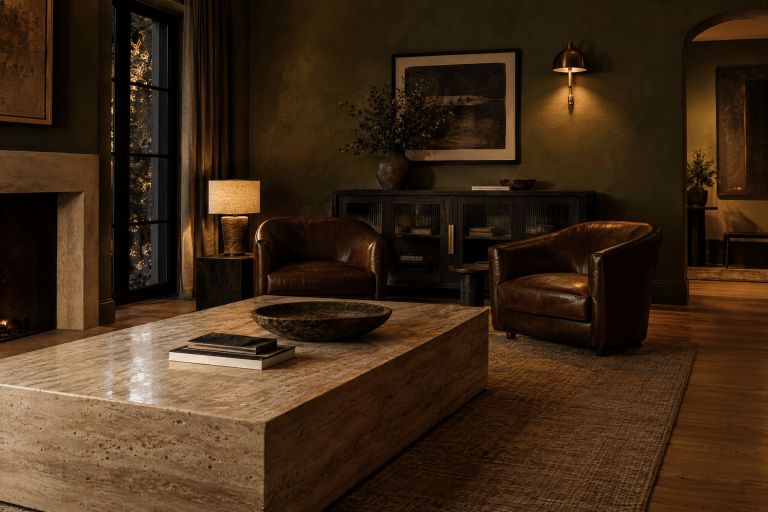
Glass reads visually light while showing every fingerprint, reflecting glare, and making edge visibility a genuine consideration. Stone brings weight, permanence, and hard edges. Wood forgives a great deal, though finish and care vary enormously from one piece to the next. An upholstered ottoman softens the center and takes feet happily, right up until the activity that needs a stable tray.
Settle the weight, the edge condition, the care requirements, and household safety before you buy. A table that cannot tolerate the people who use it is not refined. It is a maintenance contract with legs.
Storage can help or turn the center into an archive
Drawers, shelves, and lift tops will hold remotes, games, blankets, or work equipment. They will just as happily become the place unrelated objects go to disappear, because the room offered nothing better.
Assign the storage a specific job. If the shelf is for current books and games, keep it that way. If it becomes a stack of mail, spare cables, and objects nobody can identify, the table is revealing a broader storage problem.
Use Storage and Working Zones when the tabletop clutter is really a broken return path.
The center is allowed to be empty
If the room works better without a coffee table, that is a real answer rather than a failure to finish decorating. Side tables, movable ottomans, C-tables, or a tray on legs will cover the same activities and hand you back the floor for play, mobility, exercise, hosting, or simply an easier walk through.
Removing the table can also reveal whether the seating itself is arranged well. Sometimes the coffee table was acting as visual glue for furniture that was too far apart.
Run the one-week no-table experiment
Move the coffee table out for seven days. Watch what people miss and what they enjoy.
Watch for the specific things. Drinks become homeless. Conversation opens up. The children discover the floor. Somebody drags a side table into the middle every single night. Or the rug simply looks strangely empty, because the seating group has lost its center.
Those observations tell you the job the next table must perform—or confirm that the room never needed one.
If everyone walks around it, it lost
The coffee table earns its place when it makes the seating group more useful, more coherent, and easier to navigate. If everyone keeps walking around it, moving it, or piling it with objects that belong elsewhere, the choreography needs a new lead.
The center of the room is valuable territory. Give it to furniture only when the furniture knows what it is doing there.
Same problem, elsewhere in the house
Room notes
Keep the room on the record.
One useful note at a time: what to test, what to ignore, and what changed when the room got another vote.