Function and Flow
The Linen Closet Is a Volume Problem, Not a Folding Problem
A linen closet often fails because bulky categories compete for limited volume. Organize by frequency, container size, shelf height, and retrieval instead of perfect folding.

The linen closet is not failing because nobody learned a better folding method. It is failing because volume, frequency, reach, and category are fighting inside a fixed box.
When towels avalanche, sheets disappear into the back, and half the shelf is occupied by products nobody remembers buying, the first question is what the closet is being asked to hold and which items deserve the easiest space. Folding comes much later.
Measure the Volume You Can Actually Use
Shelf depth, height between shelves, door opening, trim, and the reach of the actual user determine usable capacity. A deep shelf can hold a lot and still be poor storage if the back half becomes an archive.
Measure the interior and note the zones that are comfortable to reach. Prime storage is the area that can be accessed without moving another category first.
The real capacity of a closet is whatever a tired person can reach without moving something else out of the way first. The rest is storage in the same sense that a loft is storage.
Inventory by use frequency
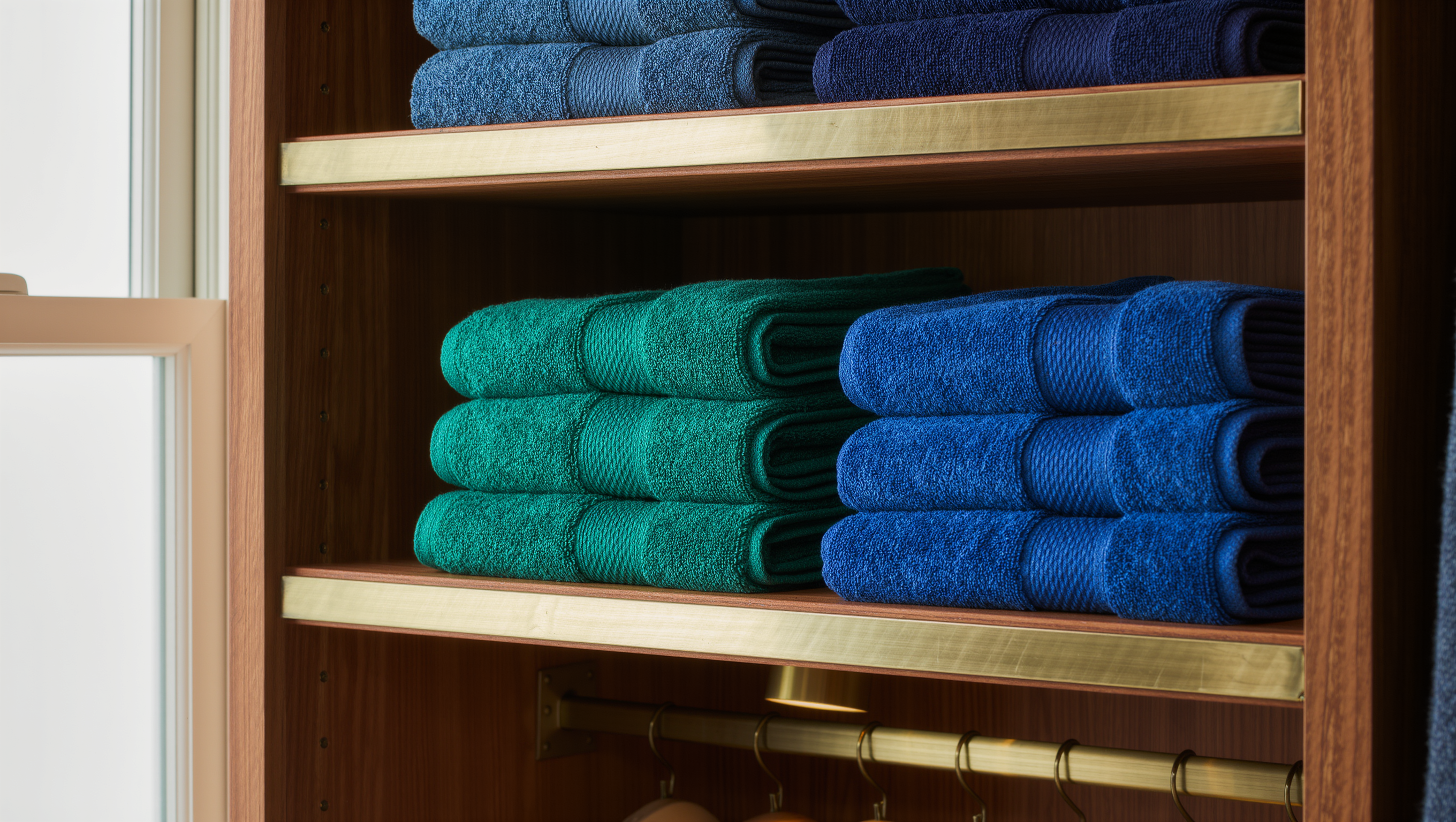
Daily and weekly linens belong in the easiest reach. Guest bedding, seasonal blankets, backup towels, and bulk supplies can live higher, lower, or deeper depending on how often they are needed.
Do not give the center shelf to rare-use inventory because it stacks neatly there.
Separate active sets from backups
Many linen closets become overfull because current-use items and long-term backups are mixed together. Decide how many sheet sets, towels, and other linens are realistically in active rotation.
Backups can be consolidated and stored less prominently. Excess beyond a useful backup level should be questioned rather than automatically accommodated.
Storage does not need to prove that every textile purchase was correct.
Deep shelves need front-to-back logic
When a shelf is deeper than the folded item, the back half needs a job of its own. Put lower-frequency items behind higher-frequency ones only where the front item can come out without dismantling everything behind it.
Bins and pull-out containers do help with small loose categories, but they bring their own volume and their own handling steps, and the handling steps are the expensive part. Test whether the container genuinely improves retrieval before buying six of them in a matching finish. A box is not organization if it turns access into excavation.
Do not stack higher than the reset can survive
Very tall stacks look efficient until one item is removed from the middle and the rest collapse. Keep stacks low enough that a normal user can retrieve and return an item without rebuilding the shelf.
This may mean adjusting shelf spacing or dividing categories into smaller stacks.
Sheet sets need a retrieval system, not a folding performance
Whether sheets are folded inside pillowcases, stacked by size, or bundled another way matters less than whether the household can identify and retrieve the correct set quickly.
Label sizes if necessary. Keep complete sets together. Avoid systems that require perfect folding to remain legible.
The closet should still work when someone is tired and putting laundry away late.
Bulky items may belong elsewhere
Large comforters, spare pillows, and seasonal blankets consume disproportionate volume. If they are used infrequently, another storage zone may be more appropriate.
Under-bed storage, a guest-room closet, vacuum storage where suitable, or another low-frequency area may preserve the linen closet for the items used regularly.
The linen closet is not obligated to store every textile in the house.
Household products need their own boundary
Toiletries, paper goods, cleaning products, and medical supplies often migrate into linen storage. If they belong there, define a specific zone and capacity so they do not slowly displace the linens.
Keep products safely stored according to their requirements and out of inappropriate reach where children or pets are a concern.
Mixed categories need stronger boundaries, not more shelf dividers.
The door and floor are part of the storage system
Over-door storage or floor-level baskets can add capacity, but only if they do not obstruct door operation, ventilation, access, or cleaning.
Use these areas for items that match their reach and weight. Heavy or frequently used items should not require awkward lifting.
Run a one-shelf reset
Do not reorganize the entire closet at once. Choose the most frustrating shelf, remove everything, and return only the items that belong to that frequency zone.
Use the shelf for a week. If retrieval and reset improve, apply the same logic elsewhere.
Folding was never the variable
Fold neatly if you enjoy it. Do not ask folding to solve a capacity problem. A full closet is full whether or not the edges line up, and the household re-proves that every laundry day until something leaves.
Use Storage and Working Zones for the larger storage framework or Small Interiors when the closet is part of a broader footprint problem.
Same problem, elsewhere in the house
Room notes
Keep the room on the record.
One useful note at a time: what to test, what to ignore, and what changed when the room got another vote.