Light and Atmosphere
When a Room Decides Who It Is
A room where six things are equally important is not eclectic. It is undecided — and the fix starts with a photograph from the doorway, not a purchase.
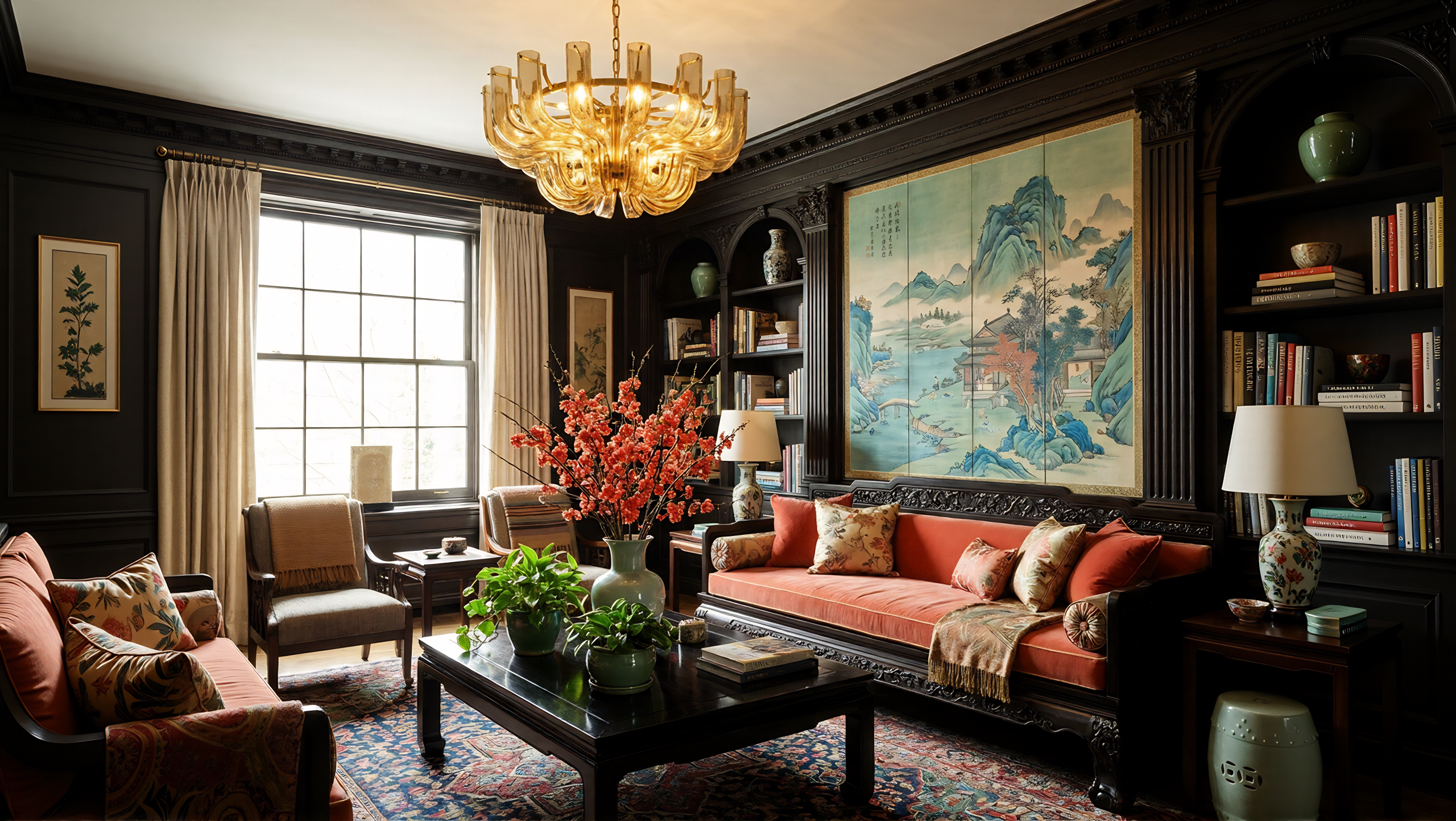
A room where six things are equally important is not eclectic. It is undecided, and everyone who walks in feels that long before they can name it.
The complaint usually arrives as a shortage. The rug is too small, the sofa was a mistake, the room needs one more lamp. It rarely does. Rooms of this kind — dark millwork, a strong upholstery color, a large picture, a light fitting with opinions — do not fail because something in them is wrong. They fail because nothing in them has been allowed to win.
So here is the verdict, before any fix: a room with no ranking does not work, and no amount of new furniture repairs it. Everything is at the same volume, the eye never lands anywhere, and what reads as busy is really just undecided. That is a behavior problem rather than a taste problem, which is the good news — behavior is much cheaper to change.
The free test, before anything gets bought
Stand in the doorway and take one photograph on your phone. Then look at the photograph instead of the room. A phone picture flattens the depth, drops the light down a stop and strips out the affection you have for individual objects, which is the whole point: the room stops being yours and becomes a flat image that either has a hierarchy or does not.
Then squint at it, or drop it into the Squint Test, which does the same thing arithmetically in your browser and never uploads the picture. Two answers come back. Either one shape holds the frame and everything else arranges itself around it, or you get an even field of mid-tone objects at roughly equal size. The second one is the diagnosis, and it costs nothing to reach.

Name the lead out loud
Pick the thing that gets to be the loudest object in the room and say it out loud. The picture, the millwork, the sofa, the light fitting. One of them. Naming it takes ten seconds and costs nothing, and most rooms have never had it done, which is why they keep getting solved by delivery van.
What follows from that is unglamorous. Everything else either supports the lead or gets quieter. Repeating the lead’s color somewhere small counts as support. Buying a second object of the same size and confidence does not — it just restarts the argument. If two things in a room are both trying to be the answer, the room has two answers, which is the same as having none.
This is also why copying a photograph rarely works. Buy the sofa and the dark millwork without the discipline that was holding them apart, and the room reads as costume. The restraint is doing more work than any single object in the picture; remove it and the boldness collapses into a furniture catalog.
The test, in one line
Photograph the room from the doorway. If nothing in the picture is obviously first, the room needs a decision, and then one object removed. Nothing needs buying.
So the move this week is not a purchase. Take the object that came second in your own ranking and put it somewhere else for seven days — the hall, another room, the top of a wardrobe. Not the tip. Then notice whether the room got easier to be in: whether your eye stops anywhere, whether there is somewhere obvious to put a cup down, whether you stop tidying it every time you walk past.
If it did, the problem was never the thing you were about to buy. If it did not, carry the object back in. That is the entire risk.
Same problem, elsewhere in the house
Room notes
Keep the room on the record.
One useful note at a time: what to test, what to ignore, and what changed when the room got another vote.