Light and Atmosphere
After Sunset, the Outdoor Room Finally Tells the Truth
Design outdoor lighting around routes, faces, food, planting, contrast, and atmosphere so the room remains useful and compelling after daylight leaves.
On this page
29
Daylight is extremely generous to weak outdoor rooms. It fills gaps, reveals the garden, and persuades the eye that the arrangement is more complete than it may actually be.
After sunset, the room has to explain itself. The path must remain legible. Faces need enough light for conversation. Food must be visible. Planting should create depth rather than become a black perimeter. The house, garden, and sky must negotiate which one is allowed to dominate.
The lights are half for indoors
With the garden dark, every window in the house shows you the room you are already sitting in. That is the strongest argument for putting any light out there at all — not the parties, which are rare, but the ordinary evenings when the glass could be showing you something else.
Begin with the route, not the atmosphere
Before considering lanterns or string lights, walk the ordinary path from the house to the room and through every necessary destination: steps, gates, seating, dining, grill, storage, waste, and the route back indoors.
Mark where a person needs to understand:
- a change in level or surface
- the edge of a step or platform
- which direction the path continues
- where a gate, latch, or door operates
- where an object might interrupt the route
- how to leave the room without crossing the darkest territory
Useful path lighting is controlled and directional. The goal is to make movement confident.
Build four layers of outdoor light

Route light
Low or shielded sources reveal steps, edges, and direction without becoming the visual event.
Task light
Focused light supports food, reading, cooking, cards, or the activity that gives the room its purpose.
Face light
Warm, controlled light near seated height allows people to see expressions without glare or theatrical underlighting.
Depth light
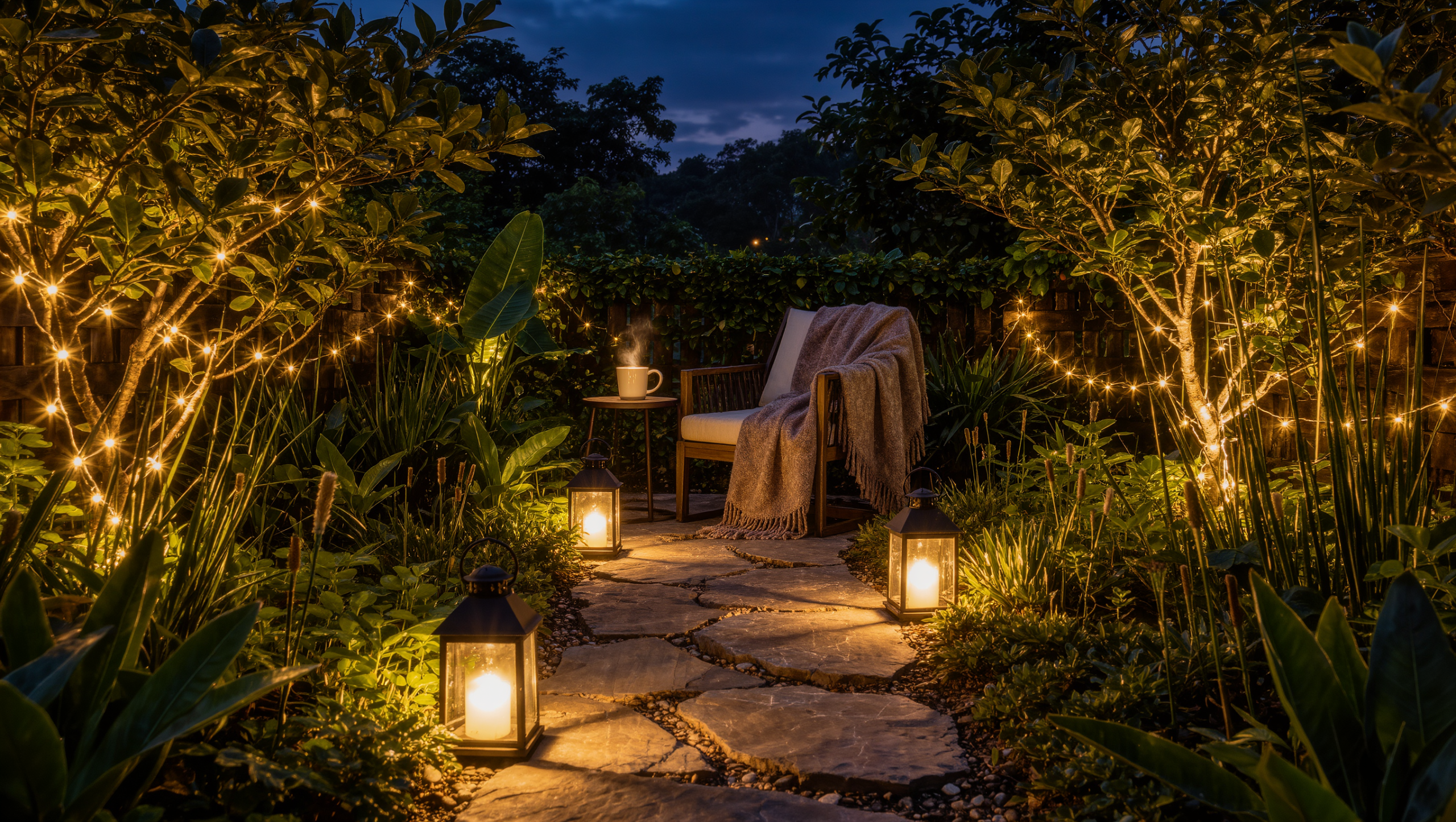
Illuminated planting, a wall, tree, structure, or distant focal point prevents the room from collapsing into a bright island surrounded by darkness.
Not every room requires four separate fixtures. One source may perform more than one job. The important distinction is the job, not the product category.
Design a lighting scene for the actual activity
The correct arrangement changes with what the room is doing. A dining table, reading chair, conversation court, and garden path need different emphasis even when they share the same footprint.
Dinner
Give the table enough light for food, hands, and faces while keeping the surrounding room softer. The brightest source should not sit directly in the sightline of seated guests.
Conversation
Use light near seated height, a soft source above or beside the group, and one distant point of depth. People should see expressions without feeling displayed.
Reading or making
Provide a focused source that reaches the page or work surface without spilling glare across the room. The switch or control should be reachable from the occupied position.
Arrival and movement
Reveal direction, changes in level, gates, and the first destination. The path should feel connected to the room rather than lit as a separate utility corridor.
A room can support several scenes with dimming, portable lamps, separate controls, or a limited number of sources assigned different jobs. One permanent setting rarely serves every use well.
Protect contrast instead of eliminating darkness
Atmosphere depends on variation. If every surface is equally bright, the room becomes visually flat and the sky disappears. If the social center is too bright, the surrounding garden becomes unreadable. If the background is entirely dark, the room can feel exposed even when it is physically enclosed.
Use brighter light where precision is needed and lower, softer light where people linger. Let some planting remain in silhouette. Light one important trunk, wall, or hedge rather than attempting to reveal the complete inventory.
Darkness is not a lighting failure. Uncontrolled glare and missing information are.
Put the source where the body needs it
Fixtures selected for appearance often fail because their height, shade, direction, or position does not support use.
- A bright source behind a seated person can turn every face across the table into shadow.
- An exposed bulb at eye level can make the room uncomfortable even when the overall light level is low.
- Overhead light alone can flatten faces and leave surfaces dim.
- Light aimed upward may reveal planting beautifully while failing to show the step beneath it.
- A portable lamp may solve a conversation zone more gracefully than another permanent wall fixture.
- A fixture mounted too high may illuminate the air while leaving the activity unsupported.
Sit in every seat and look toward every major source. Outdoor lighting should be evaluated from occupied positions. Nobody spends the evening standing in the doorway.
Use warmth, direction, and shielding deliberately
The experience of light depends on more than brightness. A warmer source can make food, skin, wood, and planting feel intimate. A cooler or harsher source can feel useful near a task and clinical in a conversation room. Direction and shielding determine whether the light reveals the room or announces the fixture.
Aim light toward the surface or element that needs it. Shield the source from direct view where possible. Use reflected light from walls, ceilings, canopies, and pale surfaces to soften the room. Avoid mixing many unrelated light characters unless the contrast is doing a job.
A patio lit by a cool floodlight, a warm lantern, a color-changing strip, and a row of solar stakes holds four separate opinions about what time it is. Choose one character of light for the room and make every exception earn its place.
Let planting create depth after dark
Planting gives the eye somewhere to travel beyond the immediate seating area. Choose a few layers rather than illuminating the complete garden.
Foreground
Keep nearby foliage mostly soft and shadowed. A small pool of light may reveal texture without placing a bright source beside the seat.
Middle distance
Light a hedge plane, branching shrub, planter group, or wall to establish the room’s edge. This can make the occupied zone feel protected.
Far point
Reveal one tree, sculpture, gate, water surface, or architectural fragment beyond the room. A distant point of light expands perceived depth and prevents the room from becoming an isolated island.
Check how leaves move in wind and where shadows fall. Moving shadow can create life. It can also create confusion on steps and routes if the placement is careless.
Let the house participate without taking over
Interior windows and doors often become large luminous surfaces after dark. They can support orientation and visual connection, but they can also overpower a carefully lit outdoor room.
Stand outside while the interior is operating normally. Notice whether kitchen light, television glow, or a bright hallway becomes the dominant focal point. Quite often the brightest thing in the garden turns out to be the refrigerator, framed by the kitchen window like a museum piece. Dim the interior, draw a shade, or give the outdoor room one lit surface strong enough to hold the eye against it.
Also consider reflection. Large windows may mirror bright outdoor sources back toward seated guests or make the interior difficult to see. Move or shield the source before assuming the glass is the problem.
Plan controls around ordinary use
A beautiful lighting plan can fail because the controls are inconvenient. If several switches are scattered inside, a portable lamp must be carried out, or the room requires a phone application no guest understands, the room may remain dark.
Arrival control
The route and first destination should be easy to activate before anyone steps into darkness.
Occupied control
Conversation, task, and portable sources should be adjustable from or near the room rather than requiring repeated trips indoors.
Scene control
Separate practical light from atmosphere so one can change without sacrificing the other.
Shutdown
The final person leaving should be able to confirm that temporary, task, and decorative sources are off without touring the entire property.
Permanent electrical work, exterior-rated equipment, and installation should follow applicable professional and manufacturer guidance. The thinking comes first, and it costs nothing: identify the jobs, positions, glare problems, and scenes before any source gets wired in for good.
Respect neighbors, windows, and the wider night
Outdoor light does not remain politely inside the room. It can reach neighboring windows, the street, upper floors, and the sky.
Use the lowest effective intensity, direct light downward or toward intended surfaces, shield visible sources, and test the room from outside the property where possible. A source that feels modest from the seat may be glaring from a bedroom across the way.
Good restraint usually improves the room. Less spill preserves darkness, makes focal light more effective, and allows the sky and garden to remain part of the experience.
Adjust the plan through the seasons
Plant growth, leaf loss, snow, stored furniture, longer nights, and changing use alter the lighting composition.
Summer
Dense foliage may absorb or block sources. Longer evenings may require only late-night layers. Insects may gather near exposed light, affecting where fixtures belong.
Autumn
Lower sun, earlier darkness, and changing foliage reveal new surfaces. Warmth and the retreat route become more important.
Winter
Bare branches, reflective snow, empty furniture zones, and interior views may dominate. Reduce glare and let structure, trunks, and architecture carry the scene.
Spring
Recheck aim and visibility after plant growth begins. A source that worked through winter may become hidden or create unexpected shadow.
Add one source at a time and stop when the room works
01
Turn everything off
Begin in actual darkness. Walk the route and record the first point where information is missing.
02
Add one portable source
Place it where it solves the route, task, face, or depth problem. Use the room for at least twenty minutes.
03
Add the second layer only when needed
Do not distribute light symmetrically by habit. Add it where the room loses clarity, comfort, or depth.
04
Photograph from the occupied view
Use the image to detect glare, overly bright sources, black voids, and competing focal points. Then return to the seat; the camera is evidence, not the final judge.
When everything is lit and nothing is visible
- Every fixture is visible and every source competes for attention.
- The path is bright but faces and food remain unreadable.
- The table is overlit and the garden disappears.
- String lights create a ceiling but no task or route support.
- Planting is lit from one flat direction and loses depth.
- Interior windows become brighter focal points than the outdoor room.
- Controls are inconvenient enough that only the default bright setting is used.
- Light spills into neighboring windows or across the wider property.
Continue after dark
Light the room, not the inventory
Light the faces, the route and the food. The rest of the garden has been managing at night without assistance for its entire life.
Same problem, elsewhere in the house
Room notes
Keep the room on the record.
One useful note at a time: what to test, what to ignore, and what changed when the room got another vote.