Outdoor Rooms
This Balcony Has No Interest in Acting Small
Make a small balcony behave like a complete outdoor room through clear circulation, deliberate scale, exposure-aware planting, compact furniture, concealed maintenance, and one strong visual move.
On this page
9
A balcony is the only room in the building where everything you set down is also something that could fall on somebody. That single fact governs more of the design than the square footage does, and it is why balcony advice written as though it were a small patio goes wrong so reliably.
These spaces work when view, boundary, wind, sun, weight, access, furniture and maintenance are treated as one system, because out here they genuinely are one system. They fail when miniaturised indoor furniture logic gets pushed through a glass door. The floor is small. The thinking should not be.
Pick one use and give it the best of everything
Breakfast, reading, a two-person conversation, containers, evening drinks, a small work spot — any of these can be excellent. Attempting dining and lounge and garden and storage and exercise on a narrow balcony produces a storage aisle with cushions on it, which nobody sits in and everybody edges past.
So choose, and then be generous about the choice. The primary use takes the best view, the best shade, the clearest circulation, and everything else folds around it lightly or stays indoors. A balcony with one thing done properly reads as luxurious. A balcony with four things done adequately reads as a corridor.
Measure the operating footprint
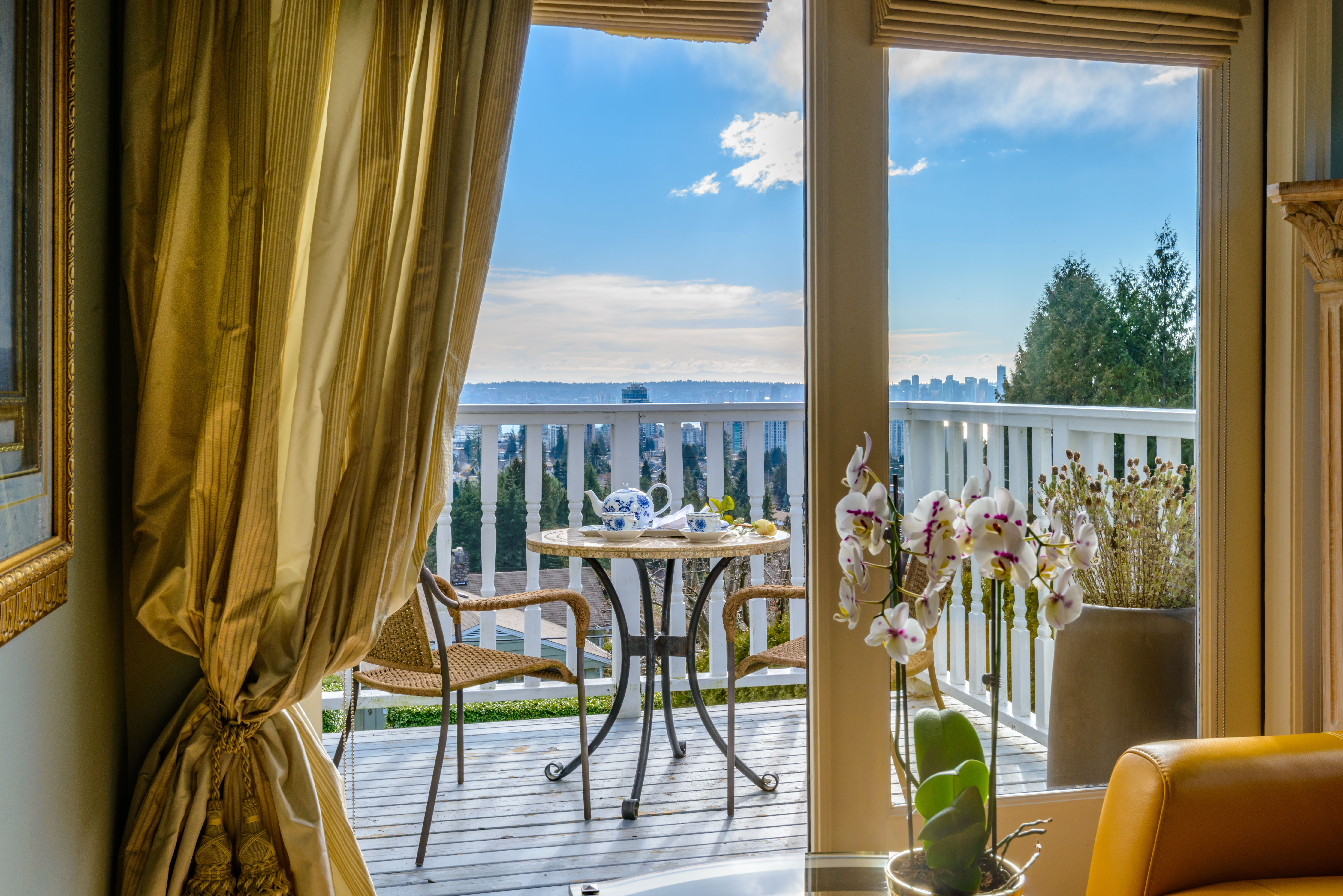
Measure the chair pulled out, not the chair pushed in. That is where most balcony plans quietly die. Chairs move, doors swing, people stand up and turn around and come through from inside with both hands full. A café table that sits beautifully against the rail on paper can make the door unusable the moment two people are actually seated at it.
Tape the occupied seat positions onto the floor and walk the route several times, including the version where you are carrying something. The threshold especially has to stay clear for food, cushions, a watering can, and everything else that crosses it, because that transition happens every single time the space gets used.
Do not let the most photogenic chair become the object everybody negotiates at the door. It will be shoved aside permanently inside two weeks, and then the plan is whatever happened by accident.
Gravity has a vote, and so does the building
Read this section plainly. It is the one with consequences outside your own household.
Elevated spaces can experience stronger or more turbulent wind than ground-level patios. Lightweight chairs, umbrellas, decorative objects, and tall plants may move, tip, or become hazards.
Observe wind patterns before relying on loose textiles, freestanding screens, or tall narrow containers. Rooftops in particular may require professional structural and wind considerations for permanent elements.
Large planters, wet soil, stone, water features, furniture, and built structures can be heavy. Do not assume the platform can carry any load because outdoor space exists there.
Building rules, structural capacity, waterproofing, drainage, fire safety, and access may all affect what is permitted. Verify requirements with building management or qualified professionals before installing heavy or permanent elements.
None of that argues for a timid design. It argues for finding out the answer before buying the stone planter, rather than afterward, with it already standing full of wet soil on a surface nobody has assessed.
The perimeter is the cheapest space you own
Every inch of boundary is vertical area that costs nothing in circulation. Privacy screens, narrow planters, trellis, light, or simply a strong color on the wall will do more for a small balcony than any piece of furniture can, because they change the enclosure instead of filling the middle.
Do not attach items to rails, facades, or building elements without permission and appropriate secure installation.
Comfort first, and the small set is usually a trap
Tiny folding chairs are not useful, because nobody wants to sit in them. That is the entire review. A balcony set of four miniature chairs around a table the size of a dinner plate is sold as the answer to a small space and functions as a reason to stay indoors. One genuinely comfortable chair, with a table big enough for a cup, a book and a glass at the same time, gets used every day of the season.
After comfort, the tests are proportion to the activity and whether one person can move the piece alone when the weather turns. Anything too heavy to shift and too light to stay put in wind has managed to fail in both directions at once.
Plants, and the arithmetic of pots
A row of small pots along the edge steals the route and reads as clutter from inside. One tall planter, a trellis, a wall-mounted system where it is permitted, or a single tight group of containers gives far more garden presence for far less floor. Choose for the conditions that actually exist up there: sun, wind and exposure at height can be considerably harsher than the same address at ground level, which is why balcony plants die faster than their labels promise.
Then the arithmetic nobody enjoys. Small pots dry out fast, sometimes daily in high summer, and a balcony needing water twice a day in August will get watered once. Large containers hold more soil and stay moist far longer, and they add weight, which sends you straight back to the paragraph about the building. Every container needs drainage, reachable water, and somewhere for runoff to go that does not stain the surface or land on the neighbors below. Container Choreography handles the composition itself.
Everything overhead is a sail
Umbrellas, sails, and other shade devices can catch wind. Use systems appropriate to the site and follow building rules and manufacturer guidance. On an exposed balcony that is not a formality — an umbrella is a sail with a stick attached, and it only has to leave once.
Which points at an answer most articles avoid giving. Sometimes the right move is to use the space during the hours it is naturally comfortable and skip the shade altogether, rather than forcing a permanent shade structure into a position that cannot hold it. Morning balconies and evening balconies are both legitimate. Not every outdoor space has to work at two in the afternoon.
After dark, low lamps, lanterns, wall sources, or string lights where permitted and safely installed will carry the room. Keep glare and light spill restrained, and use outdoor-rated equipment. Permanent electrical work requires qualified installation. Restraint is courtesy to the neighbors, but it also changes the room: a balcony lit softly reads as a room, and a balcony lit brightly reads as a fire escape.
Count the objects you carry out
If using the balcony begins with carrying six cushions, a watering can and a lantern through the apartment, it has stopped being a spontaneous decision and become a small project. Projects get scheduled. Scheduled things get postponed.
Either give the kit weather-appropriate storage out there, where the site allows it, or reduce the number of objects that need deploying at all. The second is the unfashionable option and usually the better one, because a balcony you can use in the ninety seconds between getting home and wanting to sit down is worth considerably more than one that photographs well on a Sunday.
What it looks like when nobody is sitting out there
If the view is the balcony’s strongest asset, stop decorating the perimeter and let it work. Seating faces it, the foreground stays quiet, the boundary does as little as it can get away with. Where the view is poor or the privacy is thin, screen strategically instead of enclosing every edge — a balcony walled in on four sides is a very small room with weather in it.
Then decide now what the space looks like during the months it is not being used, because a balcony is visible from inside all year and a small one has nowhere to hide neglected equipment. Covers, dormant containers, wind, snow, rain, weeks of heat: some of it stays, some of it stores, and anything with no answer becomes the view from the sofa in February.
Same problem, elsewhere in the house
Room notes
Keep the room on the record.
One useful note at a time: what to test, what to ignore, and what changed when the room got another vote.