Outdoor Rooms
Container Choreography: Stop Lining Up Pots Like Suspects
Compose container gardens through fewer larger vessels, clear scale hierarchy, repeated materials, compatible plants, working drainage, and enough open space to keep the architecture visible.
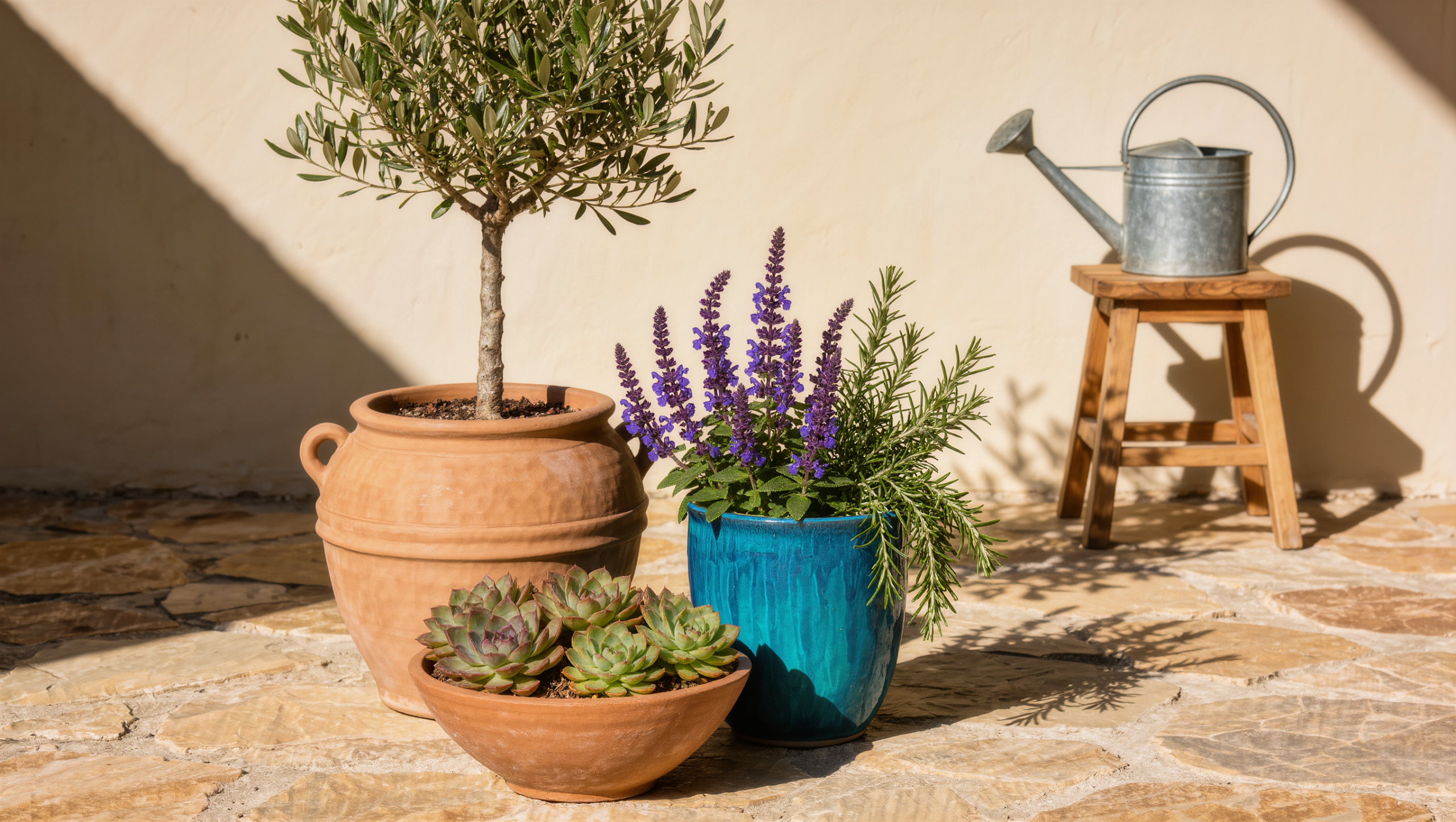
Stop lining up pots like suspects.
Containers are useful because they can create planting where ground is unavailable, define a room edge, add height, move seasonally, and concentrate care. They become clutter when every plant receives an individual pot and every pot receives equal visual authority.
Container design is choreography: scale, grouping, repetition, placement, drainage, weight, and the route around them.
Pick the job, then pick the anchor
Privacy, entry emphasis, seasonal color, edible planting, a soft boundary, height, one garden moment — all legitimate jobs, all requiring different pots. Choose the job first. A group asked to create privacy needs height and mass; a group decorating a table needs neither. The two get bought in the same aisle by the same person on the same afternoon.
Then choose the anchor before anything else: the largest or strongest pot, the one that sets the scale for everything around it. Skip that step and you end up with several objects of roughly equal importance competing politely for attention, which is the visual equivalent of a meeting where everybody has a vote. Place the anchor where it does structural work — strengthening a corner, a doorway, a view, the edge of the seating.
Use fewer, larger containers where the space can support them
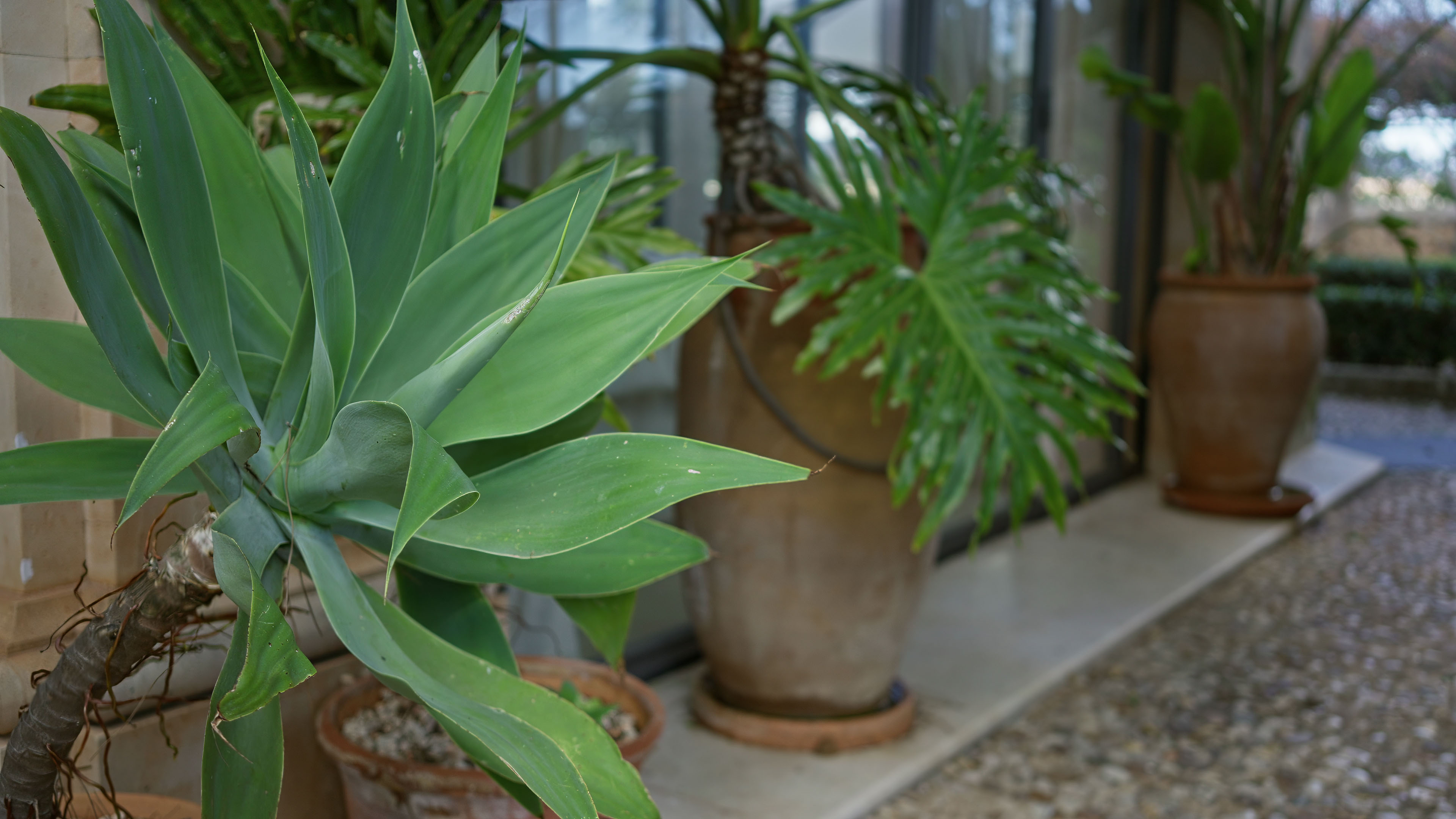
One substantial planter can carry more visual weight and often hold moisture longer than several tiny pots.
Large containers also add weight and can be difficult to move. Check the site, structure, drainage, and access before choosing oversized pieces, especially on balconies, rooftops, decks, or upper levels.
Three rules decide whether a group reads as one thing
Vary the height, but not evenly
Plant form, stable stands, and container height build a loose rhythm between them. What kills it is making every pot a slightly taller version of the one beside it. Six evenly graduated containers is a staircase; the eye walks up it and leaves. One high element, one broad middle mass, and one low spill will give more depth than any number of careful increments.
Repeat one thing, whatever it is
Pots can differ wildly in shape and still read as related through material, color, glaze, rim detail, or the plant palette. A single shared thread is enough. Without one, a mixed group looks like every pot was purchased during a different emergency, which is usually the literal truth.
Do not match all of it
A fully matching set reads rigid and retail, like the display it was lifted from. Mix compatible shapes or finishes and keep that one visual thread running through them. The strongest groups look collected. The weakest look ordered.
Water has to go somewhere, and so do you
Containers need drainage and care suited to the plant, the material, and the site. Decorative cachepots may require liners or some other plan to keep water off whatever they are standing on. Do not let runoff stain paving, damage timber, create slippery surfaces, or drip onto neighbors below. That last one is not an aesthetic question and it does not get solved by moving the pot four inches to the left.
Care compatibility matters as much and gets checked far less. Plants with similar light and watering needs are enormously easier to keep alive together, and on an exposed patio or balcony, where every container shares one set of conditions, it decides whether any of them survive. Build a beautiful group out of plants that want radically different things and you have not made an arrangement. You have made a rota.
Containers can build walls. Not all of them
Large planters will define a dining area, screen a utility view, or create privacy without anybody pouring a footing. Leave room for mature growth and for people, though. A screen of containers that narrows a comfortable route into a passage has traded one problem for a worse one, and the plants get blamed for it within a month.
The related failure is the creeping perimeter. Container gardens spread along every wall and every railing until the outdoor room is hemmed in on four sides with nowhere for the eye to rest. Concentrate the planting into groups and leave deliberate gaps. The empty stretches are what let the planted masses read as masses, and they shorten the watering route, which matters far more in August than it does in May.
The arrangement has to survive the plants succeeding
A small shrub, grass, vine, or perennial will outgrow whatever space was allocated to it, and faster than the label implies. Check mature width, height, root requirements, and maintenance before buying. A composition that works on planting day and fails in year two was never a composition. It was a snapshot.
Seasonal change belongs in one or two pots, not in all of them. Let the large structural containers stay put and stay stable, and use a small number for the short-lived color. Rebuilding every container three times a year is a perfectly good hobby and a terrible default.
Design the watering route
Can a hose, a watering can, or an irrigation line reach the group without crossing the seating or being dragged over the plants? Walk it before the pots are full and too heavy to reconsider.
Put the thirstiest containers where the care is easiest, not where they look best. A route that is mildly annoying in April becomes unbearable in July, and the planting always shows it before the person does.
Know when to edit
If pots block the route, create constant watering, look underscaled, or repeat the same role, remove or consolidate them.
A container collection is not improved by the number of containers it has successfully accumulated.
One composition, not a lineup
All of this is in service of one planted composition with a job, rather than a row of individual pots standing at intervals waiting to be judged. Scale, one repeated element, compatible care, and real empty space are what get you there.
And then it has to hold without heroics. A group that looks magnificent the week it is assembled and ragged by the second heatwave was assembled for the photograph, not for the summer.
Same problem, elsewhere in the house
Room notes
Keep the room on the record.
One useful note at a time: what to test, what to ignore, and what changed when the room got another vote.