Furniture and Scale
Beata Heuman: Whimsy Works When the Room Still Has Ground Under It
Beata Heuman is useful to study because her whimsical interiors stay grounded in setting, contrast, hierarchy, function, and one or two highly specific moves rather than decorative noise.

A scalloped headboard, brass sconces, and an emerald wall sound like a lot until you notice the vanity table still has clear reach, the mirror still catches the right light, and the chair still has somewhere to go. That’s the actual Beata Heuman lesson: the whimsy is load-bearing, and everything underneath it is still doing its job. Her rooms hold unusual color, theatrical headboards, painted detail, historical reference, and custom pieces that would sound eccentric described one by one — and they hold together because the basic mechanics aren’t also trying to be clever.
History gets redrawn, not reproduced
Heuman treats historical forms as raw material rather than rules — a familiar furniture type gets redrawn, a conventional pattern arrives in a color that refuses to behave, a headboard becomes architecture. Her Scandinavian background and the studio’s attention to flow keep that freedom from drifting into period-room cosplay: the past contributes proportion, craft, and oddness without asking the present to dress for it. Tradition stays alive when it’s allowed to mutate.
Setting is what keeps a strange move from reading as pasted-on — a scalloped edge in a small bedroom or a painted detail in a passage feels inevitable when it responds to the room around it. The same gesture dropped into an unrelated room looks like the design equivalent of wearing a fascinator to buy groceries. Before adding the strange thing, find what in the room is giving it permission.
Whimsy, checked into a hotel
The hardest place to test a whimsical method is a hotel, and Heuman took the test. Hôtel de la Boétie opened in the eighth arrondissement of Paris in September 2023 — her first hotel, forty rooms — and a hotel guest is the least forgiving audience a designer can be handed. They did not choose any of it. They arrive after a delayed flight with a suitcase and no goodwill whatsoever. Nobody is standing there to explain that the lamp is meant to be funny.
What she did with the building is the instructive part, because almost all of it is structural rather than decorative. The nineteenth-century marble entrance, the elevator and the staircase were kept. The floors were then separated by color — deep glossy blue low down, browns through the middle, pale blues at the top — so a guest half-asleep in a corridor knows which floor they are on without reading a sign. That is wayfinding disguised as a palette, and it is exactly the sort of unglamorous job people forget color can be given.
The headboards, for what it is worth, were drawn from inlaid marble floors in the Medici chapel in Florence, hand-woven as wool kilims and then upholstered. That is the eccentric bit, and note where it landed: on the one surface in a hotel room that is already load-bearing for the whole composition, and that nobody has to walk around.
Function is what earns the fantasy its freedom
A whimsical room that’s difficult to use is an inconvenience wearing a charming hat. Circulation should stay legible, the chair should still have a lamp if it needs one, the storage should open, the odd cabinet should hold something or carry enough visual authority to justify its footprint. When the basic function is boring enough to work, the decorative layer gets much more freedom — the room can tolerate a theatrical ceiling because nobody’s also squeezing around a badly placed sofa to reach the door.
That’s why concentration beats accumulation. The weak version of playful design is a pile of charming gestures — scallops, painted furniture, novelty lighting, one more little surprise because the first six needed moral support. The stronger version puts the whole idea in one place: a headboard becomes the event, a ceiling takes the risk while the furniture stays quiet. Concentration gives the unusual element authority, and it gives the room somewhere to rest. The same logic applies to pattern — rank it instead of counting it. If every pattern thinks it’s the main character, the room has stopped being whimsical and started filing noise complaints against itself.
Do not start with the scalloped edge
Whimsy is exceptionally vulnerable to imitation because its surface vocabulary is easy to recognize — one scalloped edge or animal-shaped lamp can become costume with no relationship to the room’s architecture or use. I would not start with the whimsical object. I’d start with the room’s strongest ordinary need, solve it cleanly, and then decide where one imaginative intervention could give that solution an identity. The surprising move should sharpen the room’s character, not sabotage the floor plan.

One more reason this designer is unusually worth studying rather than merely liking: she has written the method down. “Every Room Should Sing” came out in March 2021 and a twenty-lesson BBC Maestro course followed in January 2025. You can therefore check whether the whimsy is a system or a personal taste, which is more than can be said for most of the work that gets copied. Read the reasoning and the scallops become optional. Skip the reasoning and the scallops are all you get.
Source: Beata Heuman’s official site and studio background, including its stated design philosophy, her book “Every Room Should Sing” (March 2021) and her January 2025 BBC Maestro course; Sight Unseen’s coverage of Hôtel de la Boétie, her first hotel, which opened in Paris in September 2023; House & Garden’s Beata Heuman style file.
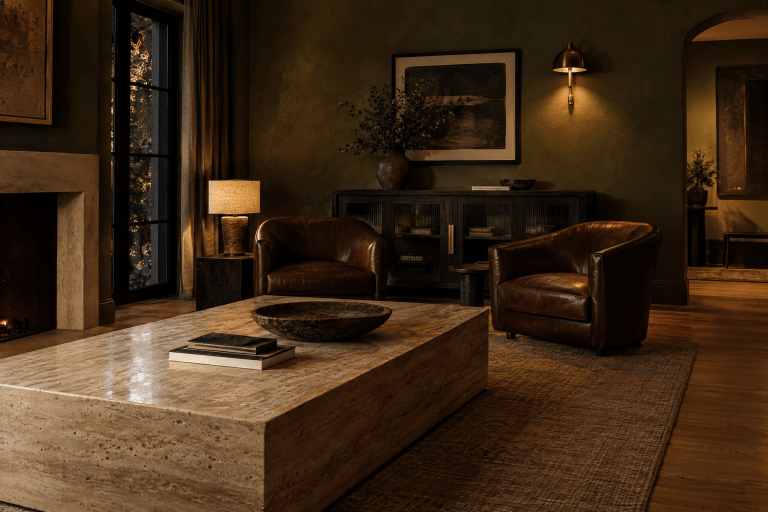
Designer study. This concise study is part of Designers Worth Studying, the deeper Room for Drama index for what to borrow, what not to copy, and how each idea survives an actual room. Photographs in this series are Room for Drama’s own illustrative images, not photographs of the designer’s projects.
Same problem, elsewhere in the house
Room notes
Keep the room on the record.
One useful note at a time: what to test, what to ignore, and what changed when the room got another vote.