Furniture and Scale
Rose Uniacke: Restraint Can Be More Dramatic Than Filling the Room
Rose Uniacke is useful to study because her quiet rooms prove that drama is not density: proportion, patina, light, material contrast, and active empty space can carry the room.
A pale room with one bronze vessel in a plaster corner has nowhere to hide a mistake. That’s the case for Rose Uniacke as a Room for Drama reference, even though her rooms are quiet, sparse, and sometimes almost severe. Visual power and visual volume aren’t the same thing, and restraint done well makes every remaining decision more accountable, not less.
Editing is not the same as emptying
Minimalism’s obvious failure mode is that calm starts to look like nobody finished the room. Uniacke’s version avoids that because simplicity is supported by material depth, historic objects, and furniture with enough scale to stand alone — her background in antiques and restoration means worn timber, aged metal, textured plaster, and handmade surfaces bring irregularity into otherwise controlled rooms. The space can be spare without feeling freshly sterilized. Call it editing with consequences, which is a far more demanding discipline than minimalism as a purity test.
Twelve tons of staircase, and you barely notice it
Her own house in Pimlico is where the studio published what the quiet actually cost. The building went up as a studio, gallery and home for an artist, was later carved into a small house plus four apartments, and carried a staircase installed after wartime bomb damage that had nothing to do with the architecture around it. Turning it back into a single dwelling meant, among other things, a twelve-ton cantilevered stone stair and plasterwork and moldings restored by hand.

Notice what that money bought. Not a feature, not a moment, nothing you could photograph as a highlight. It bought the absence of a wrong note in a house where there is nothing else in the frame to pull your attention off one. That is the line item missing from every pale-room shopping list, and it decides whether the result reads as serene or as underfurnished. Sparse rooms are the most expensive rooms in the world to get right, because every junction, edge, proportion and surface is fully exposed with no pattern anywhere to carry it.
That is also the honest bad news for anyone reading this in a rental apartment with a builder-beige hallway. You cannot get to that stillness by owning less. You can get a surprising distance, though, by repairing the three junctions your eye already snags on — the baseboard that dies into nothing, the switch plate set an inch too high, the door that will not sit square in its frame — before removing a single object. Fix the sentence structure before you cut words.
Empty space needs something worth protecting
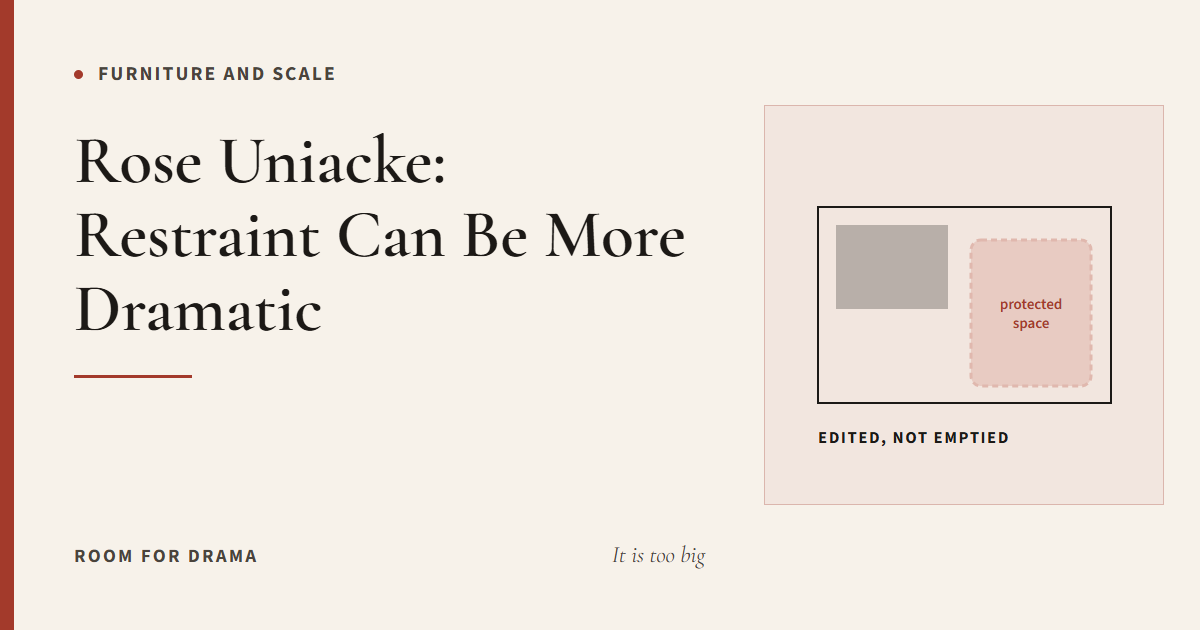
Space around an object is part of the composition — an antique table, a fireplace, a sculptural light can carry more authority because the wall and floor around it aren’t packed with backup performers. But empty space is only useful when it clarifies what matters; it’s not useful when it just exposes that nothing in the room has enough presence. Before removing half a room in pursuit of serenity, identify the element that deserves the space being created. If there’s no answer, subtraction alone won’t manufacture one.
Proportion becomes impossible to fake once the room is this quiet. Layered rooms can absorb a slightly underscaled table because pattern and objects keep the eye moving; restrained rooms can’t — scale is suddenly standing under a bare bulb with nothing to hide behind. A large room may need a genuinely large table or light rather than several smaller pieces trying to average their way into authority.
Age is material, not a theme
Worn wood, softened finishes, and surfaces that show time introduce variation a newly manufactured neutral room often lacks — which is why copying the palette misses the point. Pale plaster plus one old chair isn’t a method; the older element has to contribute scale, texture, or contrast, or it’s just an expensive prop in an unusually quiet room. At home, the principle can be modest: keep the scratched table that’s earned its place, and don’t replace every irregular surface just because a catalog has trained the eye to expect perfection.
Light does more work here too. Pale walls receive changing daylight, rough plaster reveals small shadows, old timber warms as the sun moves — a severe line can soften by evening without anything in the room physically changing. Judge a restrained room in morning, afternoon, and evening light before deciding the answer is another beige object. If it only works for fifteen photographic minutes, the calm is on a very limited contract.
Emptiness is not a strategy on its own
Restraint can become expensive emptiness remarkably quickly — pale walls, linen, a single antique chair, and acres of floor don’t automatically create tension or sophistication. I would not copy the quantity of emptiness before checking whether the architecture, light, and remaining furniture are strong enough to justify it. The lesson isn’t “own less.” It’s “remove competition after the room has a strong idea,” and that sequence is the part people skip.
Restraint is neither the cheap option nor the safe one. It is the option with the fewest places to hide, and it punishes an underscaled table, a badly hung door and a mean ceiling height harder than any amount of pattern ever will. If the architecture and the light are not strong enough to carry an empty wall, giving the room a beautiful empty wall does not fix anything. It makes the weakness larger, and quieter, and considerably more expensive.
Source: Rose Uniacke’s studio site and biography, including her essay on the studio’s approach to interiors and its project page for her own Pimlico house; Architectural Digest’s AD100 profile.
Designer study. This concise study is part of Designers Worth Studying, the deeper Room for Drama index for what to borrow, what not to copy, and how each idea survives an actual room. Photographs in this series are Room for Drama’s own illustrative images, not photographs of the designer’s projects.
Same problem, elsewhere in the house
Room notes
Keep the room on the record.
One useful note at a time: what to test, what to ignore, and what changed when the room got another vote.