Materials, Color & Finish
The Bedroom Begins With One Enormous Textile
Build a bedroom around one oversized textile—rug, curtain, canopy, quilt, or wall hanging—then let color, scale, lighting, and quieter supporting pieces follow its lead.

The bedroom can begin with one enormous textile.
Not twelve pillows, three throws, a tiny patterned rug, and several nervous accessories all trying to say something different. One textile with real scale—an upholstered headboard, wall-hung fabric, a canopy panel, curtains, a bedcover, a large rug—can establish color, softness, pattern, and proportion before the room even starts collecting smaller ideas of its own.
Choose the textile by the job it needs to do
A headboard textile creates a focal wall and tactile softness. Full-height curtains add vertical scale and control light. A large rug can gather the bed and take the edge off a hard, echoey room. A canopy or wall hanging can create enclosure where there wasn’t any before. Don’t start with a pattern purely because it’s beautiful—decide whether the room actually needs height, warmth, color, acoustic softness, visual focus, or a stronger bed zone, and let the textile solve that specific problem at a scale big enough to matter.
Scale is the whole point
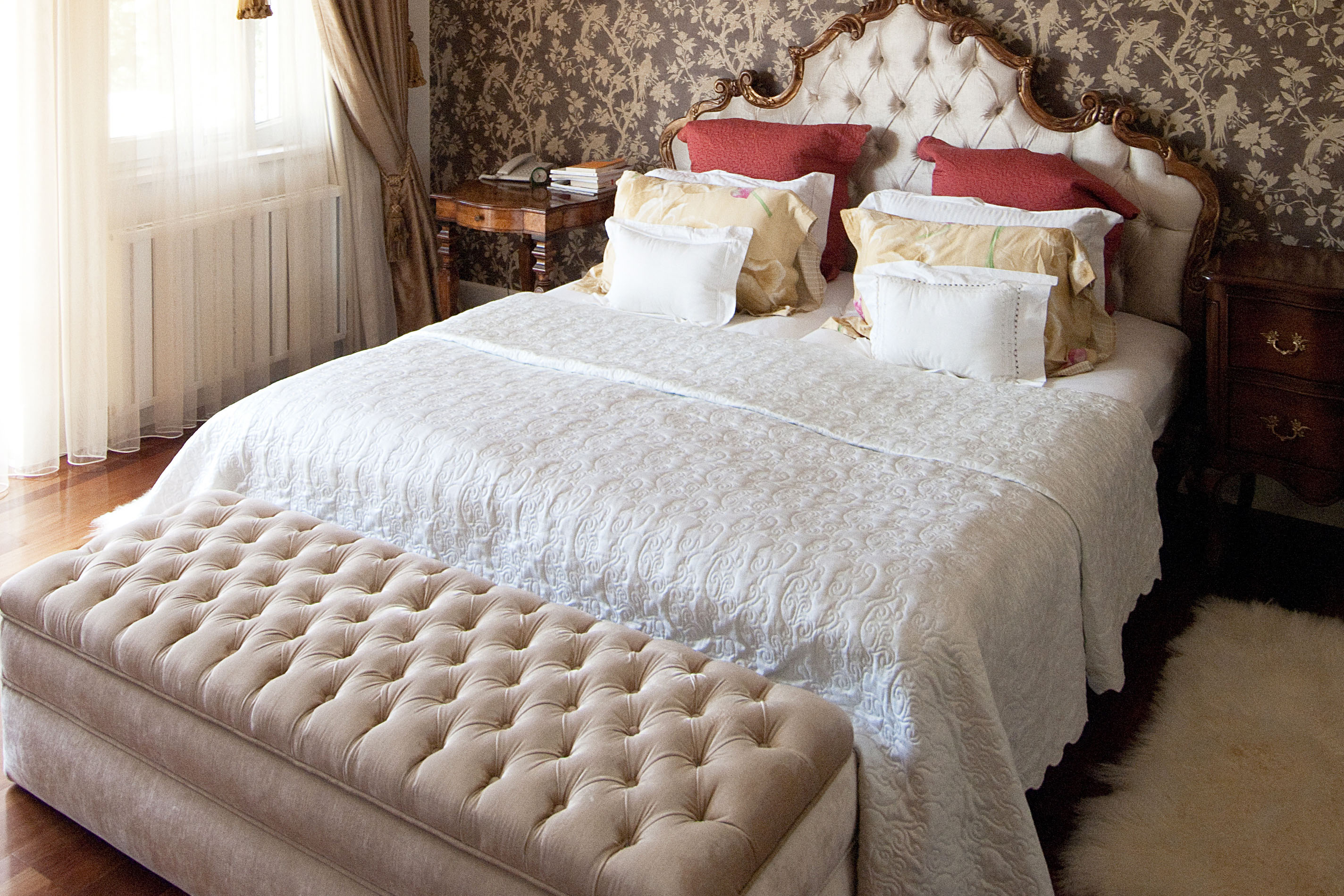
A small patterned cushion introduces a motif. A large textile changes the room entirely. Let the material occupy enough area to feel architectural: curtains need enough width and height to read as a field, a headboard can be wider than the mattress itself, a wall hanging can command the vertical plane instead of floating there like a decorative afterthought nobody committed to. Boldness gets calmer, oddly enough, when it’s concentrated in one place instead of spread thin.
Use pattern with a hierarchy
If the large textile is patterned, let it actually lead. Supporting bedding, rugs, and smaller upholstery can be simpler or work at different scales entirely. Repeating the same pattern size across several surfaces just makes the room noisy. A large floral or stripe can coexist happily with small checks, solids, texture, or one quieter secondary motif. The room needs a dominant pattern story, not a fabric sample meeting that never adjourns.
Let color spread outward from the textile
Pull two or three useful colors from the main textile and assign each a different role—one might become the wall color, another a smaller accent, another the wood or metal relationship in the room. Don’t distribute every color equally just to be fair to all of them; let the textile carry the complexity while everything else edits itself down. This is especially handy when you’re building a room around a fabric you love: let the textile do the hard palette work once, so you don’t have to keep making the same decision six more times.
Texture matters even without pattern
Velvet, wool, linen, cotton, mohair, embroidery, woven fiber—these all catch light differently, and a large field of texture alone can give a quiet bedroom real depth without leaning on strong color or pattern at all. Touch matters here too, more than in most rooms: a headboard or bedcover should feel right against skin, curtains need enough drape to actually hang well, rugs need a pile and construction suited to how the household actually lives and cleans.
Let the textile do some quiet acoustic work
Bedrooms with hard floors, bare walls, and minimal upholstery can sound sharper than they look, which is a strange thing to notice but you will, eventually, usually at 11 p.m. Large textiles absorb some of that reflected sound and make the room feel more settled—a rug, curtains, an upholstered headboard, and the bedding itself all contribute a little. The goal isn’t acoustic engineering. It’s just taking the hard echo out of a room that’s supposed to be restful.
Correct timid scale with full-height curtains
Short curtains can make a window feel smaller and the room more chopped up than it needs to be. Where it’s appropriate, full-height fabric creates a stronger vertical line and makes the wall feel taller almost immediately. Just factor in radiators, vents, window operation, moisture, and safety conditions before settling on length or hardware—the visual move still has to cooperate with the actual building.
Let an oversized headboard become architecture
A broad or tall upholstered headboard can anchor a bed that would otherwise float against a large, blank wall. It can carry color and pattern on its own, which cuts down on the need for multiple artworks and a scatter of small decorative pieces trying to fill the same gap. Mock the dimensions with paper or tape first—a headboard that looks enormous in a product photo may be precisely what a large wall has been waiting for.
A textile wall doesn’t have to be precious
Fabric panels, quilts, woven pieces, or a large textile hung securely can create real drama without any permanent construction at all. Just choose mounting methods suited to the weight and material, and keep fragile textiles away from strong sun, moisture, or the kind of frequent touch that wears things out faster than you’d expect.
Let the bedding simplify once the big move is made
When the major textile is already doing enough work, the bed itself can relax. Use fewer decorative pillows and let one coverlet, duvet, or blanket repeat a color or texture from the main piece. The room doesn’t need a second pile of fabric just to prove the first one belongs there.
Consider maintenance before romance wins the argument
Large textiles collect dust, pet hair, and ordinary wear the way everything eventually does. Check whether the material can actually be cleaned, vacuumed, laundered, or professionally maintained at a level your household will realistically keep up with. A canopy that demands heroic cleaning, or pale upholstery that causes constant low-grade anxiety, may not be the right kind of drama for real life.
Use lighting to reveal what the fabric is actually doing
Grazing light emphasizes texture, warm bedside light deepens color, daylight makes woven detail more visible than you’d think. Test the textile under the room’s actual evening lamps. A fabric that looks rich in daylight can go completely flat under a single overhead source. (Use Lighting to support the textile without accidentally turning the bedroom into a store window.)
And keep the rest of the room proportionate to the move you just made—a monumental textile needs credible furniture nearby. Tiny nightstands and delicate lamps can look accidental next to a very large headboard or wall hanging. (See Furniture Scale Check to make sure the supporting pieces carry enough visual weight without trying to compete with it.)
Choose the textile for the thing the room is actually missing, whether that is height, warmth, a bed that has stopped floating, or quiet at 11 p.m. A bolt that caught your eye in the shop is a reason to look, not a reason to buy. Then let everything else quiet down around it. A bedroom with one enormous, well-chosen fabric and very little else tends to look braver than one assembled from forty small, careful decisions.
Same problem, elsewhere in the house
Room notes
Keep the room on the record.
One useful note at a time: what to test, what to ignore, and what changed when the room got another vote.