Light and Atmosphere
Biophilic Design Without Turning the Room Into a Greenhouse
Use biophilic design through daylight, views, natural materials, ventilation, seasonal change, organic forms, and selective planting instead of filling every surface with houseplants.

Biophilic design is not a houseplant quota.
A room can be full of pothos and still feel sealed off from the natural world. The useful idea behind biophilic design is broader: strengthen the ways a space connects to daylight, air, views, natural materials, seasonal change, organic pattern, and living things. The result should make the room feel more grounded and usable, not more crowded.
Start with the nature that is already there
Before buying plants, stand in the room at several times of day. Where does daylight enter? What can you see from the windows? Where does air move? Which natural materials are already present in the floor, trim, furniture, or view?
The strongest biophilic move may be removing a heavy window treatment, repositioning a chair toward a tree, or exposing a wood surface that has been visually buried.
Design the view around the window
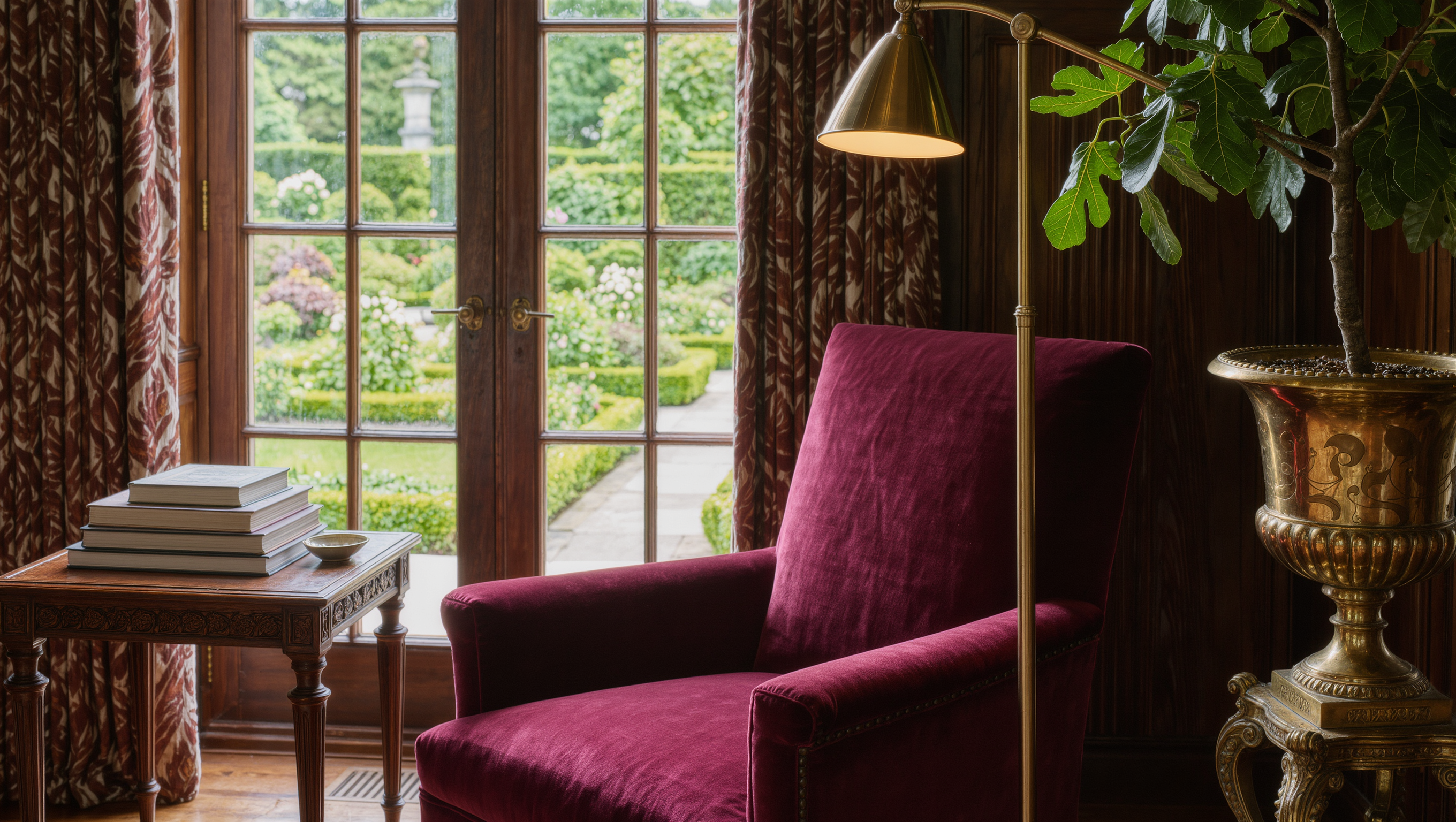
A window is most valuable when the room knows how to use it. Place seating so a person can see outside without twisting. Keep tall storage from blocking the best view. If the view is poor, frame a smaller portion with planting, a sheer layer, or furniture placement rather than treating the entire window as a problem.
At night, windows can become dark reflective panels. Interior lighting near glass should be controlled so glare does not erase the outside completely.
Use daylight according to the room’s job
Bright daylight is excellent for many tasks, but it can also create glare, heat, fading, and discomfort. Use shades, curtains, screens, or furniture placement to shape it rather than simply maximizing it.
Rooms used in the morning may benefit from stronger eastern light. Spaces used in the evening may need a lighting plan that carries the sense of softness after natural light disappears.
Let materials show where they came from
Wood grain, stone variation, woven fiber, clay, cork, wool, linen, leather, and other natural or nature-referential materials can make a room feel less synthetic when they are used honestly.
That does not mean every surface must be raw. A single substantial material story is often more effective than twelve small “natural” accessories. One wood cabinet with visible grain can do more than a tray of decorative stones and three baskets nobody needed.
Use pattern that behaves like nature
Natural environments contain repetition without perfect uniformity. Branching lines, layered scales, irregular texture, waves, leaf-like forms, and gradual color shifts can bring that rhythm indoors.
Wallpaper, rugs, tile, art, and upholstery can all carry organic pattern. The goal is not to imitate a forest literally; it is to avoid a room where every line is rigid, every surface is flat, and every repeated element is mechanically identical.
A dying plant is not a connection to nature
Choose plants for the light, temperature, humidity and maintenance routine the room actually has — not the ones it would have if you were a different person with a south-facing wall. A plant in permanent slow decline is not restorative. It is a guilt object on a stand, and it deducts something every time you walk past it.
Fewer and larger wherever the floor allows. One substantial plant delivers more presence than seven small ones and consolidates the watering into a single task rather than seven scattered ones you will start skipping in February. Keep pots out of circulation routes, and put something waterproof under every one of them, because the second most common houseplant outcome after death is a ring on the floorboards.
Use seasonal change as part of the design
A room can respond to the year without seasonal décor taking over. Change a branch arrangement, rotate a textile, adjust window layers, move a reading chair toward winter sun, or simplify the room during bright summer months.
Biophilic design becomes more convincing when the space acknowledges that light, temperature, plants, and daily behavior change over time.
The senses that are not sight
Nature was never only visual, and the body knows it before the eye does. A wool rug under bare feet, rain audible at a window, a breeze crossing through a screen, the temperature drop beside the glass in October, the feel of a wood handrail — any of these connects a person to the outside more convincingly than another botanical print. Moving air does an enormous amount of that work and costs nothing: an operable window, a ceiling fan where the room suits one, furniture placed so it is not parked on a vent.
Two limits. Keep the sensory layers controllable, because one person’s restorative water feature is another person’s dripping tap, and strong fragrance, rough texture, or visually busy planting can irritate rather than settle. And never block heating, cooling, ventilation, or egress for a plant or a furniture composition. Mechanical systems and building safety requirements come first, and anything unusual should be reviewed by qualified professionals. A beautiful arrangement standing in front of a return vent is a fault report that has not been filed yet.
The living wall is the trap
Living walls, indoor trees and conservatory-style rooms are genuinely beautiful, and they are also plumbing. Behind the photograph sits grow lighting, an irrigation line, a drainage detail, a feeding schedule, a replacement budget, and somebody whose job is to swap out the plants that failed. The photograph does not include that person. The installation does not work without them.
So the question is not whether a living wall would look good, because it would. The question is who is running it in month fourteen. A dead living wall is among the more dispiriting objects a room can hold, and it costs money twice — once to install and once to take out. The version worth building is always the one the household can maintain without resentment, and that version is nearly always smaller than the one in the picture.
Use this five-part audit
- Light: Can the room use daylight without creating glare or heat problems?
- View: Does seating acknowledge the outside world?
- Material: Is there at least one substantial natural or tactile material with real presence?
- Life: Are plants or other living elements suited to the conditions and maintenance capacity?
- Change: Can the room respond to seasons and time of day?
See Atmosphere and The Reference Room for related work on material, light, and sensory direction.
Almost none of the good version costs money. Move the chair to face the window. Take down the heavy curtain that has been blocking the best light in the house. Let the room look different in October than it did in June. That is more biophilic design than a shelf of struggling succulents will ever manage, and the room never had to perform wilderness to get there.
Same problem, elsewhere in the house
Room notes
Keep the room on the record.
One useful note at a time: what to test, what to ignore, and what changed when the room got another vote.