Function and Flow
Your Living Room Has a Social Life Beyond the Television
Build a conversation-friendly living room by changing seating angles, table placement, lighting, and screen hierarchy without turning the room into a formal parlor.
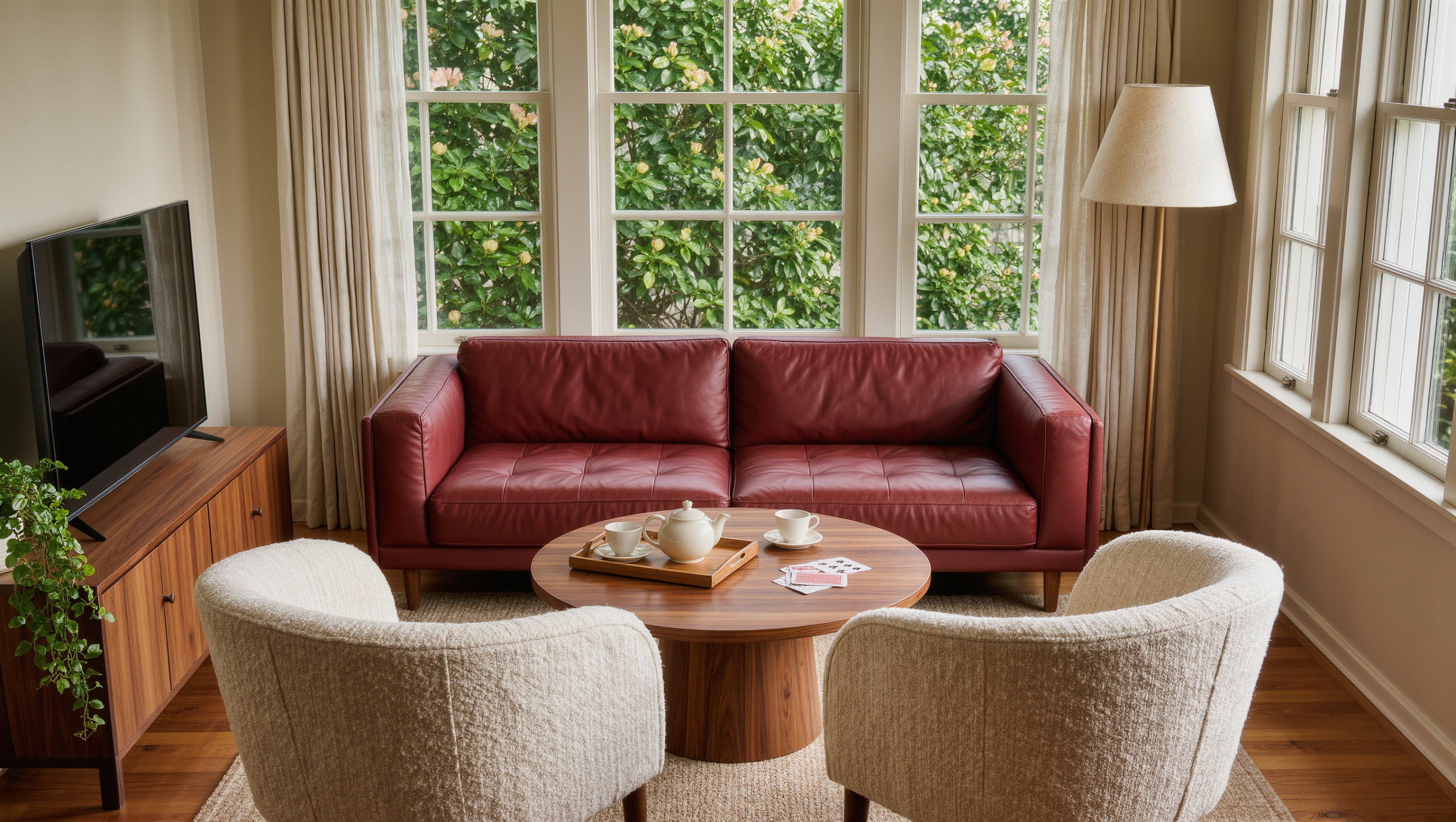
Most living rooms are laid out like a small private cinema and then asked to host a dinner party in the interval.
The television may absolutely belong there. Pretending otherwise is its own kind of design fiction. The problem starts when every chair, sightline, table, and light becomes subordinate to a black rectangle, leaving the room excellent at watching and oddly bad at being together.
A living room can support both. It needs more than one center.
Decide how important television actually is
Count the hours a week your household actually watches, which is rarely the number anybody would guess. Count how many of you watch at once. Then count what else you ask the room to do: reading, conversation, games, hosting, music. Be honest about all three.
Give the screen the amount of control its real use deserves.
If television really is the dominant activity in your house, design for that and stop apologizing for it. If it is one activity among several, stop letting it dictate every seat in the room permanently.
Create a conversation geometry

People talk more easily when the seats face each other, or at least lean that way, instead of forming a straight audience line.
Turn one or two chairs inward. A swivel chair settles the argument where the room will take one. And bring the seating close enough that nobody has to project across the rug to finish a sentence.
Test the arrangement with actual people rather than relying on a diagram.
Let some seats have imperfect screen views
Not every chair needs the same cinematic angle. A side chair can favor conversation or a book and still turn toward the television on the nights that call for it.
That flexibility is worth most in exactly the rooms where the screen is not the only job.
Perfect screen alignment can be an expensive way to eliminate social variety.
Give each seat a reason to exist
A chair earns its place with three things: light it can actually use, a surface within reach of your arm while you are sitting in it, and a relationship to either a person or an activity.
An accent chair with no light, no table, and no conversational angle is scenery.
Use Objects with a Job: The Side Table Test to finish the seat properly.
Control the television visually without pretending it disappears
Cabinetry, art, a darker wall color, a framed screen, or simply better placement will all cut how much the television dominates the room in the hours nobody is watching it.
Do not build a concealment system you will never operate. A simple dark wall may be more honest and more effective than doors that remain permanently open.
Use art as a second focal point
A substantial artwork, a fireplace, a window, or a wall with real material in it gives the eye somewhere else to land.
The second focal point should not fight the television from one foot away. Use a different wall, adjacent zone, or strong diagonal relationship so the room has more than one visual destination.
Lighting can change the room’s mode
Screen watching wants controlled glare and lower ambient light. Conversation wants close to the opposite: faces lit well enough to read, and a room that feels socially awake. One room. Two jobs. They disagree.
Use separate lamps or dimmable layers so the room can shift modes.
Use Lighting to separate television, reading, and conversation states.
Keep glare off the screen
Window placement and lamp reflections are usually what makes viewing uncomfortable. Adjust the screen angle, the window treatment, or where the lamp sits before you darken the whole room.
Daylight is worth keeping for all the hours you are not watching anything, which are most of them.
Do not let the media console become the room’s storage dump
Remotes, game controllers, cords, speakers, consoles, routers, and chargers need a system. Give them one or they will build their own, on the nearest flat surface.
Closed storage cuts the visual noise. Check what the equipment needs for ventilation before you seal it in behind a door.
Keep the media function contained enough that it does not spread across every surface.
Give games and conversation tools equal access
If you play board games, or keep books, records, puzzles, or cards, those things belong near the living room. Store them anywhere else and the television stays the only activity in the house with infrastructure.
Nobody walks to the hall closet for the Scrabble box after dinner. The remote is already on the arm of the sofa, and it knows it.
Keep the coffee table flexible
Your central table has to take drinks, games, feet, snacks, and the occasional complete clearing for children or pets.
Choose a size and shape that supports the room’s social uses rather than merely filling the rectangle between sofa and television.
Use The Coffee Table Is a Choreography Problem if the center is doing too much.
Watch what happens when guests arrive
Watch what people do with the furniture. Somebody drags in a chair from another room. Everyone lines up facing the screen even though it is off. One person ends up stranded just outside the group, half turned, contributing every third sentence.
Hosting reveals whether the seating plan is socially flexible.
Use the arrival view to establish priorities
Stand in the doorway. The first thing the room says should not automatically be television, unless that genuinely is the identity you want it to have.
Furniture orientation, art, lighting, and sightlines decide what leads, and they will put the conversation group first just as readily.
The screen gets a role, not the constitution
A good living room can stream television and still behave like a room for people. That usually takes one decision rather than a renovation: at least one seat angled toward a face instead of the screen, with its own light and a surface within arm’s reach.
Make that seat somebody’s favorite and the rest follows. The room should know what to do after the episode ends.
Same problem, elsewhere in the house
Room notes
Keep the room on the record.
One useful note at a time: what to test, what to ignore, and what changed when the room got another vote.