Function and Flow
The Entry Drop Zone That Refuses to Become a Clutter Shrine
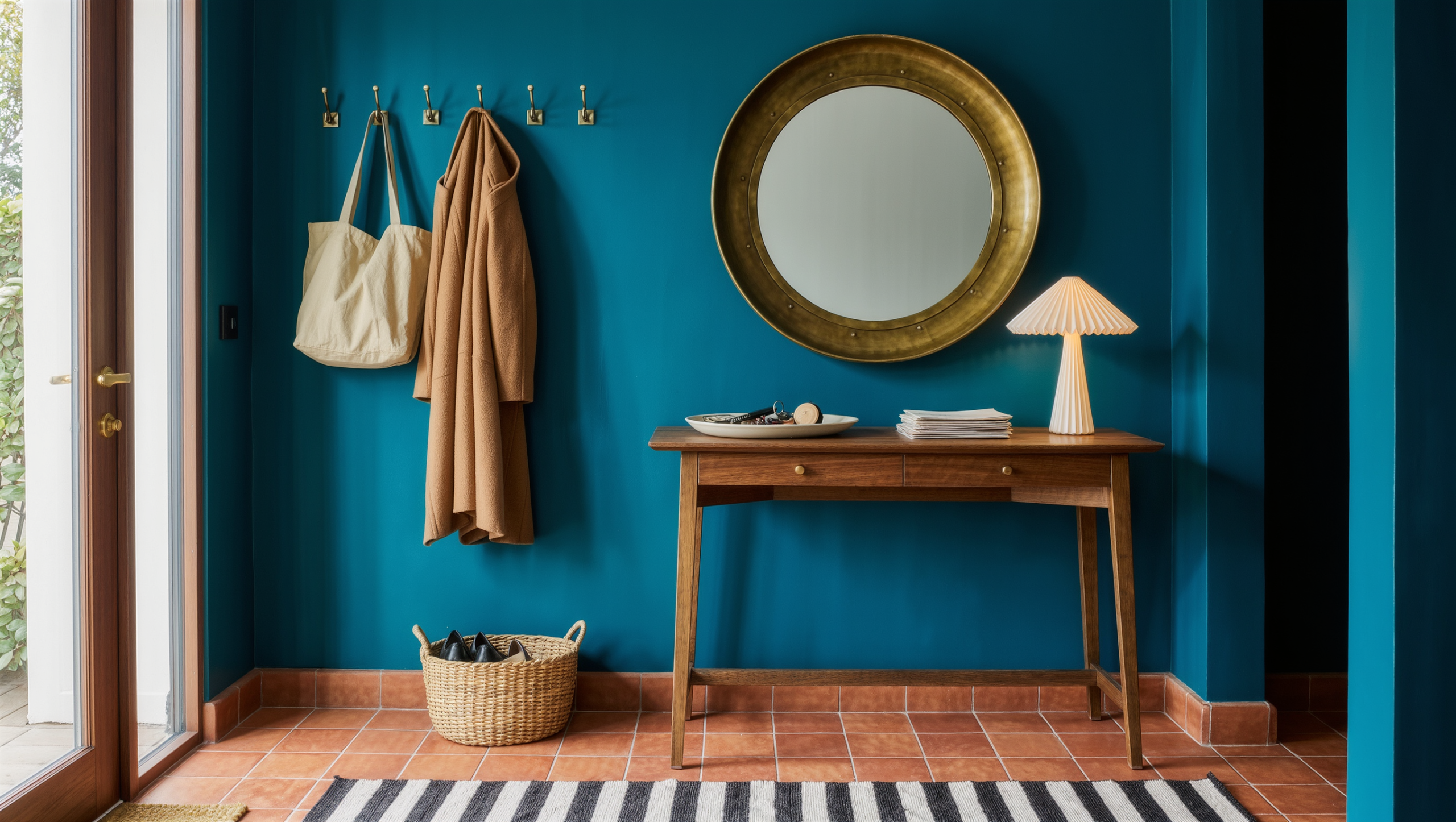
Design an entryway drop zone around the first seconds after arrival, with practical storage, clear circulation, better lighting, and enough personality that the clutter has fewer reasons to form.
On this page
16
The entry drop zone becomes a clutter shrine when it is designed as a surface instead of a sequence.
Keys, bags, shoes, mail, sunglasses, dog gear, packages, headphones and whatever else arrives with the household want a few specific destinations, placed in the order arrival actually happens. One large table to worship at is how they all end up in a heap.
The goal is not an entry that looks empty. An entry that looks empty at four in the afternoon and disappears under coats at four fifteen has not solved anything. The goal is that the ordinary objects stop spreading across every surface and blocking the route.
Watch one week of arrivals
Do not begin with baskets. Observe what enters the house and where it lands before anybody tidies.
Keys on the console, bag on the chair, shoes at the threshold, mail on the kitchen counter, dog lead over the knob. Those locations reveal the household’s natural sequence far better than any generic entryway checklist, and they are already true.
Write down the five most consistent arrivals. The drop zone solves those first and worries about the rest later.
Protect the door and the walking line
Open the door fully. Include the body, the bags, another person passing, and any nearby closet or cabinet doors. Nothing in the drop zone should turn arrival into a side-step.
If a bench, basket or console narrows the path enough that people clip it regularly, the furniture has not solved the clutter problem. It has converted it into circulation friction, which is worse, because clutter can be tidied and a badly placed bench cannot.
Use Layout and Flow when the entry is physically crowded before storage is even added.
Solve it category by category
These categories want completely different destinations, which is the real reason one handsome console cannot hold the line. It is being asked to be a key drawer, a coat rack, a shoe rack, an inbox and a parcel shelf simultaneously, and it will fail at four of those.
Keys and pocket objects
A tray, shallow drawer, wall pocket or hook may be enough. Large surfaces invite large piles because they offer unclaimed horizontal territory. Put the destination within one natural movement of entry — if putting keys away requires crossing the room, the nearest surface keeps winning, and it will keep winning for years.
Bags
Bags are too large for decorative trays and too persistent to keep pretending the floor is temporary. Hooks, pegs, a cabinet, a cubby or a defined floor position can all work depending on the load and the wall construction. Keep hooks stable and rated for the weight. Where children use the zone, put frequently used items at reachable heights without creating a row of projecting obstacles in the route.
Shoes
Decide how many pairs genuinely belong at the entry. Daily pairs stay; seasonal, special-occasion and overflow can live elsewhere. The cabinet, shelf, tray or basket should match the number and size of pairs actually stored.
Undefined capacity is what produces the row of shoes lined up in front of the shoe storage.
Mail does not need storage. It needs processing: recycle, act, file, or hand off. Give incoming paper a limited holding point and a review rhythm. A decorative basket will hide mail beautifully while preserving every postponed decision indefinitely, which is a different service than the one you wanted.
Keep confidential or important documents appropriately secure rather than on open display in a hallway.
Packages
Deliveries are bulky and irregular. The entry does not need permanent furniture sized for the largest box of the year, but it does need a temporary landing that does not block the door. Protect part of a bench, a floor zone, or a nearby surface for short-term arrivals, and clear it once the box is opened.
Dog leads and outdoor gear
Leads, waste bags, towels, umbrellas, hats, gloves — these create small-object clutter because they are used at the threshold and stored somewhere else entirely. One hook rail, drawer or contained cabinet zone closes that gap, and it is usually the cheapest fix on this list.
Closed storage handles the visual noise
Mixed categories look calmer behind a door or in a drawer. Open hooks stay excellent for the few things used constantly that need immediate access.
The entry does not have to display every organizational category it operates. Let the room show one or two useful behaviors and keep the rest quiet.
One piece of the surface stays empty
An entry needs temporary capacity for a phone, a package, a guest’s bag, gloves, or something carried in both hands. If every inch of the console is permanently styled, ordinary life instantly looks like clutter.
Protect a section of the surface from decorative occupation. Empty space is part of the operating system, not a gap in it.
Light makes the system usable
The drop zone has to work after dark. Keys, locks, steps, switches and storage should all be visible without one glaring overhead being the only option.
A small lamp, a wall light, or a well-placed ceiling source helps people actually use the storage they have. A system nobody can see at six in the evening in December is a system nobody uses in December.
Use Lighting for the full hierarchy, and qualified help for fixed electrical changes.
Weather changes the inventory before it changes the room
Wet shoes, umbrellas, heavy coats, hats, gloves, summer bags and sports gear do not occupy the same volume or want the same surfaces. The entry should adjust seasonally rather than holding permanent capacity for every condition at once.
Keep washable or durable landing space where dirty things actually arrive, and move off-season categories off the prime route. A small entry gets dramatically more useful when its inventory changes with the weather instead of accumulating around it.
Morning runs the whole thing backwards
Departure reverses the flow: shoes on, bag collected, keys found, coat on, door open. Test that sequence, ideally while late.
A system that accepts objects easily and then hides them so thoroughly that leaving becomes a search has solved half a problem and manufactured the other half.
Reset by category, not by styling
At the end of the day, return keys, bags, shoes, paper and outdoor gear. Decorative objects should not need rearranging as part of that.
If the routine takes more than a couple of minutes, shorten the routes or reduce the number of storage steps. Nobody has ever kept up a five-step reset.
An entry that is not pretending
A working drop zone does not make the threshold look as though nobody lives there. It makes arrival and departure legible enough that the clutter has fewer reasons to form in the first place.
Done properly, it is nearly invisible as a system. You notice it by what stops happening: the console stays passable, the bench stays sittable, and getting out of the front door requires moving nothing.
Use Storage and Working Zones for the larger behavior system.
Same problem, elsewhere in the house
Room notes
Keep the room on the record.
One useful note at a time: what to test, what to ignore, and what changed when the room got another vote.