Materials, Color & Finish
European Courtyard Design Without the Theme-Park Effect
Build a French- or Italian-inspired courtyard through proportion, paving, planting, shade, furniture, water, and enclosure without turning the space into a costume set.
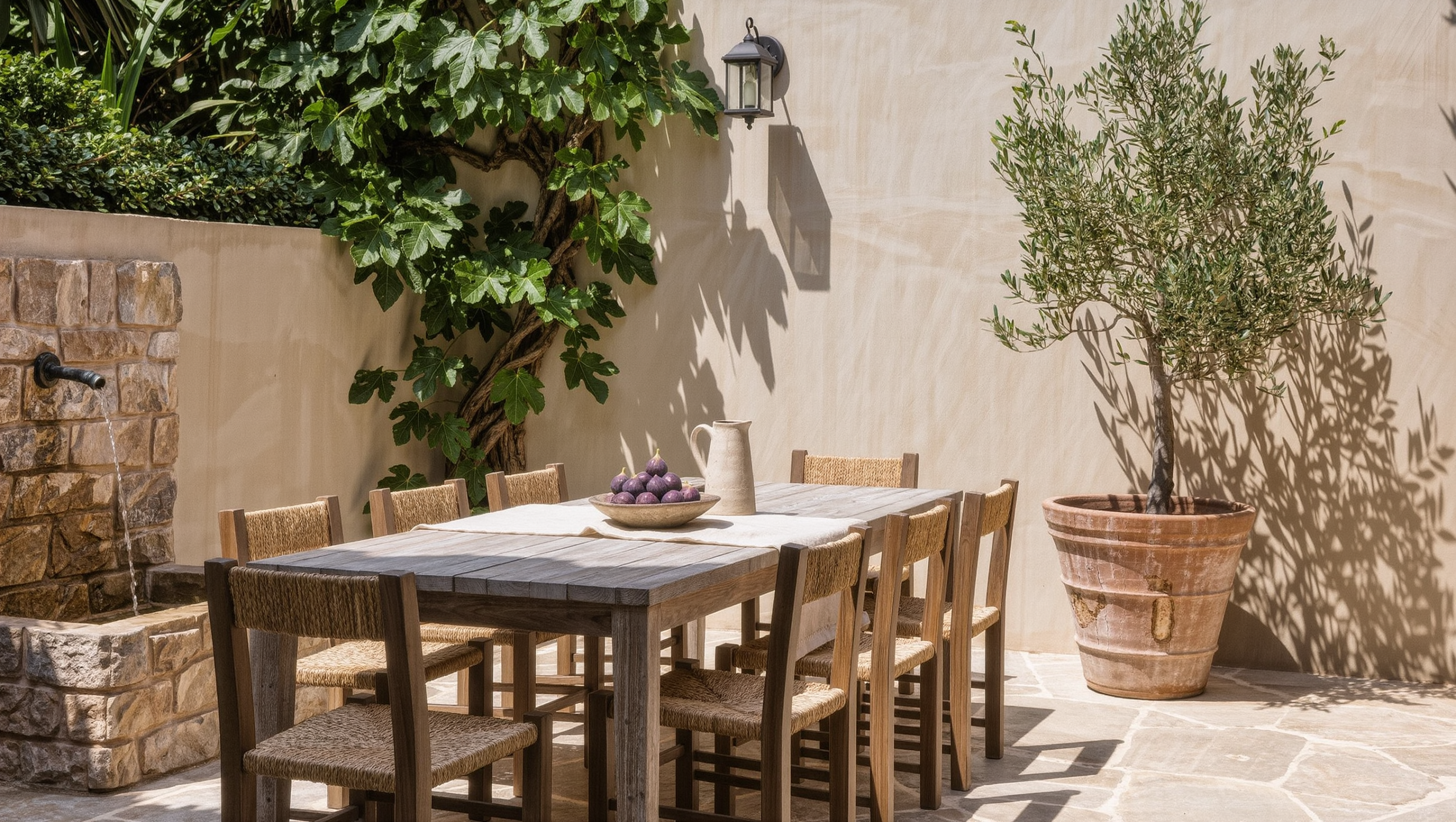
A courtyard can feel European without importing a crate of urns and asking every surface to speak with an accent.
What actually travels from French and Italian courtyards is spatial, and none of it is decorative: enclosure, a sequence you move through, shade where people sit, and materials that improve as they age instead of needing to be protected from the weather. The urns are optional. They were always optional.
Enclosure first, then something in the middle
A courtyard reads differently from an open patio for one reason — the boundary is part of the experience. Walls, hedges, fences, the house itself, screens, dense planting: any of them can hold the space without sealing it shut. Map the edges you already have before you build new ones, and decide which should feel solid, which should filter a view, and which stay open so the courtyard still belongs to the garden and the house.

Then give the room a middle. Traditional courtyards read clearly because one element organizes them — a table, a fountain, a tree, a planted island, a deliberate patch of bare paving. It does not have to sit at the geometric center of anything. It does have to be the thing the eye lands on. In a small courtyard, one good table beats four minor focal points arguing from the edges, and it beats them by a wide margin.
Fewer materials, used more often
Stone, brick, gravel, tile, concrete — any of them can carry a courtyard, and the difference is scale and joint, not provenance. Large units calm a busy planting scheme. Small units build texture and pattern, and a lot of small units build noise. Choose for climate, drainage, freeze-thaw conditions, slip resistance, maintenance, and local installation requirements. A tile that is beautiful in the photograph and slick in February is a bad tile.
The same discipline runs through color. Stone, terracotta, aged metal, lime-like neutrals, deep greens, faded reds, warm creams, weathered wood: those read as a family because they already repeat across architecture and landscape. Pick a narrow material and color range and let age, light, and planting supply the variation. Five unrelated decorative finishes will make a courtyard busier than four richer ones used over and over, and busy is not the same as layered.
Planting is allowed to touch the building
Those courtyards read lush because nothing is holding the plants back from the hardscape. Vines on walls, trees coming up through paving, herbs and shrubs leaning on boundaries, the same container repeated six times instead of six different containers scattered once each. No apologetic ring of mulch around every trunk.
Use plants suited to the actual site. A Mediterranean look does not require Mediterranean species, and forcing them is how a courtyard ends up on life support every July. Regionally adapted plants carry the same structure, fragrance, texture, and seasonal movement, and they do it without being nursed.
The courtyard works two shifts
Shade comes from trees, pergolas, awnings, umbrellas, vines, or the walls themselves. Track where it actually falls across the day before committing the main seat, because a chair sited for the view and occupied at two in the afternoon is a chair nobody sits in twice. A pergola or permanent structure may involve permits, structural design, attachment details, wind loads, or electrical work. Use qualified professionals where the project moves beyond freestanding furniture or planting.
The sun goes down and the same room has to work again. Low, layered light makes texture, leaves, walls, and paths visible; one bright source flattens all of it into a parking lot. Light the architecture and the routes first, and let decorative glow follow if it still seems necessary once the walls are doing something. Exterior electrical work, wet-location fixtures, and permanent lighting should use appropriately rated products and qualified installation where required.
A fountain is also a chore
Water masks street noise, makes the courtyard read cooler than it is, and gives the room a center. It also wants power, cleaning, winterization, water treatment, and somewhere a person can physically reach to do all of that. None of those are difficult. They are just permanent.
If that does not fit the household, a planted focal point, a sculptural vessel, or a reflective surface will hold the same position and ask for nothing. Romance should not create a new department.
Furniture that can stay outside
Two requirements that pull against each other: comfortable enough to sit in for three hours, tough enough to live in the weather. Then a third, which is the one people skip — enough visual weight to survive being seen next to masonry and a wall of planting. Thin metal café furniture disappears against stone. Fine, if disappearing is the plan.
Before the bistro set wins by default, measure with the chairs pulled out and walk the route somebody takes carrying plates. Doors, gates, storage. A courtyard that seats six and can only serve four is not a furniture problem.
Most of the time, nobody is standing in it
A courtyard gets looked at far more than it gets occupied. Through a kitchen window in January. Through a door propped open in June. From a chair indoors that happens to face the right way. So go stand at that door and decide what the outdoor room is framing — a tree, the table, a wall, a vessel, lit planting, a patch of sky — and build toward that view rather than toward the overhead plan.
This is the step that gets skipped, and it is the one that pays. A courtyard can improve the room next to it just by giving the eye somewhere to land, which is more than most interior accessories manage.
The only test worth running is subtraction
Take out every decorative reference to Europe — the urn, the shutters that do not shut, the wall plaque, the cast-stone lion — and look at what is left. If the boundary still holds, the room still has a middle, the paving and the planting still belong to each other, and there is shade where people actually sit, then a courtyard is what you built. If subtracting the props leaves a patio with a table on it, the props were doing the work, and props do not survive a second summer of being looked at.
See Outside and The Reference Room for related work on outdoor composition and material direction.
Borrow the discipline. The urns were never the part that traveled.
Same problem, elsewhere in the house
Room notes
Keep the room on the record.
One useful note at a time: what to test, what to ignore, and what changed when the room got another vote.