Awkward Spaces
The Grand Entry Is Starting to Look Like a Hotel Lobby
A large entry hall needs a clear arrival sequence, useful landing zone, strong sightline, and generous circulation—not furniture added simply because the foyer can hold it.
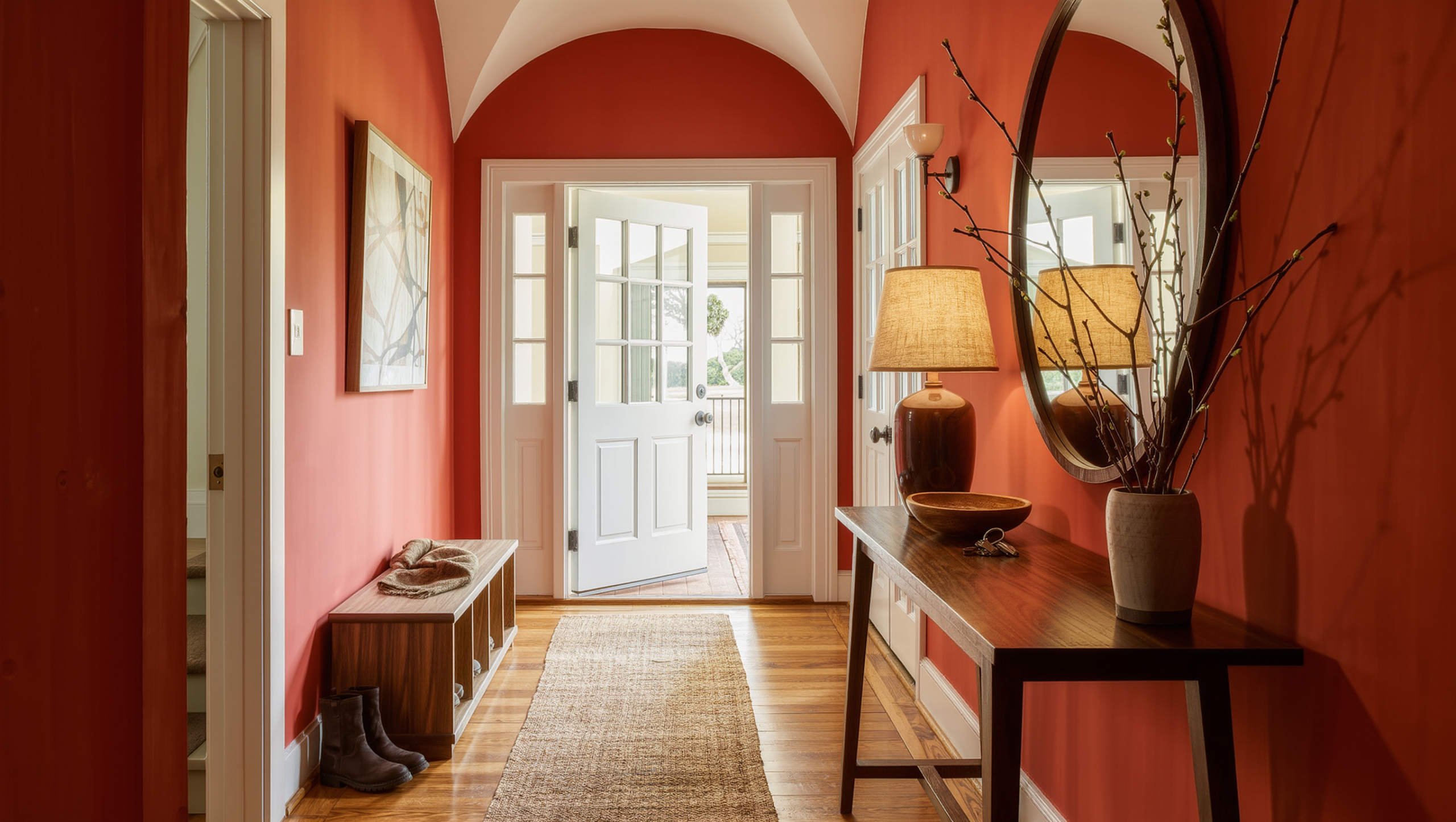
A large entry can make an impressive first photograph and a terrible first five minutes at home. The scale invites a center table, two benches, an oversized arrangement, a console on every wall, and enough decorative objects to suggest there is a concierge nearby.
An entry is still a transition space. Its first job is to receive people, belongings, weather, and movement without making any of them negotiate the decor.
Protect the arrival path first
Open the front door fully. Walk in carrying bags. Imagine another person arriving behind you. Then trace the routes toward the living room, kitchen, stairs, coat storage, and any exterior connection used regularly.
Those routes should remain obvious. A grand foyer can afford generous open floor, and that open floor is part of the experience. Do not turn it into an obstacle course because the dimensions appear to permit one.
Create one landing zone that actually works

Every entry needs a place for the objects that arrive with people. That might be a console with drawers, a cabinet, wall hooks, a bench, a tray for keys, closed shoe storage, or a combination appropriate to the household.
In a large entry, consolidate rather than multiplying. One substantial piece can function better than several small tables catching mail in different corners.
If coats and shoes live elsewhere, the entry does not need to pretend it is a mudroom. Give it only the storage it will actually use.
Choose the first sightline deliberately
Stand outside with the door open and look in. What is the first thing the house offers?
A staircase, art wall, distant window, console, sculpture, or view into another room can become the visual destination. Strengthen that sightline with lighting and scale rather than scattering several competing moments around the foyer.
The entry should introduce the house. It does not need to summarize every design idea before the guest has removed a coat.
Furniture in a foyer has to justify being walked past
A round center table can be beautiful in a genuinely large hall, because it occupies the middle without demanding a front or a back. It can hold flowers, a lamp, seasonal branches, or one restrained object. It also needs enough clearance on every side that people move naturally even when the front door stands open and several guests are arriving at once — which is the exact condition it exists for, and the only condition nobody ever tests it in.
If the table creates a pinch point, the foyer is not failing because the table is too small. The table may simply be unnecessary. That is a permitted conclusion, and considerably cheaper than the alternative.
Seating takes the same test. A bench or chair belongs in an entry when somebody uses it to remove shoes, wait for a ride, set down a bag, or pause during arrival and departure. Put it beside the function it supports. A bench fifteen feet from the door because that wall was empty may look composed and still be useless, and useless furniture in a transition space is worse than useless furniture anywhere else, because everyone in the house walks past it six times a day.
A large entry can carry a small waiting or conversation moment. It stops being an entry the moment that moment turns the arrival route into a second living room.
Use lighting to lower the scale
High foyer ceilings often need a substantial hanging fixture, but the chandelier should not be the only light available.
Sconces, console lamps, art lighting, and stair lighting bring illumination closer to eye level and make the entry feel inhabited after dark. Separate controls or dimming let the room move from practical arrival light to something softer later on. Without them a tall foyer has precisely two settings, blazing and off, and neither of those is a welcome.
Plan for weather without designing around worst-case clutter
Entries receive wet umbrellas, muddy boots, packages, pet gear, and winter layers. Provide a realistic place for those things if the front door is where they actually enter.
A durable mat, umbrella stand, boot tray, closed cabinet, or nearby closet can handle the practical load without making the whole foyer look permanently prepared for a storm.
If the household uses a garage or side entry for daily mess, let the formal entry remain simpler.
Take half of it out, then let three people in
Large entries usually supply their own drama: staircases, tall windows, arches, millwork, long axes, double-height walls. Furniture should support those features rather than fill the gaps between them. Photograph the entry with half the movable objects removed. If the architecture becomes clearer and the arrival route easier, the empty space was never the problem — the objects were, and they were bought to solve a problem the room did not have.
Then put the load back on. Have several people come in at once with coats, bags, and shoes. Open every nearby door. Walk toward the main rooms. Notice where belongings actually land and where people stop moving.
That behavior will tell you more than a symmetrical floor plan ever does, and it will contradict the plan more often than it confirms it. Keep the scale. Keep the drama. Lose whatever makes arriving at your own house feel like getting past the lobby furniture before check-in.
Same problem, elsewhere in the house
Room notes
Keep the room on the record.
One useful note at a time: what to test, what to ignore, and what changed when the room got another vote.