Function and Flow
The Lounge Has No Night Mode
A lounge that works only in daylight is unfinished. Build an evening lighting hierarchy with low, warm, directional sources that support faces, reading, movement, and atmosphere without flooding the room.

Some lounges look competent until sunset and then become one giant bright room with a television in it.
A night mode asks for more than “dim the lights.” It needs a different hierarchy: the social zone becomes brighter than the route, faces remain readable, the screen stops fighting reflections, art or material stays visible, and unused parts of the room are allowed to recede.
The room should know when evening begins. If the room is competent by day and fails after dark, treat those as two different rooms rather than averaging them into one mild complaint: the room reading at the Room Lab lets you read it at the hour it actually fails.
Decide what the night room is for
Conversation, television, reading, games, music, drinks, or some mixture of all of them will each want a different light state. Rank them honestly, by what happens on an ordinary Wednesday rather than by what the room was furnished to imply.
The brightest useful zone should belong to the activity people actually perform, not to the fixture with the largest wattage. That sounds obvious and almost no room obeys it, because the big fixture was chosen first, cost the most, and now sets the terms for every evening in a room it was never asked to understand.
Demote the overhead source

The ceiling light may remain useful for cleaning, setup, or general orientation. It does not need to dominate every evening.
Use compatible dimming or switch it off when lower sources can take over. The overhead light is the houseguest who arrives first, talks loudest and assumes they are the reason everyone came; give it a job for the vacuuming and a polite exit by eight. Any hardwired change is for a qualified electrician.
The room gains depth when light comes from several heights and directions.
Faces first, then the page, then the screen
Lamps near seating, reflected wall light and shaded sources keep people visible without the harsh shadows an overhead fixture casts on a human face. Sit in every primary seat and check glare, exposed bulbs, and whether the person opposite has disappeared. Conversation is noticeably harder when the room renders every guest as a silhouette, and nobody in that room will ever name the lighting as the reason the evening felt flat.
Reading needs its own source and only its own. A lounge can be generally dim and still support one reader perfectly well with a focused lamp placed so it lights the page without reflecting into screens or firing into the seat next door. Task light is meant to solve the task locally. Raising the whole room to serve one book is the exact failure this piece is arguing against.
The screen usually wins its argument by force. Move lamps, adjust shades, and deal with nearby window reflections before darkening everything else. A soft light behind or beside the screen area often makes viewing more comfortable while leaving enough ambient light for movement and conversation. A television that requires the room to become invisible has stopped being furniture and started being a condition.
Darkness is a material and you are allowed to use it
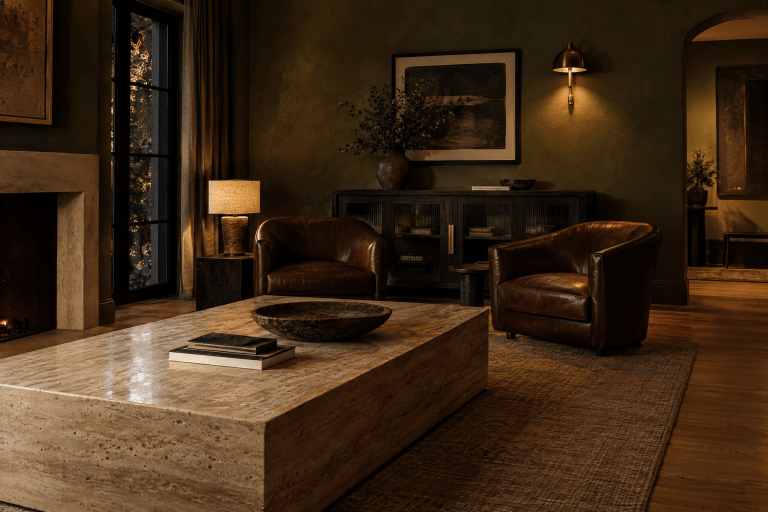
Light on art, shelving, a curtain, a textured wall or any material plane gives the room depth after dark. Choose one or two destinations and no more. Lighting every wall equally rebuilds precisely the flatness the lower lamps were brought in to cure.
Then decide what to leave out. A lounge in a large room can feel detached if the far wall vanishes completely, and one lamp or lit surface out there will hold the depth. A smaller room usually improves when a less important edge is allowed to fall dark. Night mode is spatial before it is decorative, and the parts you refuse to light are doing as much work as the parts you do.
Reflective things then supply the sparkle: glass, metal, lacquer, mirrors and glazed ceramics catching small pools of light. Check them from seated height, though, because the same surface that adds life will also cheerfully bounce a bare bulb or the television back at whoever is trying to enjoy the room.
Give the route enough light
Steps, thresholds, furniture edges, and paths to doors or stairs should remain legible.
Atmosphere does not justify creating a navigation problem. Keep transition areas sufficiently visible, especially where low vision, mobility, children, or older adults are relevant.
Three scenes, or none of this ever gets used
Most rooms need perhaps three modes: bright general use, task and conversation, and a lower screen or late-evening light. Build those and stop. If changing between them means walking a lap of the room operating eight separate fixtures, the system will be used enthusiastically for about two weeks and then abandoned for the one switch beside the door. Group the controls logically where you can and keep portable lamps easy to reach.
Which lamps you buy matters less than what the light lands on. Velvet, wood, plaster, linen, stone, paper shades and every other surface respond differently after dark — a textured wall grows richer under directional light, a glossy table becomes a glare source. Test the actual materials in the actual room rather than choosing fixtures in isolation and hoping.
Leave room for the unglamorous scene as well. After guests go or the film ends, somebody has to find the dishes, the blankets, the spill and the furniture that moved. A night plan that cannot temporarily become practical will simply get overridden, and a plan that has been overridden a few times is no longer a plan.
The dimmer was never the point. What changes at sunset is which part of the room is in charge, and when that hierarchy is right, the lounge at nine in the evening is still recognizably the room you designed rather than a bright box with a television in it.
For the whole room, plan the layers before choosing fixtures. If one lamp keeps migrating between the sofa and the table, that is the job rechargeable portable lamps exist for.
Same problem, elsewhere in the house
Room notes
Keep the room on the record.
One useful note at a time: what to test, what to ignore, and what changed when the room got another vote.