Function and Flow
Low-Voltage Lighting Is the Quiet Infrastructure Behind Better Atmosphere
Use low-voltage accent lighting to add controlled layers at shelves, niches, stairs, cabinets, art, and outdoor thresholds while keeping transformers, glare, maintenance, and qualified installation in the plan.
A light strip that is invisible from the doorway and unbearable from the sofa did not fail at installation. It failed at the moment somebody decided to add LED tape instead of deciding what the light was for.
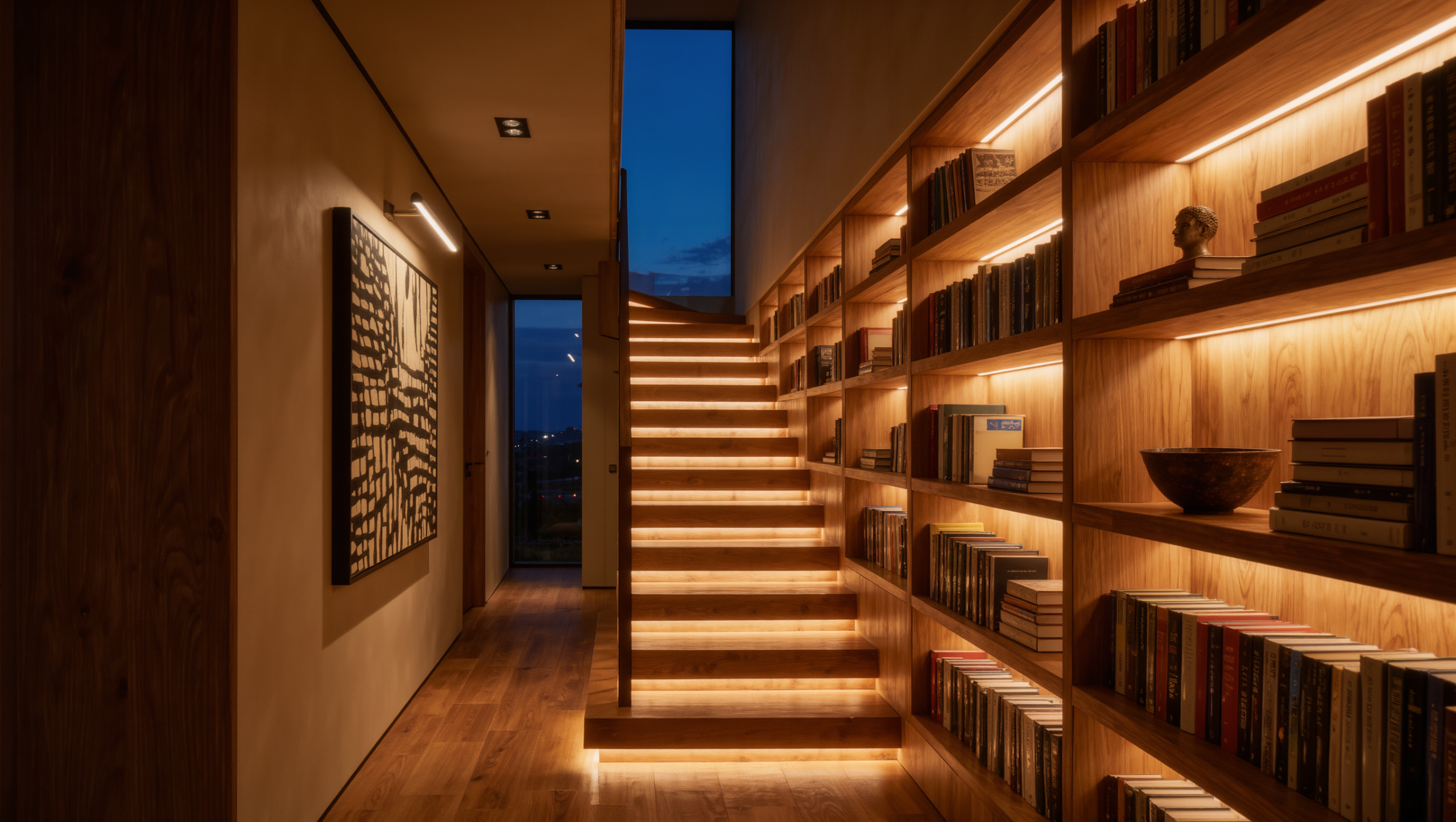
Low-voltage systems can make shelves glow, wash a wall, guide a stair, light a cabinet, define an outdoor threshold, or give an architectural detail enough light to register after dark. That is the version worth having. The other version is a room with six glowing edges and nowhere comfortable to read, because every decision got made about the product and none of it got made about the room.
Name the effect before you name the hardware
“Add LED tape” is not a lighting plan. Name the effect first: graze this stone, illuminate these shelves, light the stair edge, create a low evening path, reveal this niche, or give this cabinet enough task light to chop an onion under. Placement, diffusion, beam direction, brightness, color characteristics and control are all decided by that sentence — and none of them can be decided sensibly without it. Write the sentence badly and you will still buy something. It just will not do anything.
Use low-voltage light as a layer

Low-voltage accent lighting is strongest when it supports a broader lighting plan. It should not be asked to replace task light, general illumination, and decorative fixtures all at once.
Think in layers: ambient light for the room, task light where work happens, accent light for hierarchy, and low-level guidance where movement needs support after dark.
Glare is where most of these installations quietly die
Visible points of light look harsh, and reflective surfaces double the problem. Channels, diffusers, recesses, shelf lips, coves and honest setbacks let the light read as a continuous effect instead of a row of small bright dots. That part is well understood. What gets skipped is the sightline test, because the person installing it checks the look from where they happen to be standing, which is directly in front of the run, holding it.
Sit down. Then sit somewhere else. Under-cabinet, shelf, stair and toe-kick light bounces off glossy counters, floors, glass doors, polished stone and television screens, and a strip that vanishes politely from the doorway can be a white bar across your vision from the sofa. Mock the position up with temporary light and look at it from the three places people actually sit. The correct height is the one that puts the light where you wanted it on the real surfaces, not the one in the product photograph.
Plan the power supply before the millwork
Drivers, transformers, controllers and connections need accessible, ventilated, appropriate locations, and accessible is the word people design around rather than design for. A driver sealed behind finished joinery is fine for exactly as long as it works. When it stops — and the driver is usually the first component to stop — the replacement part is cheap and reaching it costs whatever it costs to take the cabinet apart again. That is the entire trade, and it is worth making on purpose, out loud, in front of whoever is building the millwork, before the panel goes on.
Electrical requirements vary by system and jurisdiction. Use products as rated, follow manufacturer instructions, and use qualified electrical professionals where hardwiring, new circuits, concealed wiring, wet locations, exterior work, or local requirements call for them.
Choose controls around behavior
An accent layer is much more useful when it turns on the way the room is actually used. Separate control may allow shelves to glow during evening conversation while task lighting stays off. Dimming can let the same installation serve both visibility and mood.
Do not build a control scheme that requires opening an app every time you enter the room. Physical, intuitive control still matters.
Keep color consistent
Mixed light sources can make a room feel visually unsettled when their color appearance is noticeably different. Coordinate new accent lighting with the surrounding lamps and fixtures rather than treating every LED product as interchangeable.
Check the light against paint, wood, stone, art, and textiles before installing a long run. Materials can look significantly different under different light sources.
Light will not fix a wall that was never interesting
If the architecture is weak, lighting it more dramatically will not repair the design. It will only make the weakness legible at night as well. Accent light points; it does not author. Whatever it points at had better be worth the attention it is about to receive.
Which is why the targets that repay it are specific ones with depth: a deep niche, a loaded bookshelf, a ceiling detail with real relief, a rough or textured wall, a stair landing, a built-in you can see into. A flat painted plane grazed from below is still a flat painted plane, now with a bright bit along the bottom.
Use low light for night movement carefully
Low-level illumination can help identify routes, steps, edges, and transitions without flooding the entire room. It should still provide adequate visibility for the people using the space.
Stairs, egress, accessibility, and safety lighting have specific requirements in many contexts. Decorative guidance lighting should not be assumed to satisfy required illumination or code obligations.
Think about maintenance before installation
Light sources, drivers, sensors, connectors, and controls may eventually fail. Ask what can be replaced, where access occurs, whether parts are standardized, and what happens if one component becomes unavailable.
A beautiful recessed detail is less beautiful when replacing a failed driver requires opening the ceiling.
Keep exterior lighting restrained
Low-voltage landscape and outdoor accent lighting can extend the room outside, but more light is not automatically safer or more atmospheric. Aim light where it is needed, avoid unnecessary uplight and spill, and consider neighbors, wildlife, and dark-sky principles.
Exterior and wet-location installations need equipment specifically rated for those conditions and appropriate professional installation where required.
See Lighting and Atmosphere for the broader Room for Drama lighting system.
The brief is one sentence and it gets written before anything is ordered. This light exists to make ___ visible after dark, seen from ___, and it will be serviced from ___. Fill in all three blanks or do not buy the strip. Two out of three is how you end up with a beautiful glowing shelf that has to come apart in four years.
Same problem, elsewhere in the house
Room notes
Keep the room on the record.
One useful note at a time: what to test, what to ignore, and what changed when the room got another vote.