Function and Flow
Window Treatments Are Architecture You Can Change
Use curtains, Roman shades, blinds, and layered window treatments to control light, privacy, proportion, acoustics, temperature, and the visual height of a room—not just to decorate the glass.

Nothing else in decorating is asked to do six jobs at once and then described as a finishing touch.
Curtains, Roman shades, blinds, shutters and layered systems change light, privacy, acoustics, proportion, temperature and the apparent architecture of a room, none of which requires moving a wall. That is an enormous amount of work to hand to the thing people choose last, from a swatch, mainly on the question of whether it goes with the sofa. It goes with the sofa at two in the afternoon. What matters is what it does at six in the morning and ten at night, which are the hours the window is actually a problem.
Start with the problem at the glass
Different windows have different jobs. One needs privacy from a sidewalk. Another needs glare control for a television. A bedroom needs darkness. A dining room needs softness after sunset. A west-facing room may need stronger solar control than a north-facing room.
Write down the actual problems before choosing fabric or hardware.
Separate privacy from darkness
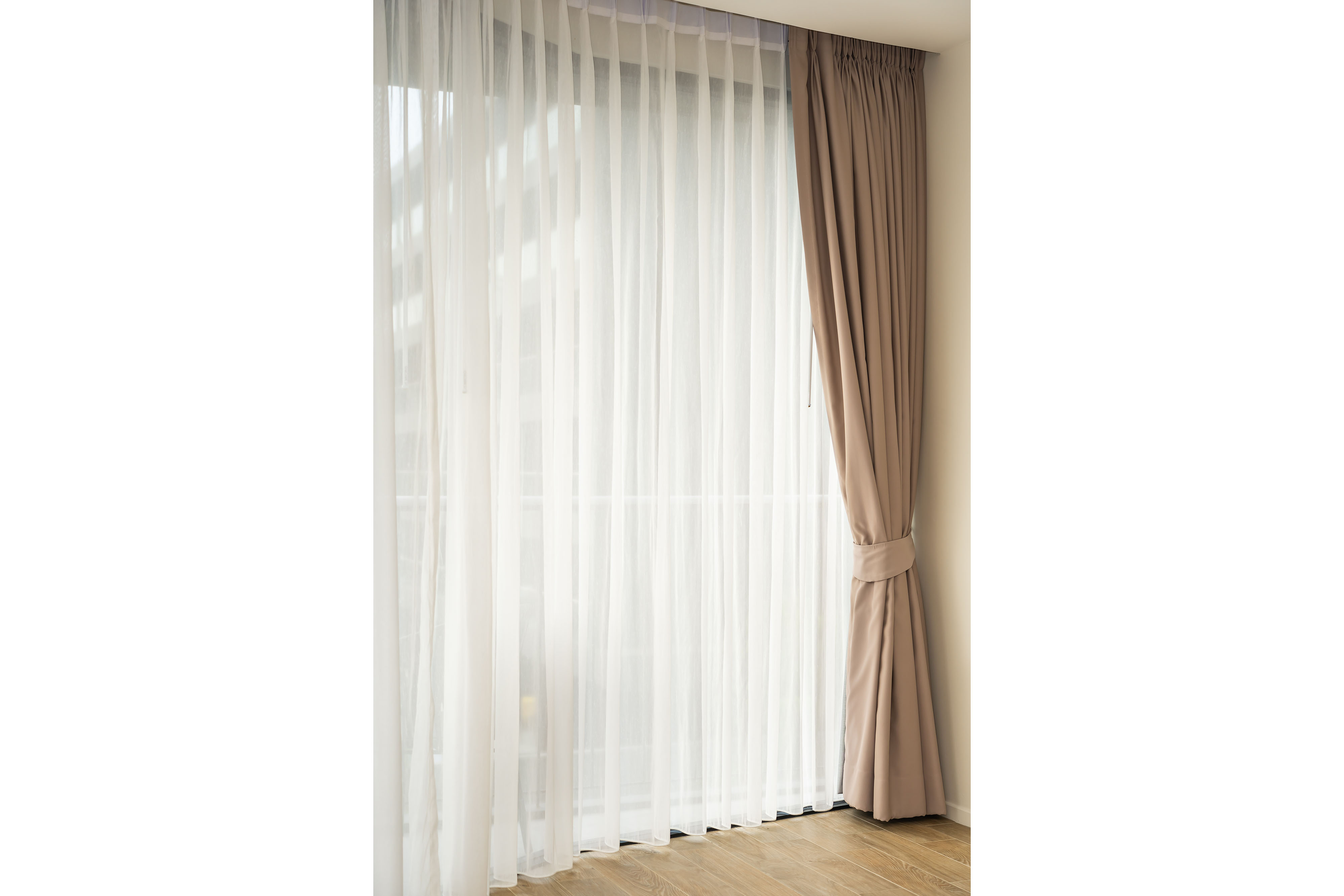
Privacy and blackout are not the same requirement. A sheer layer can reduce direct views during daylight while preserving light, but it may provide little privacy at night when the interior is brighter than outside.
A bedroom may need a light-blocking shade plus decorative curtains. A living room may need only an adjustable privacy layer and side panels for softness.
Use curtains to change apparent proportion
Mounting drapery higher than the top of the window can make the opening and wall feel taller. Extending the rod or track beyond the glass can let panels stack off the window instead of stealing daylight.
Do not follow a generic “hang them high and wide” rule without checking ceiling height, trim, radiators, furniture, return vents, adjacent walls, and how much stack-back the chosen fabric requires.
Choose fullness by fabric and effect
A lightweight sheer needs enough material to hang in folds when closed rather than stretch flat across the glass. Heavy velvet or lined fabric may require less apparent volume because each fold carries more visual weight.
Sample the actual textile if possible. A fabric that looks elegant in a small swatch can become surprisingly dominant across a full wall.
One layer, two layers, or a shade because there is no wall left
Roman shades earn their place where drapery has nowhere to stack — small rooms, kitchens, built-in seating, a window sitting tight against a return wall. They still deliver color, pattern, softness and adjustable coverage; they simply do it inside the opening instead of beside it. Inside-mount and outside-mount behave differently, so measure carefully and follow the manufacturer’s requirements, and confirm the window still opens, the hardware still clears, and any cord or mechanism safety requirements are met. That last part is not decorative and it is not negotiable.
Layer only when one treatment genuinely cannot cover the jobs: a shade taking privacy and glare while curtains supply softness, sound absorption and height; a sheer filtering daylight while an opaque layer closes at night. What layering should not be is more fabric added to look considered. If one well-chosen treatment does the whole job, that is not a missed opportunity. It is the answer, and it is cheaper.
Make the treatment answer the room’s architecture
Repeated windows may benefit from a continuous track or visually consistent treatment. A single odd window may need to be absorbed into a larger wall composition. Bay windows, corner windows, and deep recesses require more careful planning.
Do not force every window in the house to use the same treatment. Consistency can come from shared fabric, color, hardware finish, or heading style rather than identical construction.
The bottom edge is where most curtains confess
A panel stopping a visible inch or two short of the floor reads as a mistake to nearly everyone, including people who could not say why. (A deliberate clearance of a hair, to keep the hem off the floor, is a different thing and reads as tailoring.) It looks like fabric that shrank. A deliberate break or a puddle can be genuinely beautiful, but it belongs in rooms without a dog, without a toddler, without a door swinging through it and without a floor vent underneath, because a puddled curtain over a heating vent is a laundry schedule.
Decide from the floor condition and the household rather than from a photograph. And notice which way the luxury actually runs here: precision reads richer than excess. A panel meeting the floor exactly costs nothing extra and looks like somebody measured.
Think about acoustics and comfort
Large areas of glass reflect sound. Curtains and fabric shades can soften a room acoustically, especially when paired with rugs and upholstered furniture.
Window treatments can also help manage drafts, heat gain, and glare, but performance varies widely by product, fit, lining, glazing, orientation, and climate. For meaningful energy-performance goals, use product data and qualified guidance rather than relying on décor claims.
Choose hardware with enough authority
A substantial wall of fabric needs hardware scaled to its width and weight. Thin rods with heavy panels can bow or look visually underpowered.
Mounting conditions matter. Long spans, heavy treatments, unusual substrates, and motorized systems may require stronger attachment or professional installation.
Design the open position, because that is the one you look at
A window treatment spends most of its existence open. Most of the year, most of the day, the curtain is not covering anything — it is a column of fabric standing beside the glass. So decide what that column is doing. Where does the stack land? Does it eat a third of the view? Does it crowd the corner, bury the trim, foul a cabinet door, sit over a radiator?
People plan the closed position obsessively and let the open one happen by accident, which is exactly backwards. Fabric that looks beautiful closed and steals the daylight open is an expensive wall.
Test the room at night
Many window-treatment mistakes only appear after dark. Glass becomes reflective, exterior privacy changes, and interior light can make sheer fabric far more transparent than expected.
Stand outside where appropriate or look toward the window from normal interior positions to understand how the treatment behaves at night.
A window-treatment brief
- What light needs to be blocked, filtered, or preserved?
- What privacy is required by day and by night?
- Does the treatment need to improve apparent height or width?
- Where will fabric or shade stack when open?
- What furniture, vents, trim, or doors constrain the installation?
- What maintenance and cleaning will the material require?
- Can the treatment be operated comfortably by everyone who needs to use it?
See Lighting and Atmosphere for related guidance on daylight and evening use.
Go and look at the worst window in the house at four in the afternoon, then again after dark with the lamps on. Whatever it is doing wrong at those two moments is the brief. The fabric, the heading, the hardware finish are all consequences of that decision — never a substitute for making it.
Same problem, elsewhere in the house
Room notes
Keep the room on the record.
One useful note at a time: what to test, what to ignore, and what changed when the room got another vote.