Function and Flow
Rita Konig: A Room Should Look Better After People Start Living in It
Rita Konig is worth studying because her rooms become more convincing in use: practical relationships, collected objects, comfort, pattern, and enough looseness for life to keep happening.
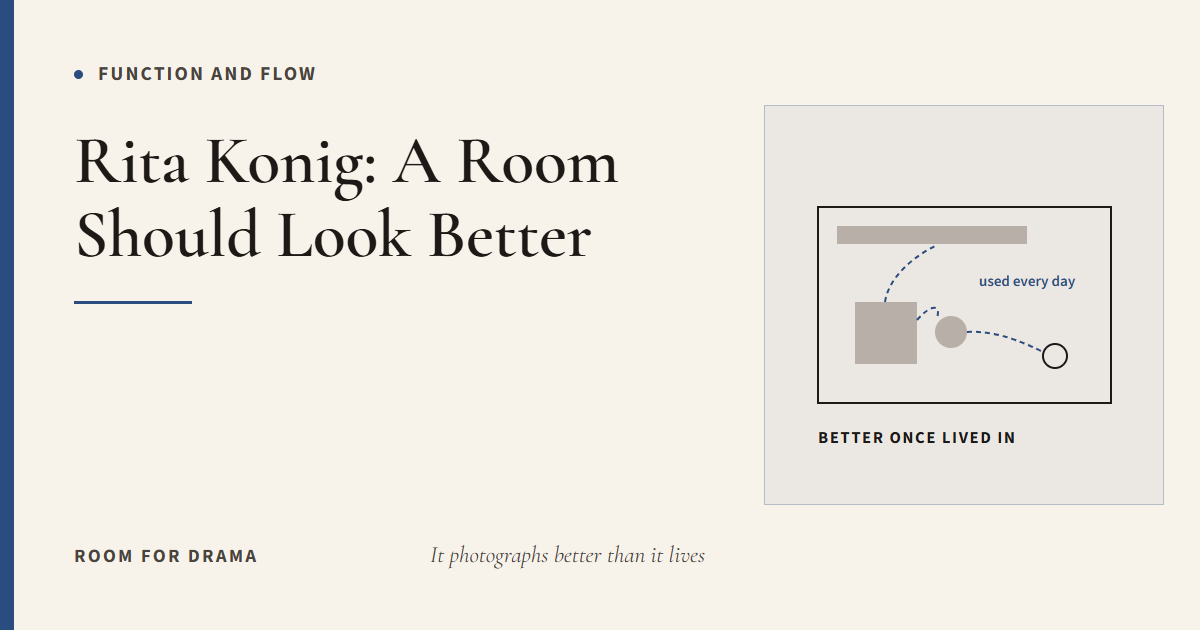
Keys, mail, a vase of pampas grass, a woven basket for the things nobody wants to put away properly — an entry table like that gets filed under finishing touches, and then quietly decides whether the house is obliging or annoying every single day. That’s the Rita Konig lesson, and it’s the one this whole series keeps circling back to without quite saying it: personality doesn’t get applied after function. It grows out of how the room actually gets used.
The small relationships are the design

A side table stops being a finishing touch the moment it decides whether a chair is usable at all. A lamp stops being atmosphere when it becomes the difference between a chair that gets read in and a chair that gets photographed. Konig gives those ordinary relationships the same seriousness other rooms reserve for the big gestures — which is a useful correction, because drama doesn’t always need architecture or a heroic budget. Sometimes the strongest move is putting the useful thing exactly where the body expects to find it, then making that relationship beautiful.
Comfort isn’t a concession here, either. A reachable table, a flattering lamp, an old piece somebody refuses to give up — these can make a sophisticated room more convincing, not less. Too many rooms are styled as though use is the mess that happens later: seating that looks right from the doorway but doesn’t support a conversation, a console beautifully arranged and unable to accept a bag. If normal life immediately wrecks the composition, the composition was too fragile to begin with.
Collected is not the same as decorated
A collected room contains real differences — in age, origin, finish, emotional weight, sometimes sheer oddness. An antique table can sit beside a newer chair; art can vary wildly in period and scale, because the room has more than one reason to exist. The weak imitation buys things that merely look collected, which produces coordinated irregularity: a room full of new objects styled to imply a history they don’t have. The slower, better move is to keep what already has meaning, add only what the room genuinely needs, and resist replacing something simply because the old and new don’t match on paper.
Pattern gets used the same disciplined way — wallpaper, rugs, and cushions can pile up, but the effect stays cumulative rather than announced by one enormous gesture, because some of it leads and some of it sits back. Don’t ask how many patterns a room can hold. Ask which one sets the rhythm and where the room needs a pause.
The one house where the claim can be tested
Most designers’ own houses are unfalsifiable. They are photographed once, at the best hour of the best day, by somebody who was invited. North Farm is the exception worth knowing about: the Victorian farmhouse in County Durham that Konig renovated for her own family, published by House & Garden in March 2020 and given a house tour by Elle Decor — and let out to strangers.
That changes what the house is obliged to survive. Renters did not choose the sofa, do not know which chair is the good one, arrive in the dark with wet coats and a cooler, and will eventually set a glass down on something that deserved a coaster. Any room in that house that only works while the owner is quietly managing it gets found out inside one weekend. I can’t think of a harder test a designer can voluntarily set for their own taste than handing it to people who owe the composition absolutely nothing.
You can run a weak version of the same test without letting anybody in. Ask what in your room currently depends on you tidying it. Not once a week — daily, invisibly, by reflex. Every one of those is a design decision the room lost and you are now personally covering for.
Copy the habits, not the chintz
English layering turns into costume fast when it’s copied without the underlying habits — chintz, antiques, small lamps, and a few intentionally eccentric objects don’t automatically produce warmth on their own. I would not copy the look before copying the method. Where does the drink actually go? Which chair gets used? What’s earned its place through use rather than trend compatibility? Once those questions have answers, decoration has something real to support — and the room stays flexible enough to survive a new painting or a reupholstered chair without the whole concept collapsing.
Source: Rita Konig’s studio site and its interior-design approach, including its North Farm, Co. Durham project page; House & Garden’s March 2020 feature on the farmhouse and its Rita Konig style file; Elle Decor’s house tour of the same property.
Designer study. This concise study is part of Designers Worth Studying, the deeper Room for Drama index for what to borrow, what not to copy, and how each idea survives an actual room. Photographs in this series are Room for Drama’s own illustrative images, not photographs of the designer’s projects.
Same problem, elsewhere in the house
Room notes
Keep the room on the record.
One useful note at a time: what to test, what to ignore, and what changed when the room got another vote.