Furniture and Scale
Kit Kemp: Pattern Is Better When Comfort Wins the Argument
Kit Kemp is useful to study not because she gives permission to add more, but because her layered rooms keep comfort, hierarchy, craft, and hospitality visible through all the pattern.
A Kit Kemp bedroom can carry a bold headboard, patterned curtains, striped upholstery, art, books, painted furniture, and a rug with opinions — and by all reasonable odds it should collapse into decorative static. It doesn’t, and the reason is the actual lesson: the room never loses its chain of command.
Kemp’s rooms are visibly having a good time, but the harder test is hospitality, not decoration. A hotel room has to be memorable without becoming confusing, comfortable without becoming anonymous, distinctive without asking the guest to admire it from a safe distance. Pattern, art, craft, painted furniture, and color are the obvious signatures. Comfort surviving contact with luggage, wet coats, and tired guests is the part that’s actually hard.
The scale is what makes this checkable rather than merely a matter of taste. Firmdale, which she founded with Tim Kemp, runs eleven hotels: eight in London — Ham Yard, Haymarket, The Soho, Charlotte Street, Covent Garden, Number Sixteen, Dorset Square and Knightsbridge — and three in New York, at Crosby Street, The Whitby and Warren Street. That is a sample size rather than a portfolio. Every one of those rooms has to be re-let tomorrow night to somebody who has never heard of the designer and will not be charmed into forgiving a bad reading light. A pattern scheme that quietly irritates people does not turn up in the comments. It turns up in whether they book again.
The ordinary actions have to stay visible

Guests arrive distracted. They need to know where to put a bag, charge a phone, sit down, and get into bed without conducting a spatial investigation. Kemp’s strongest interiors keep those actions visible — the bed stays the anchor, seating forms an understandable social territory, lamps create usable pools of light — and let decorative decisions sit on top of that structure instead of replacing it. Before adding the embroidered cushion or the eccentric lamp, make sure the room already explains itself. Drama is much easier to enjoy when nobody has to walk sideways around it.
Pattern needs a volume control
Collect several patterns that all shout at the same size and contrast, and a room becomes a committee meeting in fabric form. Large florals, small repeats, stripes, and graphic art do different visual jobs; when they change scale, the eye can move through them. Kemp’s better rooms usually have one dominant pattern or color relationship establishing the main note, with supporting fabrics that know whether they’re leading, answering, or staying quiet — one pattern that earns the long look, one smaller pattern to keep it company, and enough solid material to keep the room from becoming wallpaper with furniture inside it.
Comfort organizes the room
A sofa group tells you where conversation happens. A substantial headboard makes the bed feel settled. A lamp beside a chair turns furniture into an actual reading place instead of a chair-shaped accessory. If the furniture plan is weak, more pattern doesn’t make it stronger — it just makes the weakness more expensive to ignore. The test that matters is whether the room can still perform its job on a completely unremarkable day, which is why hotel work is such a useful study case: the guest does not owe the room good behavior.
Craft breaks the sameness that abundance can create
Art, textiles, sculpture, and work by makers do more in a hotel room than signal luxury — they introduce irregularity a purchasing package can’t fake: a visible hand, an unexpected proportion, a piece that refuses to behave like filler. At home that doesn’t require commissioning a room full of bespoke work. One distinctive object, inherited piece, or serious artwork can carry more identity than twelve generic accessories recruited to look collected. And art itself is a participant, not what happens after the furniture is finished — it can establish a color, interrupt symmetry, or give a busy wall one clear destination, and a strong piece can be quieter than a gallery wall and still carry more authority.
What gets lost in the copy
The weak version of Kemp is predictable: pattern on pattern, trim on everything, art on every wall, enough small objects to turn dusting into a part-time job. That reproduces ingredients while missing the relationships — layering without hierarchy is clutter, whimsy without comfort is theater scenery, color without a spatial reason is just paint with confidence. I would not copy the quantity of detail automatically, especially in a small or high-maintenance room. I would copy the nerve to choose a dominant idea, the willingness to let craft carry identity, and the insistence that comfort stay visible through all of it.
A faster way to check a busy room than copying its shopping list: name what anchors it, find the pattern or color story that would leave the biggest hole if removed, notice where scale changes from bold to quiet, and ask what could disappear without damaging the idea. That last question is the useful one — a layered room still needs expendable pieces.
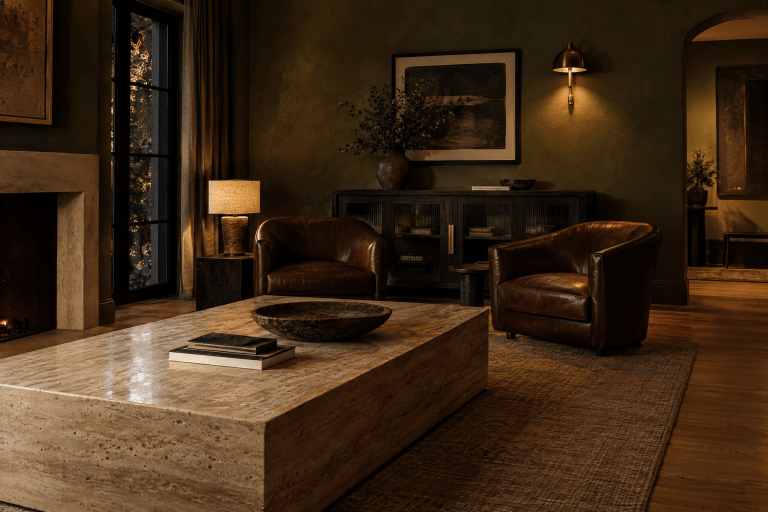
Source: Kit Kemp Design Studio’s project archive and philosophy; Firmdale Hotels’ own listing of its eleven London and New York properties; House & Garden’s designer profile; Kemp’s own Design Stories. The photograph above is Room for Drama’s own illustrative image, not a Kit Kemp interior.
Same problem, elsewhere in the house
Room notes
Keep the room on the record.
One useful note at a time: what to test, what to ignore, and what changed when the room got another vote.