Function and Flow
Rooms in Real Life: Design After the Photograph
Design for the room after the styling is over: chargers, shoes, blankets, pets, work, cleaning, guests, aging, and reset routines are part of the interior, not evidence that design failed.
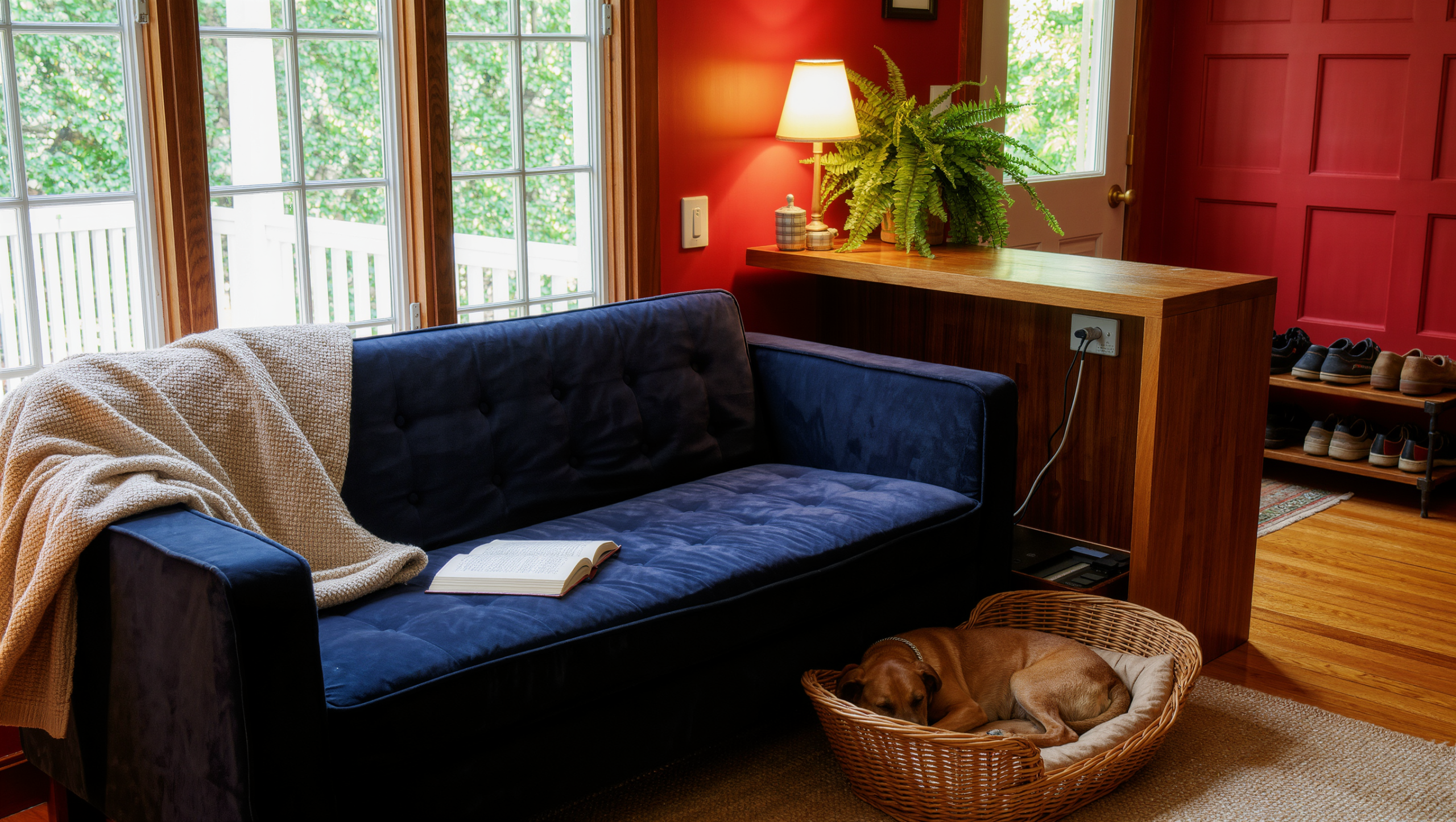
The photograph gets three minutes. The room gets the rest of your life.
Real interiors contain charging cables, laundry in transit, dog beds, medication, mail, school bags, half-read books, wet coats, guests, work, and objects that did not make the styling edit. Good design does not pretend these disappear. It gives them choreography.
The useful room is the one that can absorb ordinary life, recover without resentment, and still retain its point of view.
Design the landing places
Notice where objects pause on their way to being put away. The chair, the counter edge, the third stair, the floor beside the door: every one of them is telling you the system needs a landing zone right there, or a much shorter route to the one it has.
Put the landing point close to the action: keys near arrival, blankets near seating, laundry near dressing, chargers near the devices that use them. A storage solution across the house may be technically organized and practically ignored.
Test the room occupied

Sit in every primary seat. Open every nearby drawer and door. Walk the busiest route while someone else is seated. A layout that works only when the furniture is empty is not finished.
Put the moving parts in the test. Dining chairs pulled out. Recliners extended. Desk chairs occupied. And the bags, coats, and cups people actually carry in with them, which never appear in the plan.
Check reach before adding accessories
Reach for the lamp, the table, the outlet, the control, the storage, and notice whether you had to lean awkwardly to get to any of it. Styling moves the practical objects out of the frame. Daily use puts them straight back.
If the room needs several tiny tables because the useful surface sits too far away, the furniture relationship is the problem. More accessories will not fix it.
Include the reset burden
A room can look flexible while quietly depending on one person to restore it every night. Make the storage obvious, reachable, and close to the activity, so putting the room back does not require specialist knowledge that lives in one head.
Count the steps between use and return. If changing the room from work to dinner requires clearing six piles and moving furniture, the room is asking too much of daily discipline.
Judge the room after dark
Photogenic daylight hides poor task light, glare, and evening circulation that does not work. Use the room at the hours that actually matter. Read a page. Look at a screen. Talk to somebody across it, and walk the route while they are still sitting there.
Move the plug-in lamps around before you buy more fixtures. Fixed electrical changes need qualified installation, and they are a great deal harder to undo than a lamp standing in the wrong corner.
Let furniture age with use
Choose finishes and textiles for the household you have, not an imaginary careful version of it. Go through the cleaning, the repair, the sun exposure, the pet use, the spills, and the replacement cost before you commit to a material that will make everybody anxious every time somebody sits down with a glass.
Patina can be beautiful when expected. Damage is less charming when every mark feels like a crisis. Select the level of preciousness the household can actually support.
Design around changing bodies
Needs shift with children, injury, aging, guests, and mobility, and they shift without much notice. Stable paths, good light, usable reach, and furniture that can be rearranged will serve you longer than one fixed perfect composition.
Accessibility does not have to look institutional. A stable chair with arms, a clear threshold, better contrast, and a switch somebody can actually reach all sit comfortably inside the room’s aesthetic while making it easier for more people to use.
Make technology part of the room
Chargers, routers, screens, speakers, game controls, and work equipment exist even when a photograph crops them out. Plan the power, the ventilation, the cable routes, and the storage, so the technology can be used without turning into permanent visual clutter.
Do not conceal powered devices in closed spaces that create heat or violate manufacturer guidance. Practical integration beats decorative hiding.
Give guests somewhere to exist
Hosting reveals whether the room has spare capacity. A guest needs a place for a coat, bag, drink, and body. Leave enough empty surface and flexible seating that hospitality does not require evacuating everyday objects first.
For related planning, see Rooms in Real Life and Room Function.
Photograph the room when it is ordinary
A photograph of a normal day will show you object drift, weak storage, blocked routes, and visual imbalance far more honestly than a styled one ever could. Use it as information, not as evidence of failure.
Ask what repeatedly appears in the image. If the same bag, blanket, paperwork, or charging cable is always visible, the room probably needs a better home for that category.
Look for camera tricks
Wide-angle lenses exaggerate floor area and distance. Cropping removes the television, the doorway, the storage wall, and the second chair somebody sits in every single day.
Take the principles from an inspiration image: the color, the scale, the lighting, the material. Do not take it as proof that the same furniture coordinates will work in a different footprint.
Preserve pleasure
Designing for real life does not mean reducing every decision to efficiency. Art, color, plants, beautiful objects, and generous textiles all make the daily routine better to move through. The point is to give those pleasures a room that can hold them without constant staging.
A successful room is not the one that never looks lived in. It is the one where living and design stop behaving like competing interests.
Same problem, elsewhere in the house
Room notes
Keep the room on the record.
One useful note at a time: what to test, what to ignore, and what changed when the room got another vote.