Outdoor Rooms
The Side Yard Becomes the Supper Room
Turn a side yard into an outdoor supper room with a clear table footprint, practical kitchen route, shade, lighting, privacy, planting, and weather-ready materials.
On this page
14
The side yard is often treated as the house’s service corridor: bins, hose, gate, mystery shovel.
That same strip makes a good supper room for an unglamorous reason: the walls are already there. You do not have to build a room. You have to stop treating the one you own as storage. The version that works does not pretend the bins moved out. It puts dinner around the drainage, the gate, the meter, and the route somebody still needs on an ordinary Wednesday.
Keep the service jobs honest
Before a single chair goes down, find the meter, the hose bib, the gate, the drain, the bins, and whatever somebody will need to reach in February. Dinner moves around those. They do not move around dinner.
Anything parked in front of equipment someone has to reach should be liftable by one person. Build a permanent screen across a shutoff and you have built a thing you will dismantle at the worst possible moment. Clearances and property rules apply to anything fixed, so settle those before you pour anything.
Test the table in full use
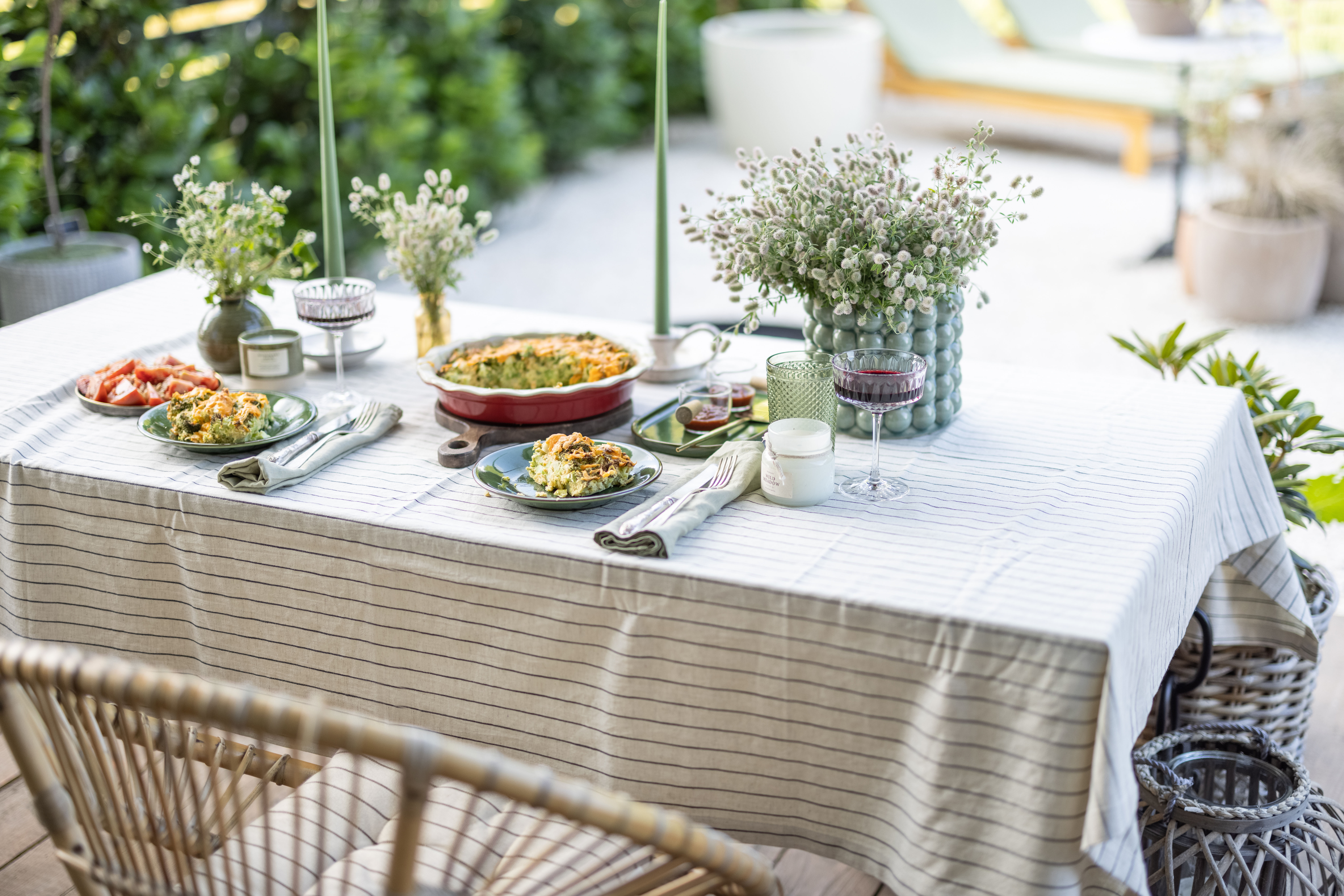
Tape out the table and the chairs as they sit when people are in them, which is considerably larger than the footprint on the product page. Then carry a tray from the kitchen to the far seat. If somebody has to stand up so you can get past, the layout has already failed, and no quantity of string lights is going to fix it.
A narrow rectangle agrees with the geometry. A small round table argues with it, pleasantly, and sometimes that is the better call. A bench on the wall side takes four chair pullbacks out of the equation entirely. Which one wins depends on how many people actually eat out there and which direction traffic has to get through.
Choose the daily table size, not the party size
Two or four people eat out there most weeks. Eight show up twice a summer. Build the permanent room for the twos and fours.
The eight get folding chairs and an extension leaf, carried out for the night and carried back. A side yard feels twice as wide the moment it stops storing a party that is not happening.
Make the kitchen route part of the plan
Outdoor dining turns irritating at the precise moment a forgotten fork requires an expedition. Keep the serving path straight, and give it one landing surface near the door. A console, a stool, a shelf, anything that lets you set the tray down before you open something.
Leave the threshold alone. The door still has to swing, and nobody should walk out of the kitchen into the back of an occupied chair.
Give dirty dishes a return route
Serving is the half everybody plans for. The dishes come back the other direction, at night, usually carried by the person least interested in the job. Plates, glasses, napkins, and the serving pieces all need somewhere to go that is not the doorway.
One tray or landing surface can keep the reset organized and reduce repeated trips through a narrow space.
Control sun and wind
Watch the strip for a week before you buy anything. Note the hour it bakes, the direction the wind comes through, and where the shade actually falls at seven. A narrow gap between two buildings concentrates heat and wind both. It is a flue and an oven, depending on the day.
Umbrellas, shade sails, planting, or a pergola may help, but structural installations require appropriate anchoring and local compliance. Choose solutions for the actual exposure rather than copying a wider patio; a shade sail sized for somebody else’s yard will spend the summer flapping at the wrong hour.
Use the buildings as shelter when they already help
A wall you already own may be making afternoon shade or a wind shadow for free. Notice what the architecture is doing before you pay somebody to duplicate it.
Four feet of table repositioning beats most purchases, and in a strip this narrow, every object you do not buy is a win.
Create privacy without a fortress
Planting, slatted screens, outdoor curtains, layered containers: anything that softens the view without sealing the strip shut. Light and air still have to get through. Property lines, codes, and the neighbor’s opinion all apply before anything permanent goes in.
One panel in exactly the right place usually outperforms the whole boundary fenced. Privacy is a question about one sightline from one seated position, not a question about perimeter.
Use planting to widen the experience
Depth comes from layering foliage near and far, not from marching identical pots down both walls like a guard of honor. Where floor area is precious, go up, provided the support is genuinely stable and somebody can still reach the thing to water it.
Pick plants for the sun, wind, and winter you actually have. Heavy containers where it blows. Freeze-resistant materials where it freezes. Terracotta is a beautiful object and, in the wrong climate, a February casualty.
Do not let planters become the new corridor walls
Big containers read as mass, and mass narrows a corridor fast. Put them where they earn it: screening a sightline, marking where dinner starts, softening the one view you would rather not have.
Nine small pots down the passage is nine things to water and a narrower walk. One or two substantial plantings do more and ask less.
Plan the trip after dark
Light the route, the table, and every step, with fixtures rated for outdoors. Keep the glare out of people’s eyes and the spill off the neighbor’s bedroom window. Several low sources beat one floodlight, which lights a side yard the way a parking structure lights a car.
Fixed electrical work needs a real installation by somebody qualified. The point is that the strip gets better after dark, not harder to walk.
Repeat one thing down the whole length
Repeating one material, color, or light rhythm along the length can make the side yard feel like a designed passage leading to dinner rather than a service alley that acquired furniture.
A runner-like paving pattern, repeated wall lights, one continuous planting edge, or a strong color at the far end can give the space visual structure without adding more objects.
Give cleanup somewhere to go
Decide now where the cushions, serving pieces, candles, and linens sleep. If every evening ends with carrying the entire room back indoors, the room is too elaborate to use often, and a supper room you use twice is a storage problem with a tablecloth on it.
Narrow can be intimate if service works
The strip becomes a supper room on the night eating out there is easier than not. Narrow is an advantage. It puts people close, which is what you wanted, as long as service, safety, weather, and the reset are all in the plan.
The room is successful when it still functions as a side yard the next morning.
Same problem, elsewhere in the house
Room notes
Keep the room on the record.
One useful note at a time: what to test, what to ignore, and what changed when the room got another vote.