Function and Flow
The Clothes Are Not Dirty. They Are Not Clean Either.
The bedroom chair is not a moral failure. It is evidence that the room has no place for clothes that are worn, usable again, and currently homeless.
Room for Drama · Diagnosis Card
The chair pile is evidence, not a moral failure.
Diagnose first. Buy last.
Every bedroom has a category of clothing that storage systems would prefer not to acknowledge.
Not clean enough for the closet. Not dirty enough for the hamper.
The jeans you wore for two hours. The sweater that can absolutely go again. The bra that is not returning to a drawer because nobody wants to pretend that is happening. The robe. The cardigan. The shirt you changed out of because the restaurant was warmer than expected.
None of these things are trash. None are laundry yet.
They become furniture.
The chair gets them first.
The chair is not the problem
People love to solve this with discipline.
Put everything away immediately. Hang it up. Fold it. Do not let clothes accumulate. Become a better citizen by 9:14 every evening.
Maybe.
Or notice that the room has a perfectly legitimate category with no assigned destination.
When a behavior repeats, I would rather design for it than keep treating it like an administrative error.
If a chair becomes the holding zone every night, the chair has been promoted. Either accept the job and make it work, or give the clothing somewhere better to land.
Create a short-term home, not another closet
The solution does not need to be large.
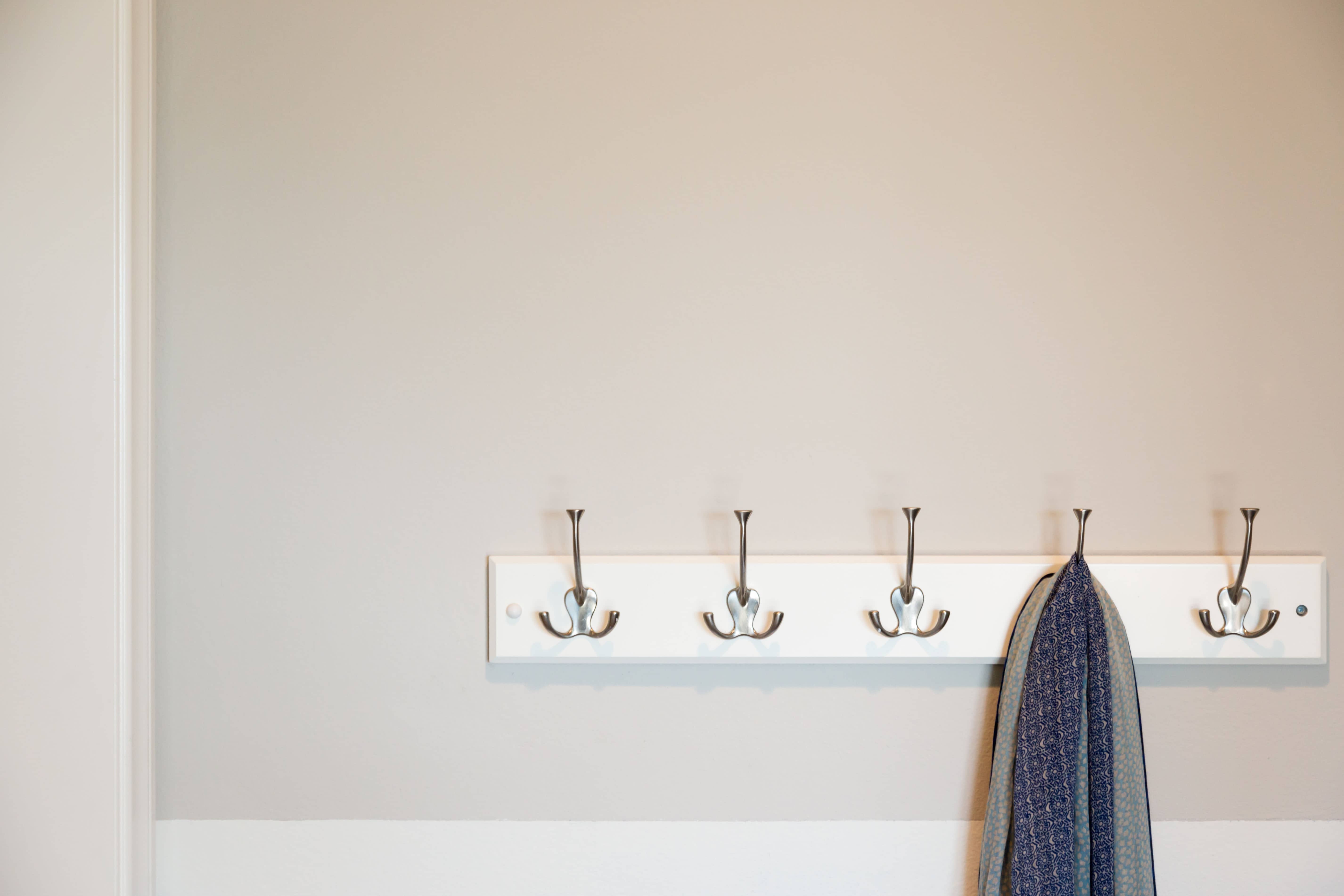
A row of handsome hooks behind a door. A valet stand. One open rail. A shallow wall-mounted peg system. A bench with a very clear upper limit. A dedicated section at the end of a closet where worn-again clothes can hang without merging back into the truly clean population.
The point is not capacity.
Too much capacity turns the temporary zone into permanent storage with worse lighting.
Give the category enough room for ordinary life and no more. Five hooks can be useful. Twenty-five hooks are a closet having an identity crisis.
Put it where undressing actually happens
This sounds obvious and apparently is not.
If clothes come off beside the bed, a system across the room behind a closed closet door may be technically available and behaviorally irrelevant. If you change near the bathroom, the landing zone may belong closer to that transition. If the bedroom is tiny, the back of the door may be more useful than a freestanding piece occupying precious floor area.
Watch the route.
Where do shoes come off? The bag lands somewhere too, and it is rarely where anybody planned. Pajamas begin in one place and tomorrow’s clothes get staged in another, and in most bedrooms those two places are on opposite sides of the room.
The room already has a sequence. Storage should stop pretending everybody teleports between wardrobe states.
The floor is the warning light
Once clothing leaves the chair and reaches the floor, the temporary category has exceeded its container.
That is useful information.
Either the holding zone is too small, the laundry rhythm is too slow, the clean-storage system is inconvenient, or the room is asking one chair to process seven days of clothing decisions.
Do not buy a larger basket immediately.
First ask whether some of the pile has become dirty, some should return to storage, and some should simply leave the wardrobe entirely. A bigger container can hide the volume without fixing the decision.
Open storage has to look intentional when it is full
A row of hooks looks beautiful empty because almost everything does.
Test it with actual clothes.
Put up the dark coat, soft cardigan, denim, robe and whatever else usually appears. Does the wall still feel deliberate? Can the door open? Does fabric cover an outlet or drag across the floor? Does a long garment swallow the bedside table?
This is why I like a strong material or clear shape for the holding zone. Wood pegs. A dark metal rail. A beautiful valet stand. Something with enough presence to remain furniture even after clothing arrives.
The system should not disappear. It should hold its nerve.
A bench is useful until it becomes geology
Bedroom benches are magnets for horizontal decisions.
One sweater becomes three. Three become a tote bag, dry-cleaning envelope and the decorative pillow exiled from the bed every night. Eventually the bench is a sediment layer.
If you use a bench as the worn-clothes zone, define the edge.
One layer only. Nothing underneath. Nothing that blocks the lid if the bench also stores bedding. Clear it on laundry day. Make the rule physical enough that the room gives you feedback before the pile becomes permanent.
Couples may need two completely different systems
This is not a matching-furniture problem.
One person may rewear almost everything and prefer hooks. Another may put most clothing straight into a hamper and only needs a place for pajamas. One may dress in the bedroom; another may use a closet or bathroom.
Do not duplicate a system for visual symmetry if the behavior is not symmetrical.
Two different landing zones can still belong to the same room if the materials, height or finish relate. Function does not have to become ugly simply because two people have different habits.
Clear the chair first and count what comes back
Before installing anything, clear the chair.
For three ordinary nights, place every not-clean-not-dirty item in one temporary location: a spare hook rail, freestanding rack, even a clearly designated basket if that is what you have.
Count what arrives. Notice the garment lengths. Notice where you naturally reach for the system and where you ignore it.
That is your actual requirement.
Not a Pinterest photograph of a bedroom containing one linen robe and a hat nobody wears indoors.
The clothes were never evidence that the room is failing. They are evidence that one category of life never got an address.
Give it one.
Then the chair can decide whether it still wants a job.
Same problem, elsewhere in the house

