Furniture and Scale
The Lamp Is in the Right Room and the Wrong Place
A lamp can be in the right room and still fail the seat it serves. Learn how to place task, ambient, and accent lighting around real use, glare, reach, and sightlines.
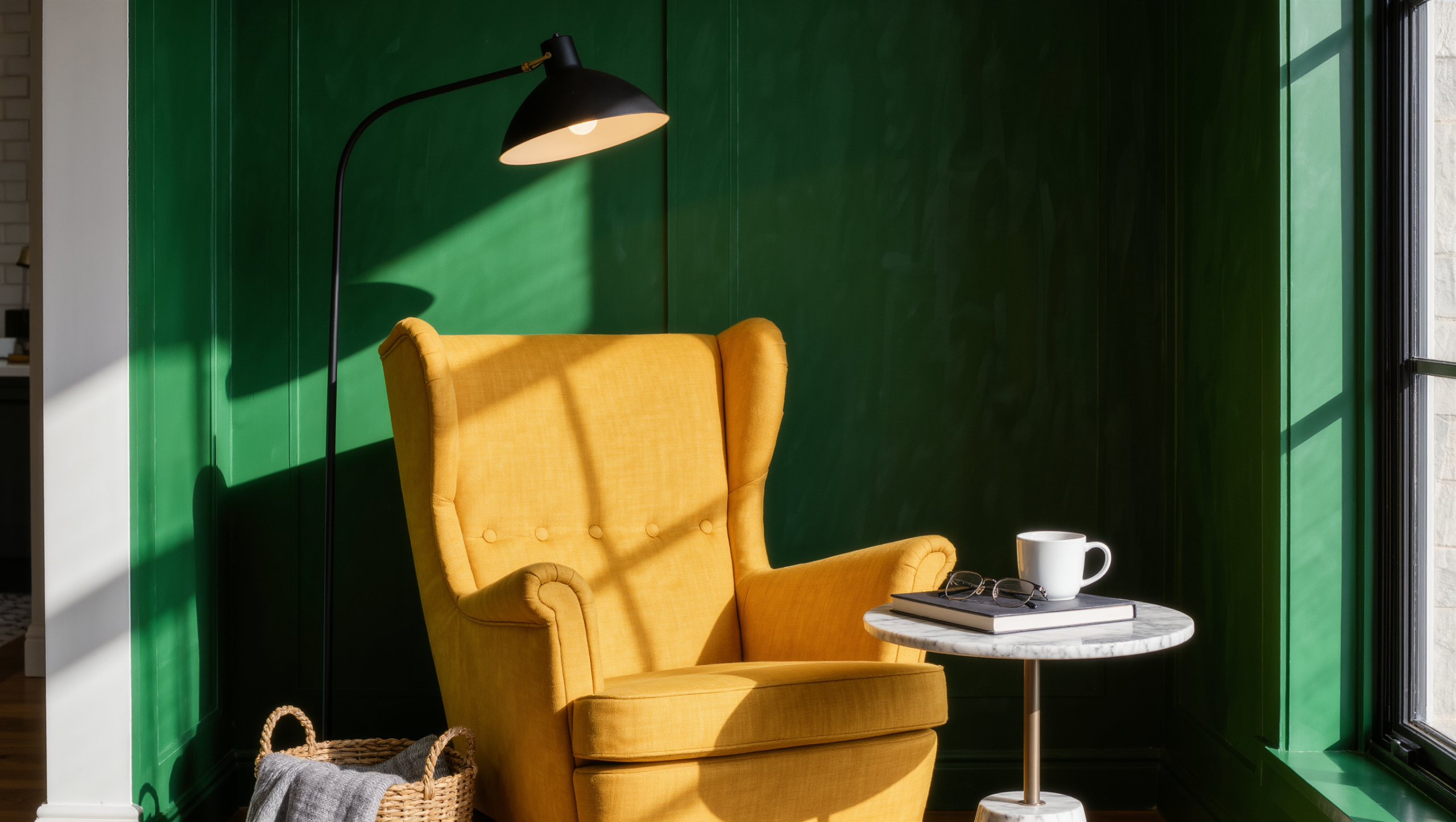
The lamp can be perfectly attractive, correctly sized, and completely useless because it is standing three feet from the job it was supposed to do.
Most lighting problems are placement problems wearing a fixture problem costume. Before you go shopping, ask four questions about the lamp you already own: right height, right distance, right angle, right side of the activity. Three of those are free to fix.
Start with what the lamp is meant to support
Reading, conversation, ambient glow, desk work, bedside, accent. Six different jobs. A lamp that does one of them beautifully is often bad at the other five, which is not a flaw in the lamp.
Name the job before anything else. And if the honest answer is atmosphere, that is fine, but be specific about it: which part of the room is supposed to become more legible, or more intimate, because this lamp is standing there?
A lamp without a job becomes illuminated sculpture. That can be valid, but then it is being judged as an object, not as light.
Reading light belongs near the page

A reading chair needs a source near enough and aimed well enough to light the page without putting a bulb in the reader’s field of view. Those two conditions are in tension, which is the whole reason reading lamps are hard.
Move the lamp before you buy a brighter bulb. A modest source in the right position beats a powerful one on the other side of the room, every time, and costs nothing.
Test it sitting down, with an actual book open, and not while standing beside the chair admiring the shade.
Height changes both function and atmosphere
A table lamp set too low lights the tabletop and nothing else. Set too high, it puts the bulb straight into somebody’s eye. Floor lamps swing between useful reading light and broad ambient wash depending on height, shade and which way they are pointed, and most people never find out which theirs is doing.
Two things to look at: where the light actually lands, and where the brightest point sits relative to the eye of whoever is using it.
The lamp base is furniture; the light source is the real decision.
The side matters for tasks
Writing, drawing, sewing, anything at a desk: put the light on the wrong side and the person’s own hand throws a shadow across the exact spot they are working on.
Move it to the side that clears the shadow for the person doing the work, which depends on which hand they write with. A desk two people share may need two answers.
Bedside lamps should support the bedtime sequence
A bedside lamp has to be reachable from the bed, give enough light to read by or to find the door, and switch off without a final expedition across a dark room.
If the nightstand is already full, take the lamp off it. A wall mount or a floor lamp gives the surface back. And if the shade is blocking the light you need, the lamp is wrong for the job no matter how well proportioned it is.
Conversation areas need light inside the group
A lamp behind the seating decorates the perimeter and leaves every face in shadow. Bring the sources down and in, close to the furniture, and the group acquires an edge you can feel. That is what makes a large room feel occupied after dark.
Put the light where people talk, not where an empty wall needed something on it.
Use a lamp to reveal material
Light raking across a surface brings out texture that flat light erases: plaster, stone, wood grain, the leaves of a plant, the surface of a painting. Quite often a lamp does more work turned toward a wall than pointed into the middle of the room.
Play with the angle. Ten degrees can make a material you already own look considerably more expensive, and you bought nothing.
Watch the shade
The shade decides how the light gets out. Dark and opaque gives you a focused pool. Translucent gives you a broad glow. A wide open bottom gives you glare, at some heights, to some people, which is the kind of problem nobody diagnoses because it only happens from one chair.
Judge the lamp at night, from the seats people use and the routes they walk.
The shade is part of the optical system as well as the outfit.
Placement should respect circulation
A floor lamp can solve the lighting and invent a tripping hazard, if its base or its cord has landed in a route. A table lamp can take over a narrow surface until that surface no longer holds anything else.
Check the approach, the cord, the reach to the switch, and whether anyone can clean around it.
A well-lit obstacle is still an obstacle.
Do not replace the lamp before trying three positions
Move the lamp you have: closer, farther, higher on a different surface if that is safe, or to the other side. One variable at a time, and give each position a normal evening rather than a glance.
If it is still wrong after all three positions, now the fixture has earned your suspicion.
The lamp-placement test
- Job: Reading, task, ambient, bedside, conversation, or accent?
- Distance: Is the source close enough to the activity?
- Height: Does the light land where needed without exposing glare?
- Side: Does the user’s body cast a shadow across the task?
- Reach: Can the lamp be controlled naturally from where it is used?
- Route: Are base and cord clear of circulation?
- Surface: Is the lamp revealing something worth seeing?
A lamp should be judged by the relationship between source and activity, not by whether it belongs to the room stylistically.
Move it before replacing it. The right lamp in the wrong place is still wrong.
For the larger lighting system, use Lighting or browse the Light and Atmosphere hub.
Same problem, elsewhere in the house
Room notes
Keep the room on the record.
One useful note at a time: what to test, what to ignore, and what changed when the room got another vote.