Furniture and Scale
Put the Furniture on the Wall and Give the Floor Back
Wall-mounted desks, nightstands, consoles, and storage can release floor area and simplify circulation. The trick is choosing the pieces that genuinely benefit from floating.
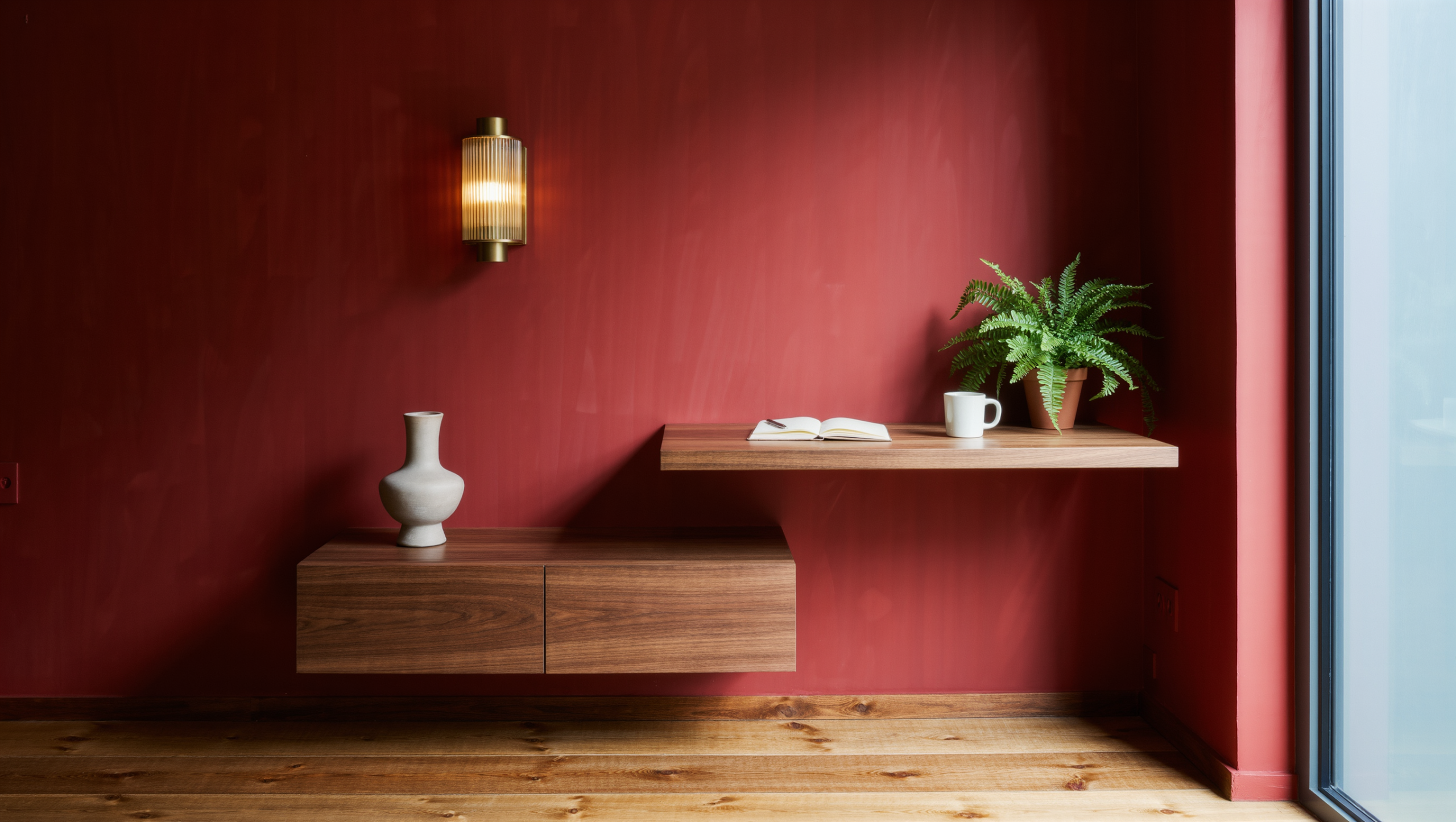
Every piece of furniture that touches the floor creates a footprint, a cleaning edge, and one more object for the room to route around. In a generous room, that is usually fine. In a small one, a nightstand, console, desk, floor lamp, bookcase, and cabinet can make the floor plan look like an obstacle course assembled by committee.
Wall-mounted furniture can return some of that floor to the room. Not because floating objects are magically smaller, but because they remove legs, reduce visual interruption at floor level, and can sometimes fold away when the function is finished.
Start at the pinch point
There is usually one spot in a small room where everybody turns sideways, and it is almost never a mystery. A bedside table squeezing the route to the closet. A console that has quietly made the entry a one-person passage. A desk chair that hits another piece of furniture before anyone has sat in it. That is the candidate. Not the wall that merely looks empty and is therefore begging for a shelf.
Architectural Digest has specifically recommended wall-mounted furniture in compact rooms because the negative space beneath it reduces visual clutter and, in folding versions, can release usable floor when the function is off duty. That is the useful part: the floor gets a second job instead of being permanently assigned to furniture supports.
The wall now has to do structural work

A floating shelf holding a few books is one thing. A wall-mounted desk, bench, vanity, or cabinet loaded with dishes is another. Fasteners, blocking, wall construction, weight, leverage, and installation quality matter. Drywall anchors are not a personality test. If a piece will carry a person or substantial load, the mounting strategy needs to be appropriate for that load and the wall.
This is also why freestanding can be the smarter choice for renters, older walls with uncertain construction, or households that rearrange often. The goal is not ideological floating. The goal is a better room.
Wall-mounted desks work best when work can actually stop
A fold-down desk is useful when the work itself can be put away. If a monitor, printer, notebooks, cables, charger, and office chair remain permanently deployed, the folding mechanism is mostly theater. Pair the surface with nearby storage, cable management, and a chair that can move somewhere sensible after work.
A shallow fixed desk can be better when the station is used every day. It still eliminates front legs and can create a cleaner sweep of floor beneath, while avoiding the daily ritual of packing the office into itself.
Floating storage should not float at forehead height
Wall-mounted cabinets free the floor but can make a room feel top-heavy if every useful wall is filled above eye level. Keep some open wall around the system. Align storage with existing architectural lines where possible, and use depth carefully so circulation does not trade floor legs for shoulder-level collisions.
Two small floating ledges are usually enough beside a bed; the second nightstand nobody has room for was never the point. A narrow wall drawer in an entry holds keys and mail and saves you the console entirely, which is the rare case where the cheaper object is also the better one. And a fold-down dining table is only a good idea if it genuinely clears the path when closed — half of them don’t, and a table folded flat against a wall you now have to walk around has solved nothing.
Legs are not the enemy
A room where everything floats is its own kind of strange — cabinets hovering, ledges hovering, nothing quite meeting the ground, like furniture that has been asked to leave and is thinking about it. Float the one piece whose legs are causing the trouble. If taking those supports away opens a route, makes the floor sweepable, or lets a surface vanish when the job is done, the wall has earned the responsibility. Otherwise let the thing keep its feet.
Research note: This piece is informed by Architectural Digest’s small-space wall-mounted furniture guidance and IKEA’s research into flexible, multifunctional small-space furniture. Structural mounting and load-bearing installations should be verified for the specific wall and product.
Same problem, elsewhere in the house
Room notes
Keep the room on the record.
One useful note at a time: what to test, what to ignore, and what changed when the room got another vote.