Furniture and Scale
Built-In Beds Are Back. Small Bedrooms Can Handle It.
Built-in beds can turn awkward bedroom geometry into architecture—if access, storage, light, ventilation, and normal human behavior survive the idea.
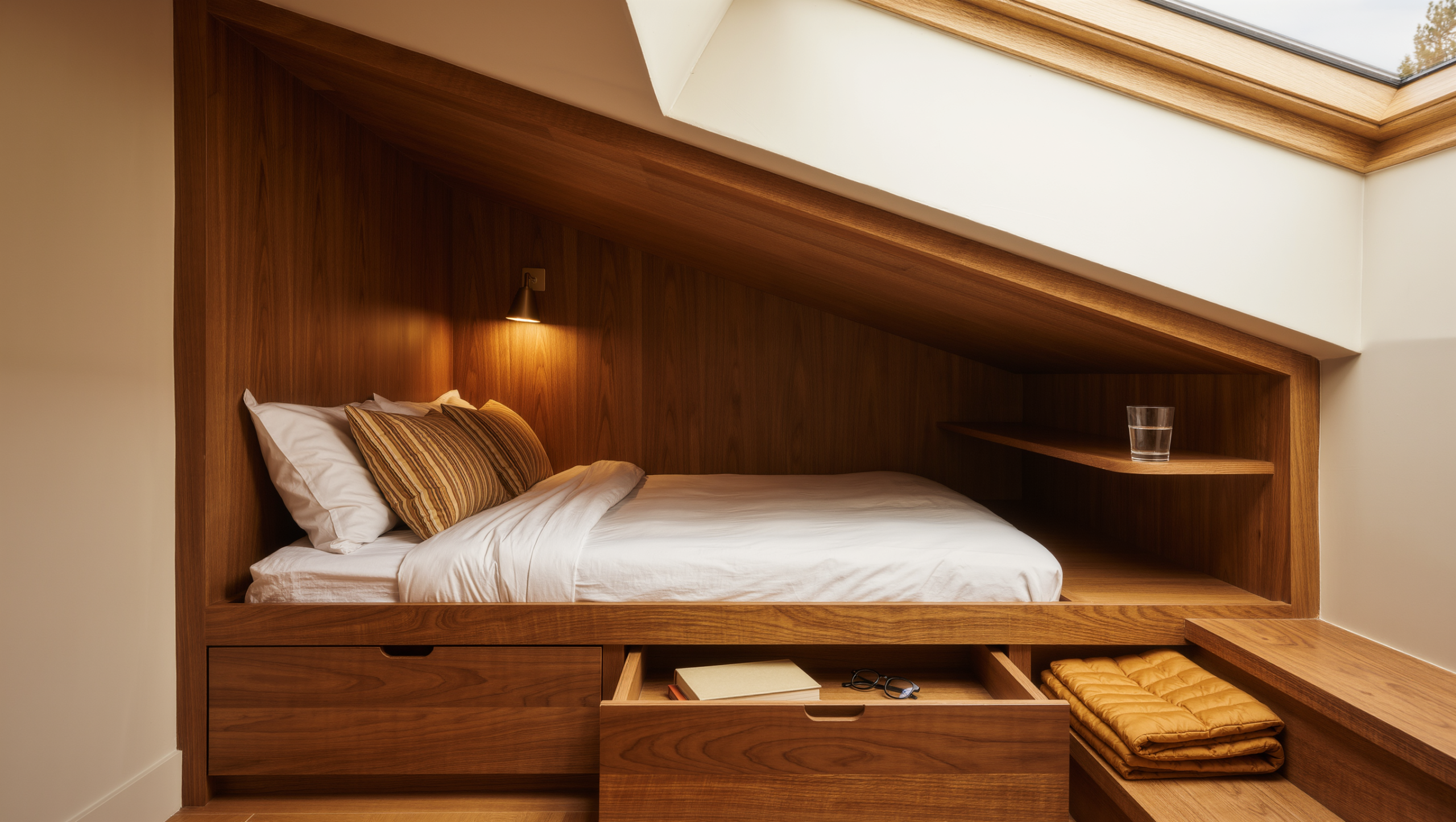
Built-in beds are having a moment, and I understand why immediately. A freestanding bed is a very large rectangle that arrives with demands. It wants clearance, nightstands, lamps, maybe a headboard, maybe a bench, and enough visual authority to justify eating half the room.
A built-in bed can negotiate with the architecture instead of standing in the middle of it asking everyone else to move.
Architectural Digest has been showing compact homes where the bed becomes part of the room itself—folded into storage, shelving, dividers or window niches. That is the version I like. Not “look, we squeezed a mattress into a hole.” I want the awkward geometry to come out of the deal looking smarter than it went in.
Make the weird wall look like it was always the plan
Deep window bays, attic edges, narrow end walls, alcoves and strange recesses are exactly where a built-in can earn its drama.
A wide headboard can bridge an uneven wall. Shelving can replace the nightstand that never fit anyway. Drawers can use the base. Cabinets can climb around the bed instead of taking another wall. The whole composition can turn one awkward edge into the strongest visual move in the room.
I am not interested in making every small bedroom disappear into pale paint and tiny furniture. Small does not mean timid. If the bed is already the biggest thing in the room, let it have a point of view.
Then imagine changing the fitted sheet on a bad day
The beautiful photograph stops helping at exactly this point.
A mattress tucked tightly between three walls can look fantastic and turn laundry day into a minor contact sport. Can you reach the corners? Can the mattress lift enough to tuck bedding? Can somebody sit up without meeting a shelf? Can the person nearest the wall get out at 2:00 a.m. without crawling over another human like a burglar escaping a skylight?
If the answer is no, that does not automatically kill the idea. It may be perfect for a child’s room, guest room or daybed. It may be deeply annoying for two adults every night. The glamorous idea gets to stay only if normal life can live with it.
The other thing a built-in bed quietly does is marry the room to one mattress size for as long as the cabinetry survives. A freestanding bed can be sold, given away, or swapped when a child grows or a household changes. A niche built to the inch around a full mattress is a decision about who sleeps in that room, and the next person to want a queen in there will be looking at a saw. Worth it when the geometry is genuinely awkward and the room has one obvious occupant. Much less worth it in a spare room whose job has changed twice already.
Do not count storage you cannot comfortably reach
Three mechanisms. Three separate ways to be disappointed.
Drawers
Under-bed drawers sound like free square footage right up until one of them hits the rug, the radiator, a chair leg or the only walkway through the room. Measure the pull-out distance, not the drawer. A drawer that opens four inches is a shelf with a handle on it.
Lift-up bases
Lifting the whole mattress solves the clearance problem by replacing it with a physical one. Excellent for spare bedding, luggage and off-season clothes. Miserable for anything wanted on a weekday morning, and a poor choice for anyone who should not be hauling a loaded deck overhead at all. The mattress also still needs to breathe: a solid platform boxed in on every side can trap moisture underneath it, which is why so many lift-up and built-in bases use slats or a vented deck. Ask for one, or drill for one, before the bedding goes in.
Open cubbies
Cheapest, easiest, and visually noisy in about twelve minutes. They hold up if the contents are books or matched baskets and nothing else. They stop holding up the instant the household notices a free horizontal surface.
Pick the mechanism from the room and from the body using it. I have no interest in theoretical storage. If opening it is a production, it will end up holding holiday linens and objects nobody remembers owning.
This is one of the rare times I want the room to close in a little
A sleeping zone does not always need to feel expansive. A little enclosure can be the whole point.
Wrap the niche in color. Bring in fabric. Use a darker ceiling inside the alcove. Add wall lights so the bed has its own pool of glow. Give the back wall pattern or texture. Make it feel less like a mattress inserted into cabinetry and more like a destination you actually want to climb into.
There is a strange reflex in small rooms to make everything lighter, smaller and quieter. Sometimes the room feels bigger because one function has been made stronger. The bed becomes a contained world; the rest of the floor gets to relax.
Let the room tell you what the built-in needs to include
If the real problem is clothing storage, build around that. If the room needs a desk, make the desk part of the composition. If daylight is scarce, do not bury the best window behind a heroic cabinet scheme because the rendering looked balanced.
Small rooms usually have competing priorities. A good built-in bed settles the argument. A bad one wins the visual argument and loses every practical one.
The one worth building earns its keep, adds atmosphere, and leaves the room easier to use than it was. All three. I am greedy that way.
Research note: 2026 examples and trend direction from Architectural Digest’s coverage of built-in beds for small spaces.
Same problem, elsewhere in the house
Room notes
Keep the room on the record.
One useful note at a time: what to test, what to ignore, and what changed when the room got another vote.