Function and Flow
Your Home Bar Has a Morning Shift Now
The all-day beverage station is replacing the bar that only wakes up for cocktails. Coffee, sparkling water, zero-proof drinks, and evening pours can share space—if the workflow resets cleanly between shifts.

The home bar has acquired a morning shift.
That is probably healthier for the floor plan than another cabinet devoted to bottles nobody touches before Saturday. The more useful 2026 version is an all-day beverage station: coffee in the morning, water and sparkling drinks through the day, cocktails or zero-proof drinks after work, then a clean reset before bed.
The concept sounds wonderfully efficient. It can also become a countertop where an espresso machine, kettle, wine opener, shaker, syrup bottles, tea tins, citrus bowl, blender, and six kinds of glassware all apply for permanent residency.
The surface has to change jobs twice a day
The important question is not whether coffee and cocktails can coexist. Of course they can. The question is whether the surface can change jobs without requiring a full excavation.
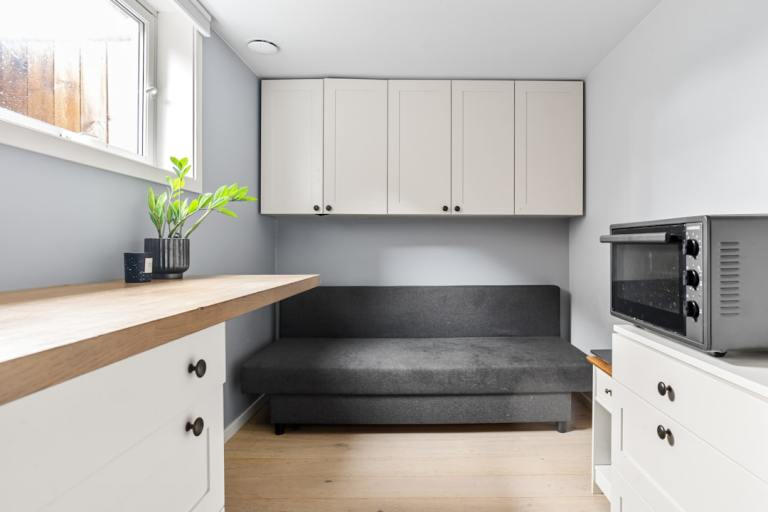
Morning needs cups, coffee or tea tools, water, perhaps milk or refrigeration. Evening needs ice, glassware, mixers, bottles, garnish, and somewhere to set a drink down. The overlap is useful. The clutter is not. Choose what genuinely stays out all day and what disappears between shifts, and be ruthless, because everything that stays out is a decision you are making on behalf of the person who uses the counter at six in the morning, half awake, in the dark.
Protect one piece of empty counter
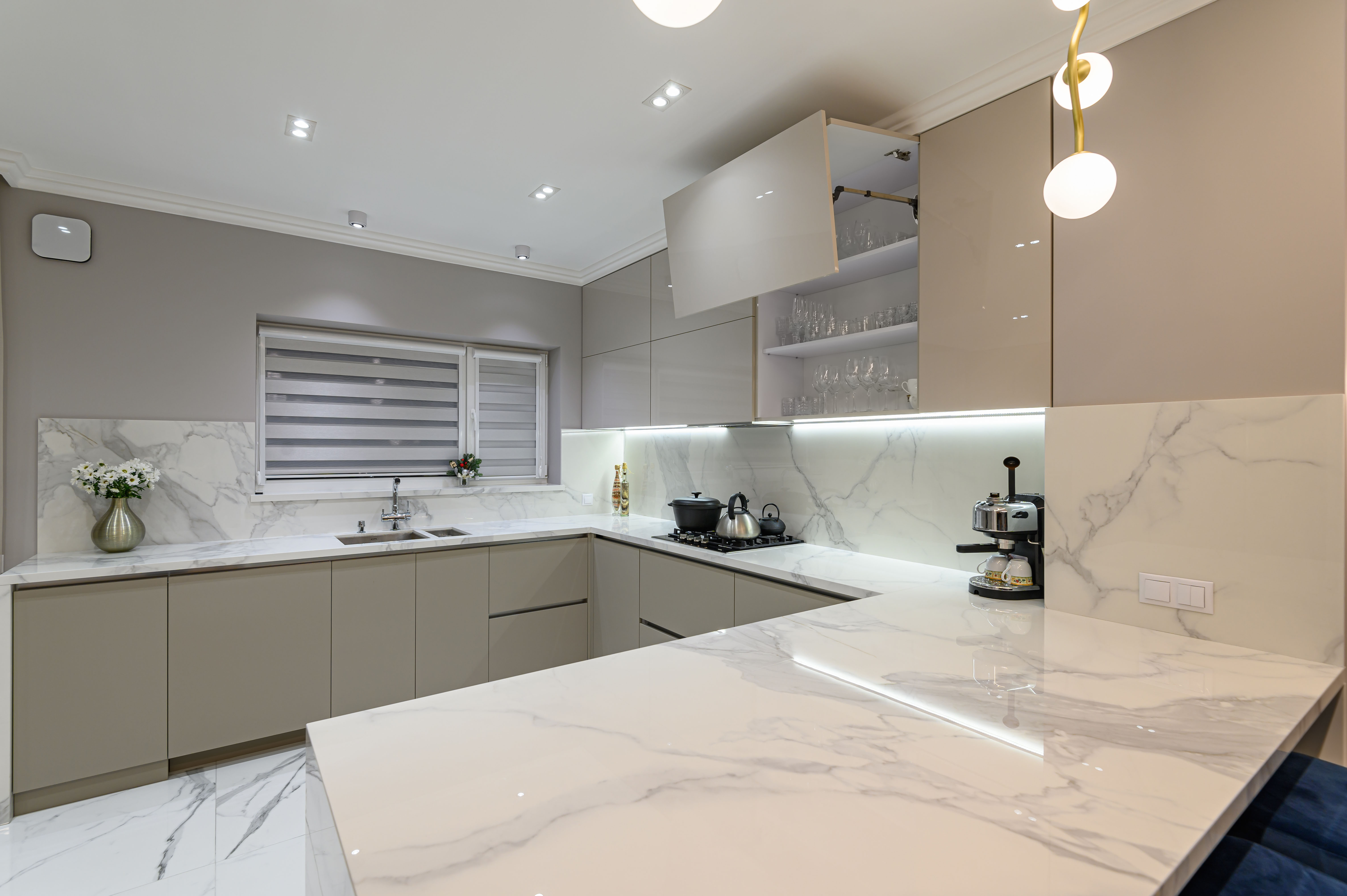
Every beverage station needs a landing zone. Not decorative space. Working space.
If the espresso machine occupies the left, the ice bucket occupies the right, and bottles line the back, there is nowhere to put a cup while pouring or a glass while opening something. The station may contain every tool and still fail at the actual act of making a drink.
Mark a clear working rectangle and defend it with unreasonable loyalty. Nothing decorative gets to stand in it. Nothing seasonal. Nothing that arrived as a gift.
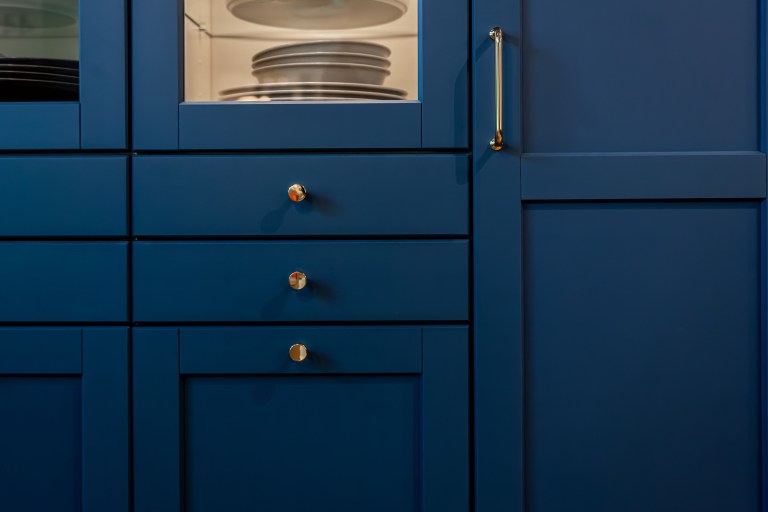
Most of the inventory therefore has to live behind a door. The more jobs a station has, the harder it needs to be edited: keep the most-used daily objects visible if that genuinely makes the morning faster, and put backups, specialty glassware, spare tools and visually noisy packaging into drawers. Open shelving on a beverage station is a promise you are making about how tidy you will be for the next decade, and most of us should not be signing that.
Do not make non-alcoholic drinks the consolation shelf
Water, sparkling water, tea, coffee, and zero-proof options deserve the same easy reach and decent glassware as alcohol if people in the household or guest list actually use them.
That does not require building a second bar. It means the station should not visually announce that one category is the event and everything else is what you offer when somebody says no. The signal is not subtle and guests read it instantly: the good glasses are in front, the tonic is behind the door, and the person drinking sparkling water gets a tumbler that belongs to a different set.
The current home-bar trend is moving toward broader day-to-night hospitality, and it is worth taking seriously rather than treating as a compliance exercise. It aligns the cabinet with the way the household actually drinks instead of with a fantasy inventory assembled for four evenings a year.
Refrigeration has to earn the cabinet space
A beverage refrigerator can be convenient, especially if it keeps guests out of the main kitchen route. It also needs ventilation, electrical access, service clearance, and enough use to justify the volume it consumes.
Before adding one, track what actually needs to stay cold for two weeks. You may discover that the main refrigerator is close enough. Or you may discover that chilled water, mixers, milk, and wine are sending everyone across the kitchen twenty times a day.
Evidence first. Appliance second.
Appliance boundary: Follow manufacturer requirements for ventilation, clearances, electrical supply, and installation. A cabinet door that hides an appliance beautifully while starving it of airflow is not a design success.
Morning light and evening light should not be the same scene
Coffee wants enough light to read labels, measure, clean, and wake up without drama. Evening drinks can tolerate lower, warmer light, but the working surface still has to be usable.
Use a task layer at the counter and a softer ambient layer around it, on separate switches, because that separation is the entire trick and it costs almost nothing at rough-in. If the station sits in a dining or living area, the room has to be able to drop to evening without the cabinet glowing away like a tiny airport café at eleven at night.
One sink can be useful. One sink can also start a renovation.
A wet station makes sense when water access repeatedly improves coffee prep, drink service, and cleanup. If the kitchen sink is five steps away, plumbing may solve less than the cabinetry brochure suggests.
Use the logic in The Home Bar as a Room: wet versus dry is a workflow decision, not a status marker.
Location follows the same reasoning. The station wants to be reachable without crossing the main food-prep path — the edge of the kitchen, a dining-room cabinet, a pantry threshold, a living-room wall, a hall niche between social rooms. Get the Drinks Out of the Kitchen covers the traffic test in detail, and the evening version of that argument is well rehearsed. The morning version is the one nobody checks. Two adults, one school run, one coffee machine and one dishwasher being emptied is a genuine queueing problem, and if the beverage station sits in the middle of it at seven in the morning it has not removed friction. It has built a second counter for the same argument.
Whoever resets it is the person the design is for
A station with two shifts has a handover, and the handover is unpaid work somebody in the household is going to do every single day. That is the part the cabinetry drawing never shows.
Set it up temporarily before committing and use it for a real weekday morning, a real afternoon and a real evening, resetting at the end of each shift. If the surface clears in a minute or two and the tools stay near their use, the hybrid concept is earning its space. If every transition means carrying a bin of equipment back to the kitchen, the station has too many ambitions, and it will quietly settle into whichever configuration was easiest to stop changing — usually the evening one, with the espresso machine behind the shaker, going cold.
Trend source line: Current home-bar coverage is emphasizing bars that serve more than alcohol, including coffee, sparkling water, and zero-proof drinks, while 2026 bar examples increasingly combine concealed storage, refrigeration, and day-to-night use. Sources: Architectural Digest and Houzz.
Same problem, elsewhere in the house
Room notes
Keep the room on the record.
One useful note at a time: what to test, what to ignore, and what changed when the room got another vote.