Light and Atmosphere
The Listening Bar Is What Happens When the Speakers Get Equal Billing
A listening bar is not a wet bar with a turntable dropped on top. The room has to balance sound, seating, glass, light, storage, and drink service so music remains the main event without turning the space into a shrine.
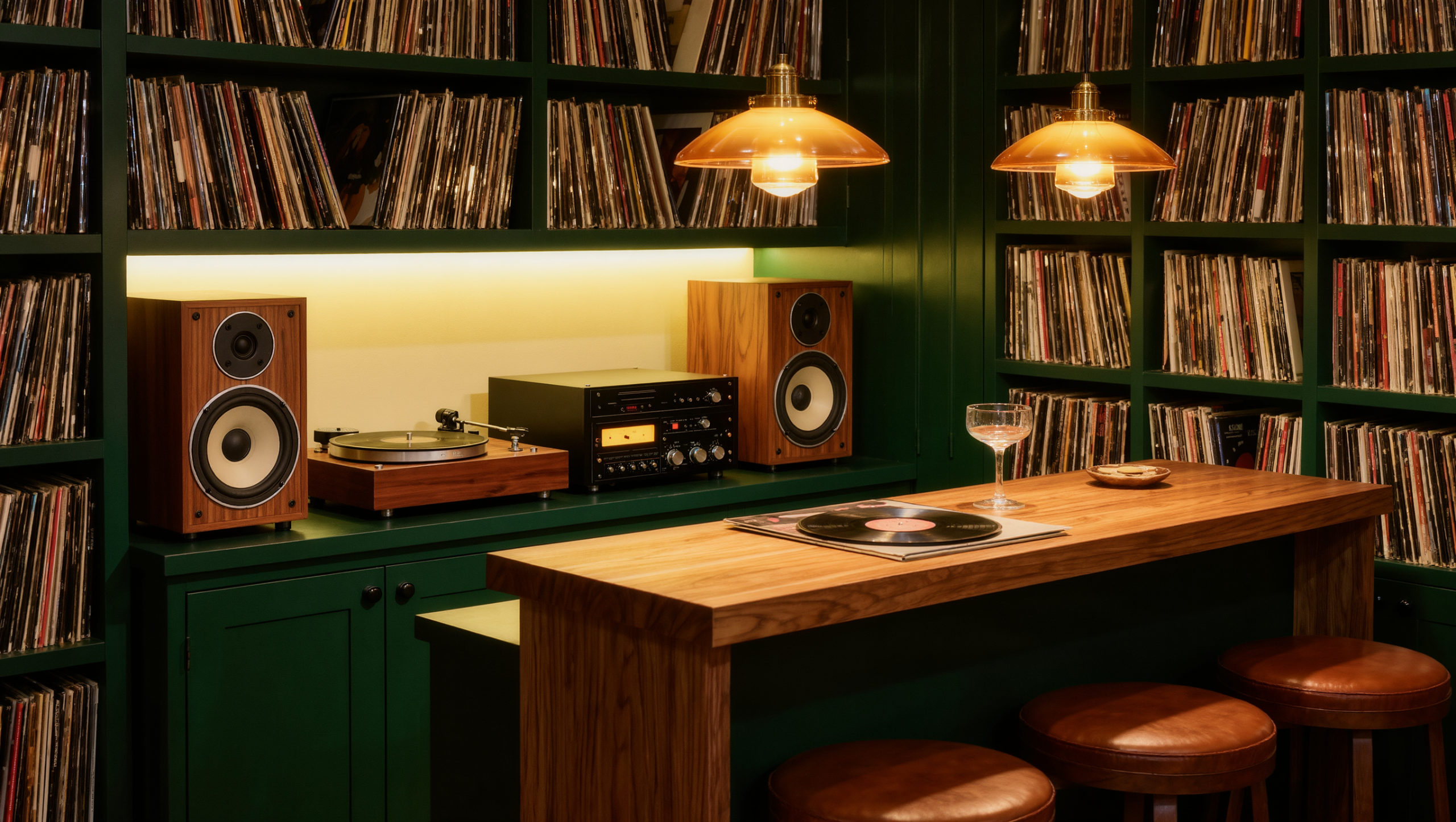
A listening bar is not a wet bar with a turntable dropped on top. That is how you get a damp record collection and three rattling glasses trying to solo over the bass.
The current listening-room revival is more interesting than the usual nostalgia cycle because it is changing what the room is for. Music stops being background. People sit down to hear it. Drinks support the ritual rather than becoming the whole point.
That changes the floor plan.
Everything in here is acoustically employed, including the glassware
Start with the compromise, because there is one. A dedicated listening room can privilege one or two excellent seats and a carefully controlled speaker relationship. A listening bar has a more social job: people arrive, pour something, choose a record, talk between tracks, and sometimes stop talking because the song deserves it. Those are not identical acoustical conditions and no amount of equipment reconciles them. Decide which behavior leads most often, then let the furniture admit what it is giving up.

Speaker placement depends on the equipment and room. Follow the manufacturer’s guidance and, for more complex systems, use qualified audio advice rather than inventing symmetry because the cabinets looked nice on paper.
What the interior can do is keep obvious interference out of the listening zone. Do not park a tall bar cabinet directly in front of a speaker. Do not wedge a speaker into a recess because the wiring disappears there. Do not put every reflective object in the room on one shelf and then wonder why the space sounds sharp.
And then there is the glass, which is beautiful and has opinions about vibration. A room full of bottles, stemware, mirrors, hard counters and bare floors can look superb and sound exhausting. The bar side needs enough soft material around it to stop the space turning brittle: rugs, curtains, upholstery, books, timber, felt, or other appropriate absorptive surfaces. This is the part people skip, because soft materials are not what anybody photographs.
Secure loose glassware and keep delicate objects off surfaces that visibly vibrate at normal listening volume. If the cabinet buzzes during the chorus, the cabinet is now part of the band.
The bar is staff, not the star
The social version of a listening room still needs practical surfaces. A low table, a side table, or a shared central surface should hold a drink without forcing anybody to lean toward equipment or set a glass down on a record sleeve. Small choreography, but it decides behavior. When the room makes the careful thing easy, people take the hint without being asked, and nobody has to be the person who says be careful of the turntable.
The most expensive object in the room should not share a crowded counter with citrus, condensation and a shaker. Create a clear beverage surface away from turntables, amplifiers, receivers and record handling. In a compact room that separation can be as simple as opposite ends of one cabinet, or a small side station. The line only has to be obvious enough that a wet glass never travels over electronics.
The broader service logic in The Home Bar as a Room still applies: a pour surface, a usable edge, light, and a sequence people can follow.
And keep the drink station close enough that refills do not mean leaving the room, without building a counter that installs one person as permanent bartender while everybody else gets the good chairs. That is the quiet failure of most beautiful home bars. Somebody ends up working. A compact self-service water and zero-proof zone, a few prepared mixers, and glassware at the point of use keeps the host in the room, which is where the host wanted to be and why the room was built.
Do not cosplay a jazz kissa
Light first, because listening bars are drawn to darkness for a reason and it is a good reason. Warm, low light makes the room feel focused. It also makes record labels, controls, steps and drink ingredients harder to read, and a lighting plan consisting of one heroic amber bulb and optimism will fail at all four. Separate the jobs. Give the equipment and the records enough task light to be used safely. Give the bar enough light to see what is being poured. Let the rest of the room stay low and warm.
The collection itself gets heavy faster than people expect. Use furniture or shelving suited to the load, keep frequently played records easy to browse without blocking circulation, and store them away from moisture, direct heat, and the splash zone.
If the records end up in horizontal towers on the floor because the shelves photographed better half empty, the room has chosen styling over the actual hobby, and the hobby was the entire reason for the room.
That brings us to the reference everybody borrows. Japanese jazz kissa are an important historical part of listening culture. Inspiration does not require copying another culture’s visual language into a themed basement.
The lesson worth taking is behavioral rather than decorative: music is treated as worth sitting down for. Seating, sound, light and service all exist to protect that attention. A room can learn the ritual without becoming a set, and the tell is simple enough. In a set, the records are props. In a listening bar, somebody has to get up and turn them over.
Trend source line: Architectural Digest’s 2026 entertaining forecast identifies listening bars as a growing residential request; Hospitality Design reports a broader 2026 rise of listening lounges inspired by jazz-kissa culture; Better Homes & Gardens describes listening rooms as a growing home-design trend focused on intentional music, acoustics, and analog ritual. Sources: Architectural Digest, Hospitality Design, Better Homes & Gardens.
Same problem, elsewhere in the house
Room notes
Keep the room on the record.
One useful note at a time: what to test, what to ignore, and what changed when the room got another vote.