Multi-Use Rooms
The Guest Room Office That Can Change Personalities in Ten Minutes
Create a guest room office that changes modes quickly: control the work footprint, protect sleep comfort, hide cables and paperwork, and make the reset possible in ten minutes without buying a whole second room.
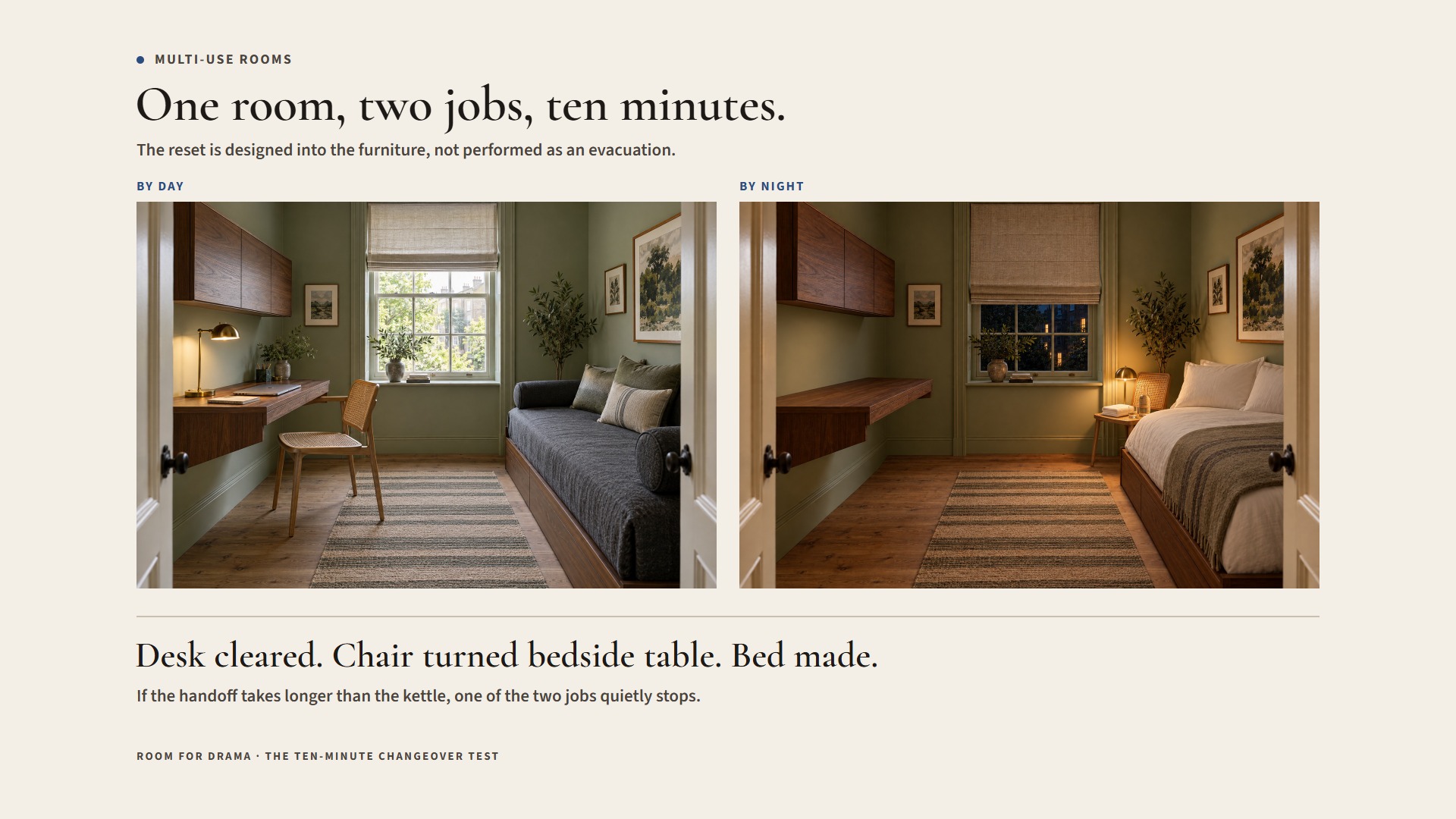
The guest room office fails when one use is permanent and the other is ceremonial. When the room has to work for an actual tired person rather than just convert neatly, Tangled Thistle has the hospitality-side test.
Most of the year, the desk wins. Cables spread. Papers colonize the bed. The guest linens live somewhere mysterious. Then company arrives and the room requires a three-hour evacuation disguised as tidying.
A true dual-use room can change personality in about ten minutes because the reset is designed into it.
Decide which use is daily and which is episodic
If work happens five days a week and guests arrive six weekends a year, the office deserves the more efficient daily setup. That does not mean the guest function can be miserable. It means storage and furniture should make the occasional transformation simple rather than forcing daily compromise.
If guests are frequent and work is occasional, reverse the priority. Use actual frequency, not guilt, to rank the jobs.
Keep work inside one footprint

Choose a desk, cabinet, secretary, or wall area that can contain the active job. Power, monitor, laptop, notebook, headphones, and paper should have a believable home within or immediately beside that footprint.
If work materials routinely spread onto the bed, floor, nightstand, and dresser, the room does not have a workstation. It has an occupation.
Build a shutdown ritual into the furniture
The best dual-use desk can be cleared in a few moves. A drawer receives the notebook. A cabinet hides the monitor or peripherals. A cable channel prevents the floor from becoming a snare. A tray gathers the small items that otherwise migrate.
The goal is to stop the room from making a guest sleep inside someone else’s unfinished Tuesday.
Protect the bed as a bed
Do not use the guest bed as long-term storage if you want a fast reset. Keep linens together and accessible. Give guests a clear surface, useful reading light, charging access, and somewhere for a bag or clothing.
A sofa bed, daybed, Murphy bed, or regular bed can all work; the right choice depends on frequency, comfort expectations, floor area, and how much transformation ceremony you can tolerate.
Keep guest storage small and actually empty
Most short-stay guests need a few hangers, a drawer or shelf, a bag surface, and a place for personal items. They do not need the room’s entire closet if that closet is the only practical office storage.
Reserve a defined portion and keep it genuinely empty. “Guest space” already filled with household overflow is not guest space.
Use lighting to signal the mode change
Task light belongs at the desk. Guest light belongs at the bed. Let them operate independently.
When work ends, turning off the desk light and switching on warmer bedside or room lighting helps the room change emotionally even before a single object moves.
Use Lighting when one ceiling fixture is forcing both modes into the same atmosphere.
Give office storage a closed face
Open shelves are useful until they display printer paper, cables, binders, mail, and half-used notebooks beside the guest bed. Use closed storage for operational material and reserve open space for books, art, or a small number of objects that can belong to both modes.
The room should not require decorative camouflage every time someone stays.
Give guests a landing surface that is not the desk
If the desk remains visible in guest mode, keep part of it clear or provide a separate nightstand, bench, luggage rack, or small table.
A guest should not have to choose between putting a phone on top of office paperwork and leaving it on the floor.
Make the office chair behave in guest mode
A full ergonomic chair may be essential for daily work and visually dominant during a stay. Give it a parked position that does not block the bed or route.
Do not replace a genuinely supportive work chair with a decorative chair purely because guests arrive occasionally. Daily function gets the stronger vote.
The ten-minute changeover test
- Set a timer.
- Close or clear the active work surface.
- Contain cables and papers.
- Make the bed or open the sleep system.
- Place a clear landing surface and towels or linens if relevant.
- Switch the lighting from work mode to guest mode.
- Walk into the room again from the hall.
If the process exceeds ten minutes because objects lack homes, solve those specific bottlenecks. If it exceeds ten minutes because the furniture requires heavy lifting or complicated assembly, the room may need a different transformation strategy.
Reverse the test when the guest leaves
The office should return just as easily. If restoring the workstation requires rebuilding cable routes, unpacking boxes, or moving heavy furniture, the guest mode is still too disruptive.
A dual-use room needs two easy transitions, not one heroic setup.
Do not decorate two rooms on top of each other
You do not need office art plus guest art, office accessories plus guest accessories, office rug plus guest softness. Give the room one material and color language that can tolerate both roles. Let function change; let identity stay.
One good wall color, rug, curtain, and art composition can outperform a pile of “guest touches” stored between visits.
Keep hospitality supplies together
Guest linens, spare hangers, towels, a charging cable, and other recurring hosting items should live in one accessible zone. The arrival should not trigger a scavenger hunt across the house.
Likewise, office supplies should have one compact home so the guest reset does not require relocating the whole business.
Test the room before a real guest arrives
Sleep there for one night or simulate the stay. Check reading light, charging, privacy, bedding access, temperature, and whether the desk feels intrusive.
The exercise will reveal missing details much faster than styling the bed and assuming hospitality is complete.
Neither use has to apologize
A guest room office is not successful because it technically contains a bed and a desk. It succeeds when neither use has to apologize for the other.
Same problem, elsewhere in the house
Room notes
Keep the room on the record.
One useful note at a time: what to test, what to ignore, and what changed when the room got another vote.