Outdoor Rooms
A Pollinator Garden Needs More Than Flowers
Design a pollinator garden as functioning habitat with bloom succession, host plants, nesting opportunities, water, reduced pesticide pressure, and a clear relationship to how people use the yard.
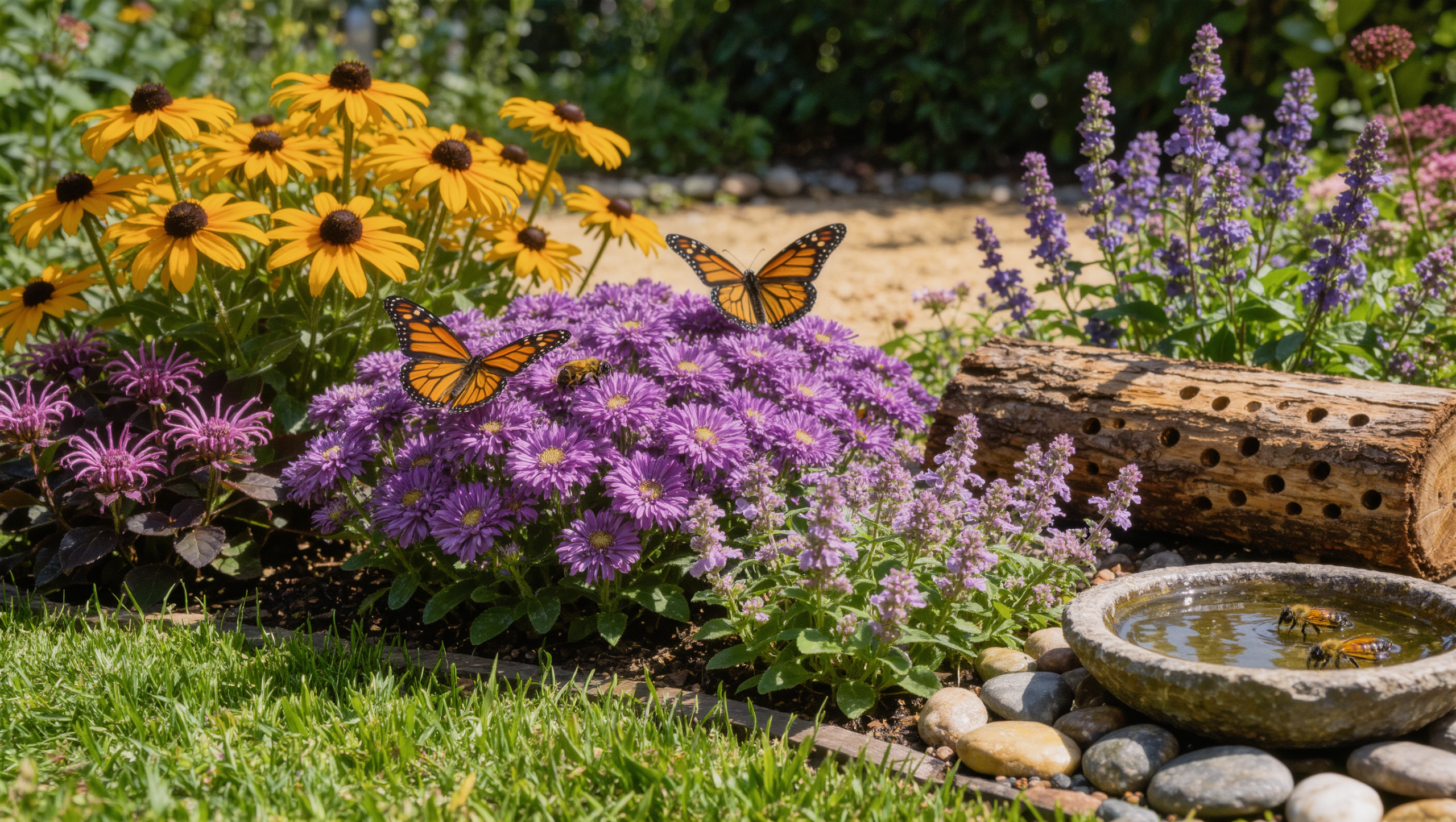
A pollinator garden can be full of flowers and still offer a very short lunch service.
Effective habitat depends on timing, plant diversity, host relationships, nesting conditions, water, pesticide exposure, and the larger landscape around the property. A bed that explodes in June and goes silent by August is beautiful, but it is not a complete system.
Start with the pollinators in your region
Butterflies, moths, native bees, beetles, flies, hummingbirds, and other pollinators use landscapes differently. Plant recommendations should come from regional extension programs, native-plant organizations, conservation groups, or other locally credible sources.
Do not build the garden around a generic national seed mix. Habitat becomes more effective when the plants and insects have an actual ecological relationship.
The gaps in the calendar are the actual design

Write down what flowers in early season, midseason, late season, and into fall — then look at the gaps rather than the entries. The gaps are the garden. Most pollinator beds are overstocked for June, because June is when people shop, and a garden bought in June will flower in June forever.
Cover each major bloom window with several species instead of leaning on one star plant. Weather shortens flowering, shifts it, or skips a year outright, and a reliable performer is reliable right up until the spring it is not.
Add Host Plants to the Menu
Many butterflies and moths require particular plant groups for their larvae. Adult nectar alone does not complete the life cycle.
Identify locally relevant host plants and place them where some chewing, ragged leaves, or temporary decline will not trigger a household crisis. Habitat gardening requires accepting evidence that something is actually eating the habitat.
Masses across, layers up
Repeated groups of the same flowering plant are easier for pollinators to find and easier for people to look at, which is one of the rare cases where the ecology and the composition want exactly the same thing. Use drifts, blocks, or repeated clusters sized to the space you actually have. A small yard does not need twenty species represented by one lonely plant each. That is a collection, and it reads as one.
The second move is upward. Groundcovers, perennials, grasses, shrubs, vines, and trees all supply different resources, and stacking them pushes the habitat past the single flower border where most gardens stop. The layers do double duty: low planting defines the paths, shrubs make rooms, trees hand you shade and structure. A pollinator garden that is only a flat bed of perennials is doing about a third of the work available to it.
The parts that are not flowers
Different native bees nest in bare ground, hollow stems, cavities, or other protected conditions. A landscape mulched smooth from fence to fence has removed all of that without anyone deciding to remove it. Before buying a bee hotel, check regionally appropriate habitat guidance: poorly maintained nesting structures can create their own problems, and a decorative one screwed to a fence and never cleaned is closer to a liability than a feature.
Water is simpler than the catalog makes it sound. Damp soil, shallow water, moisture at the garden edge. No large open water feature is necessary, and if you provide water, keep it easy to clean and do not let it stand stagnant. The best habitat feature is the one you will still be maintaining in year three, which is usually the smallest one.
Reduce pesticide pressure
Before treating an insect problem, identify the organism and the damage. A pollinator garden cannot function well if broad insect control repeatedly removes the animals the planting was designed to support.
When pest management is necessary, use integrated pest-management guidance appropriate to the specific problem, plant, and region. Follow product labels and local regulations.
Keep the traffic out, then put a chair at the edge
A dense flowering bed does not belong against the children’s play surface, the grill, or the narrow gate everyone squeezes through sideways. Give the pollinator activity some spatial dignity and give the people a clear route — high-flower zones beside quieter paths, garden edges, or viewing positions, with primary circulation left alone.
Put something to sit on at the edge of it. A bench, a chair, a small terrace, anywhere the household can watch the garden without walking through the habitat to reach the view. That seat is also the diagnostic instrument, because it is where you notice which week went quiet. At night, light only what people need to move safely and gather, keep brighter fixtures away from the planting where you can, and resist lighting the whole bed as a backdrop. The garden does not clock off when dinner ends.
Keep stems and seedheads selectively
Leaving some stems, seedheads, and leaf material through winter can support habitat and create winter structure. The answer is not abandoning maintenance entirely.
Use a selective cleanup strategy: clear paths, remove diseased material, manage invasive species, and keep the parts of the garden that contribute ecological or visual value.
Use signs of life as the metric
Success is not the number of flowers purchased. Watch what visits, what feeds, what nests, what survives winter, and which bloom periods remain empty.
A garden that changes because you observed it is more effective than a garden copied permanently from a planting diagram.
Eight ways this quietly fails
- Flowers in one season and nothing on either side of it.
- Nectar everywhere and no locally relevant host plants, so nothing completes a life cycle.
- Single plants scattered rather than grouped. Hard to find, hard to look at.
- One vegetation layer, almost always perennials, with no shrubs or trees doing any work.
- Nesting conditions mulched out of existence, or replaced by a bee hotel nobody maintains.
- Broad-spectrum insect control applied by habit, which removes the animals the bed was planted for.
- The busiest human route running straight through the densest flowering.
- Winter cleanup so thorough the habitat ends in October, or so absent that the whole thing reads as neglect to everyone but you.
See Native Landscaping Without the Wild-Mess Excuse and Plants Can Build the Walls.
A pollinator garden is most convincing when the garden is visibly being used by something other than the person who paid for it.
Same problem, elsewhere in the house
Room notes
Keep the room on the record.
One useful note at a time: what to test, what to ignore, and what changed when the room got another vote.