Outdoor Rooms
Edible Landscaping Should Still Look Like Landscaping
Blend fruit trees, berries, herbs, vegetables, and edible flowers into the landscape by planning structure, access, harvest, irrigation, wildlife pressure, and seasonal gaps from the start.
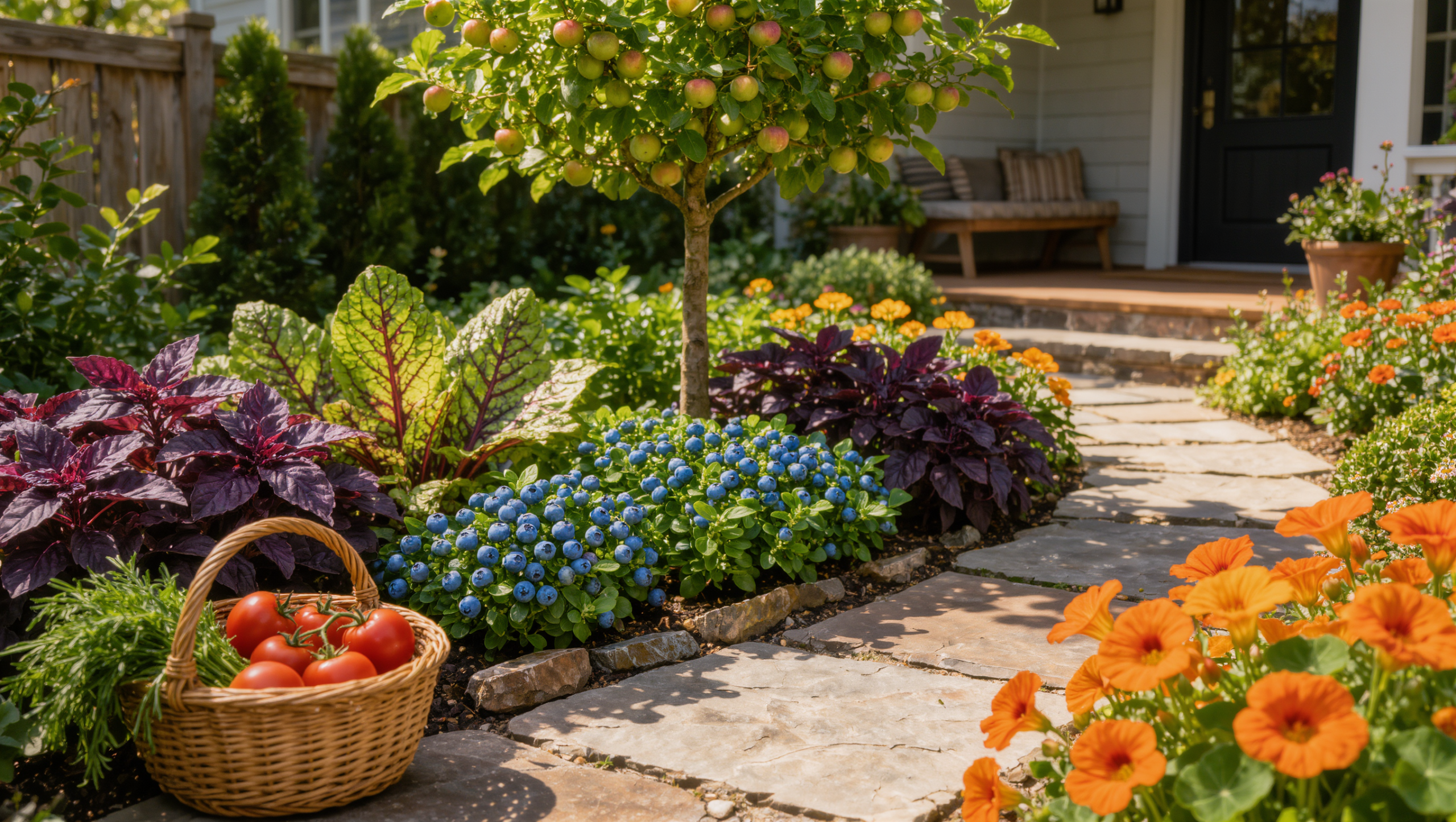
Edible landscaping gets interesting when the yard stops separating “the garden” from everything else.
Fruit trees can provide canopy. Berry shrubs can create an edge. Herbs can fill a sunny path border. Vegetables and edible flowers can become seasonal color. The trick is designing for the less glamorous parts too: harvest, pruning, irrigation, pests, bare soil, support structures, and the month when the tomato plant looks like it has had enough.
Choose edible plants for a landscape job
Start with form and function. A fruit tree may create shade. A berry hedge may define a boundary. Herbs may edge a path. A grapevine may cover a structure where local conditions support it.
If an edible plant has no spatial job and no realistic harvest plan, it may be better in a dedicated production bed.
Design around mature size

Fruit trees and berry shrubs can become much larger than nursery containers suggest. Check mature canopy, root behavior, pruning needs, pollination requirements, and access for harvest before planting.
Do not tuck a productive tree into a narrow corner because it looks charming at five feet tall.
It all depends on how far you are willing to walk
Herbs, salad greens, small fruits — anything picked often — earn their place by sitting within reach of the kitchen or the route you already walk every day. The farther harvest requires special shoes, a gate, and a flashlight, the more likely food will ripen beautifully for someone else.
Reaching is only half of it. Leave room to prune a branch, inspect a leaf, pull a weed, tie up a vine, and get a basket or a wheelbarrow through. Dense mixed planting turns hostile quickly when every harvest means stepping over one plant to reach another, and walking on the soil under a fruit tree all summer compacts the root zone you paid to establish. Paths, stepping stones, or honest bed widths fix it. An unreachable plant is a decorative plant with extra steps.
The bed still has to exist in November
Vegetables leave holes when they are harvested, and they look tired on the way out. Evergreens where appropriate, grasses, shrubs, permanent edging, paths, trellises, and perennial edibles hold the composition once the annuals have gone. That is what separates a productive landscape from a flower bed that looks temporarily abandoned every autumn.
The same thinking applies across the whole season, including the messy middle. Spread spring, summer, and fall interest so productivity does not all arrive inside the same two weeks. Perennial herbs, berries, fruit trees, edible flowers, and annual vegetables can be sequenced rather than stacked, which is the difference between picking something most weeks and processing everything you own over a single humid weekend.
Use the crop as a design material, not a sample tray
One kale, one basil, one chard and one tomato may be productive, but visually it reads like a tasting flight. Repeat crops in blocks, ribbons or deliberate clusters so the edible layer has enough mass to register as part of the composition.
Work with foliage color, leaf shape, flowers, fruit and support structures as seriously as you would in an ornamental border. One dramatic crop can carry the seasonal gesture; the rest can be quieter. Tall or trellised plants belong where their mature height will not shade smaller neighbors, block a view or fall into the path.
Combine plants by what they need, not by how they look together
Color compatibility is the easiest thing to get right and the least consequential. Sun, water, soil, fertility, spacing, disease pressure, and maintenance schedule all have to line up too, and where they do not, the plant with the loudest demands wins. A drought-tolerant ornamental bed should not be pushed onto frequent irrigation because one crop in the middle wants consistently moist soil. That is one plant taxing nine.
Edible production can justify more water than a decorative dry garden — a fair trade, not a lapse in discipline — but keep it deliberate. Group crops by similar moisture needs so the thirstiest annual is not writing the schedule for the entire border. Mulch, soil health, shade at the root zone, and appropriate irrigation all reduce plant stress, and they reduce how much of August you spend holding a hose.
Expect wildlife to notice
Birds, squirrels, rabbits, deer, insects, and other animals may discover the landscape before harvest day. Decide what level of sharing is acceptable and what protection is appropriate.
Use regionally suitable exclusion, timing, netting, fencing, or integrated pest-management strategies where needed. Avoid creating wildlife traps or unsafe entanglement.
Keep food safety separate from decorative enthusiasm
Know what has been applied to edible plants and nearby surfaces. Do not assume a product appropriate for ornamental use is appropriate around food crops.
Follow label directions, local guidance, and safe harvest practices. What happens to the fruit once it leaves the tree is a different subject in a different kitchen, and it lives over at Salty and Clever.
Plan attractive support structures
Trellises, stakes, cages, espalier wires, netting frames, and raised edges become part of the visual landscape. Choose systems that remain credible when the crop is small or dormant.
A good support does not need to disappear. It needs to look like part of the garden before the vine covers it.
Decide which garden you are actually building
Here is the trade-off nobody prints on the seed packet. A landscape designed to be beautiful and moderately productive is not the same project as a garden designed for maximum food, and it will not perform like one. Espaliered fruit against a warm wall is a lovely piece of architecture and a smaller crop than the same tree allowed to be a tree. Herbs edging a path get brushed past and picked in handfuls; herbs in rows get harvested properly. Almost every decision in this piece that improves the composition costs something at the harvest. Most of those costs are worth paying. Pay them knowingly in March rather than discovering them in September.
See Outside and Native Landscaping Without the Wild-Mess Excuse.
If food is the point, build a production bed and let it look like one. If the landscape is the point, take the smaller harvest and stop pretending the espalier was ever about apples.
Same problem, elsewhere in the house
Room notes
Keep the room on the record.
One useful note at a time: what to test, what to ignore, and what changed when the room got another vote.