Furniture and Scale
Rounded Furniture Is Better Traffic Engineering
Curved and rounded furniture can soften tight circulation and reduce collision points in compact rooms. Use the shape where bodies actually turn, not as a decorative theme.
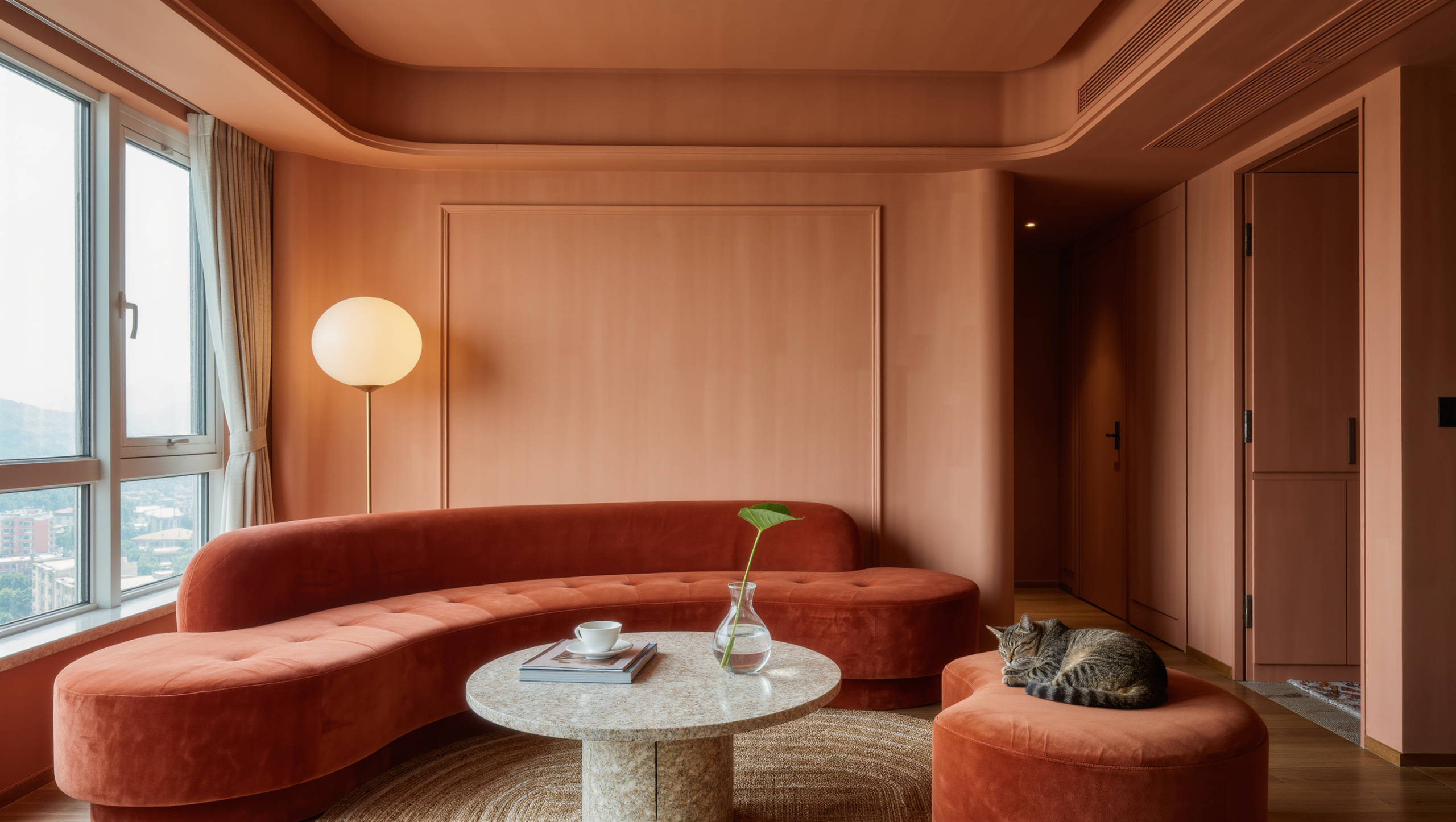
Rounded furniture is usually sold as softness. In a small room, its more useful quality is that it removes the corner your hip keeps finding in the dark.
A circular table, oval top, curved cabinet end, or sofa with a softened arm can improve a tight route because bodies rarely move through rooms in perfect right angles. We turn. We arc around chairs. We carry baskets sideways. We open doors while already moving. The furniture should acknowledge this.
Find the collision, then change the geometry
Do not buy curved furniture because the room is small. Buy it because a corner is actively misbehaving. The best candidates are tables beside a narrow path, cabinets near doorways, kitchen or dining pieces people must pass frequently, and furniture placed where two circulation routes cross.
Mark the current path with painter’s tape. Walk it carrying a laundry basket, a tray, or a bag. If everyone naturally swings around the same corner, that corner is the design brief.
A round dining table solves some problems and creates others

Round tables remove projecting corners and can make circulation around a compact dining area feel more forgiving. A pedestal base can also reduce the forest of legs beneath. But round tables use space differently from rectangular ones and can become inefficient when pushed against a wall. They are strongest when the room allows circulation on several sides.
Oval tables can be a useful compromise in narrow rooms: the length remains, but the ends stop behaving like barricades. Again, measure the actual route. Shape should respond to movement, not become a theme you apply to every object.
Curved built-ins can protect sightlines
Small-apartment projects published by ArchDaily have used custom joinery with curved forms to organize storage while preserving flow and revealing the space gradually. The lesson is architectural: a storage volume does not have to meet every path with a hard ninety-degree corner. A radiused end can turn a bulky cabinet into a more navigable edge.
Custom curves are more expensive, so reserve them for a place where the geometry actually solves something. A standard cabinet with a carefully chosen shallow depth may do the job perfectly well.
It is worth saying that curves are also having a moment, and a moment is not an argument. Arched mirrors, scalloped edges, bulbous little side tables with no flat surface on them — some of that is genuinely good and some of it is a shape applied to objects that were working fine. The question to hold onto is whether the radius is doing something for a body in motion. If the curve is only there because curves are what showrooms are selling this year, it is decoration, and decoration should have to compete on price like everything else.
Do not let “soft” become oversized
Curved sofas and barrel chairs can have deceptively large footprints. Their outer dimensions may consume corners and wall length even when the silhouette looks friendly. Check the full plan dimensions, not the front view. A compact rectangular chair can be much more efficient than a rounded one with generous arms.
Universal-design guidance also reinforces the value of protecting clear movement paths. The specific clearance a household needs varies, but the principle is straightforward: furniture geometry should support people moving through the room, including people using mobility aids, not merely maximize how many objects fit on the plan.
Curve it where the body turns
A room full of circles is not the goal and would in any case be exhausting. One radius, in the place where the route clips the table or the cabinet meets the doorway, is usually the entire job. You will know it worked the same way you knew there was a problem: by walking through at night, in the dark, carrying something in both hands, and arriving on the other side without meeting anything with your hip.
Research note: This article combines compact-interior case studies from ArchDaily with current residential universal-design circulation guidance. Furniture and passage requirements should be tested against the specific users, room dimensions, and applicable accessibility needs.
Same problem, elsewhere in the house
Room notes
Keep the room on the record.
One useful note at a time: what to test, what to ignore, and what changed when the room got another vote.