Function and Flow
Toy Storage Is a Return Trip, Not a Basket
Toy storage fails when it only answers where things can fit. The useful question is whether a child can find the thing, use it, and put it back without rebuilding the room.
On this page
8
Toy storage photographs beautifully when the toys have been removed from the photograph.
There is the low cabinet. The tasteful baskets. The labels. The tiny wooden rainbow sitting on top like it has never once been stepped on in the dark.
Then a child actually plays.
The room does not fail because toys exist. It fails when the storage system understands containment but not return.
A basket can hold forty things. That does not mean forty things know how to get back into it.
Start with how the toy leaves storage
If a child has to move three bins to reach the train set, the train set is not stored. It is buried.
If every art supply is inside one deep opaque basket, the basket solves the adult visual problem by creating a child search problem. Everything comes out because that is the only way to see what exists.
Watch the beginning of play. What gets pulled out first? What requires help? What container dumps completely onto the floor? Which pieces are always separated from the thing they belong to?
Those behaviors tell you more than a storage catalog.
Frequently used things should be easy to see or easy to identify. Sets that depend on their parts should live together. Heavy objects should not require a child to lift a high bin over their head. A system can be pretty without making retrieval an obstacle course.
Categories have to make sense to the person putting things away
Adults are excellent at inventing storage categories children did not ask for.
Imaginative Play. Fine Motor. Educational. Creative Materials.
Wonderful taxonomy. Completely useless if the person cleaning up thinks in dinosaurs, cars, dolls and markers.
Use categories that match how the objects are recognized. They can be broad. Blocks. Animals. Dress-up. Art. Puzzles. Little pieces. The point is to reduce the number of decisions required during cleanup. A museum collection would be worse, not better.
And if everything routinely ends up in one catch-all basket anyway, that basket may be telling the truth about the household. Keep one. Just do not make it responsible for every object in the room.
A child cannot choose what a child cannot see
There is a strong case for hiding visual noise, especially in a living room that has more than one job. Doors and baskets can let the adult version of the room return after play.
But fully closed storage can have a cost: when everything disappears behind opaque doors and bins, it can be harder for a child to see what is available and choose independently.
A mixed system often works better. Keep a small amount visible and inviting. Put the rest behind doors or in simple containers. Rotate only if rotation genuinely makes life easier; do not create a private warehouse management program that requires an adult to curate toys every Sunday night.
The system is supposed to reduce work.
If maintaining the storage is more complicated than the play, the storage has become a hobby.
Design the cleanup path at child height
The end of play matters as much as the beginning.
Can the child carry the object back? Can the bin be opened without an adult? Is the label understandable? Does the lid require two hands and unreasonable optimism? Does a chair have to be moved to reach the cabinet?
Children can participate in returning a room to order when the room gives them a realistic job. That does not mean a two-year-old is now facilities management. It means the physical system should not make independence impossible and then complain that nobody uses it.
Open baskets at low height are useful for large soft or irregular items. Shallow drawers can be easier for small pieces than deep bins. Picture labels can help before reading is reliable. Clear containers can be useful where seeing the contents prevents dumping.
Choose the container after you know the behavior.
The floor needs an exit route
Play expands. That is normal.
A train track, puzzle, block city or costume situation can occupy serious floor area. The room should have enough open space for that without requiring every chair to be relocated first.
But the main walking route should not disappear every time play begins. Keep the biggest play zone beside the route rather than directly across it when possible. If the only available floor is the path between sofa and kitchen, accept that the room has a multi-use conflict and solve the furniture layout before blaming the toys.
Sometimes the best toy-storage improvement is moving an adult chair six inches.
Every hollow piece of furniture is another place to search
Storage ottoman. Storage bench. Storage table. Storage stool. Bed with drawers. Sofa with compartments. Suddenly the room contains twelve places where a puzzle piece might be hiding.
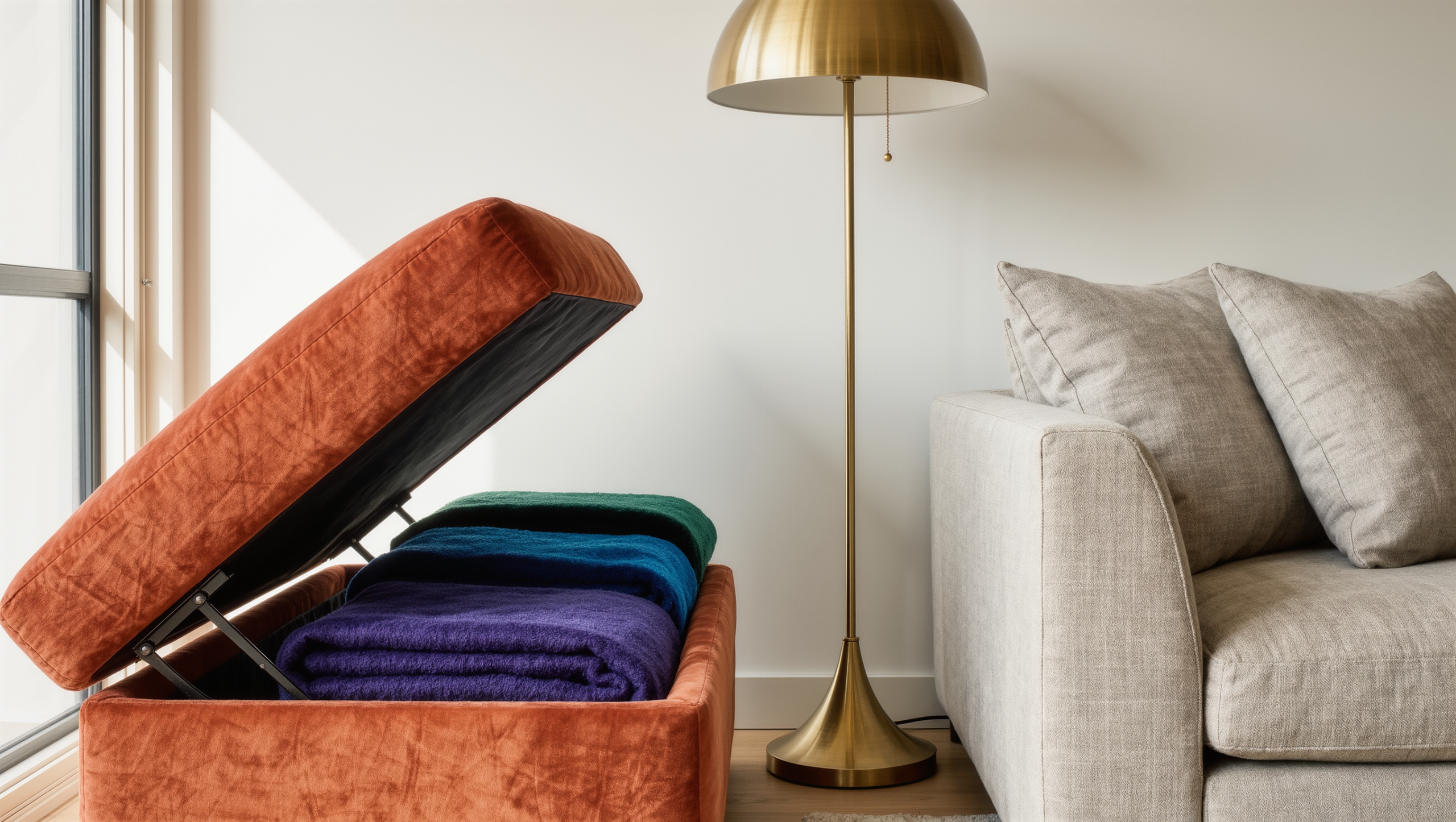
Hidden storage is valuable when the location matches the object. Blankets in an ottoman near the sofa? Sensible. Board games in a bench beside the table where they are played? Useful.
Random toy overflow distributed across every hollow piece of furniture creates retrieval debt. Nobody knows what lives where, so cleanup becomes stuffing and play begins with searching.
Give the toy system a center of gravity.
Let the adult room come back without erasing the child
A family room can still have adult design. Strong color. Art. Good lighting. Furniture chosen because you like it rather than because it arrived in a primary-color children’s catalog.
The child’s presence does not need to be hidden like evidence.
Keep one shelf of books visible. Let a beautiful wooden toy live out if it is genuinely used. Use baskets in materials and colors that belong to the room. Choose a cabinet you would still want after the toys change.
At 8 p.m. the room should be usable by adults. That is a lower bar than looking childless, and a considerably more achievable one.
Five minutes will show you where the return breaks
At the end of ordinary play, set a timer for five minutes and return only the obvious things.
Notice what causes hesitation. One toy has no home at all. One bin is already full before cleanup starts. One category produces a debate every single time. Something is too high to reach, and something else is a half-built project that should probably be allowed to stay assembled until Sunday.
Fix those points one at a time.
A useful toy system lets play be as loud and sprawling as it likes, as long as every piece knows the way home afterward.
Buy the basket last. The path back to it is the part that decides whether the room recovers.
Related reading: Function and Flow Without the Pinterest Hangover
Same problem, elsewhere in the house
Room notes
Keep the room on the record.
One useful note at a time: what to test, what to ignore, and what changed when the room got another vote.