Awkward Spaces
Your Bathroom Door May Be the Bulkiest Thing in the Room
In a small bathroom, the door swing can steal more usable space than the vanity. Read the moving footprint before buying another storage piece.
Room for Drama · Diagnosis Card
The door may be stealing more room than the room is missing.
Diagnose first. Buy last.
Small bathrooms get blamed for being small as though the square footage committed the crime by itself.
Sometimes it did. Sometimes the room is simply asking one object to occupy the same patch of floor over and over again, and because that object happens to be the door, nobody counts it as furniture.
I do.
An inward-swinging bathroom door is a moving wall. It can erase the only useful hook location, block a shallow cabinet, make a towel bar impossible, force the vanity to stay smaller than the wall could otherwise support, and create that ridiculous little shuffle where one person has to step behind the door to let another person through. The room may be forty square feet on paper. The usable room is whatever is left after the door performs its daily sweep.
Before blaming the vanity, read the swing.
Open the door and stop pretending that space is available
The easiest test costs nothing. Open the bathroom door all the way and leave it there. Now look at the wall, floor, hooks, towels, hamper, bath mat, toilet clearance, cabinet doors and the route to the sink.
Anything inside that arc has to coexist with a moving slab several times a day. That does not automatically make the layout bad, but it means the space is conditional. A basket that fits beautifully when the door is closed may be a basket that gets kicked twice before breakfast.
Mark the door sweep with painter’s tape if you need to see it. Then walk the room the way it is actually used: enter with an armful of towels, step out of the shower, reach for a robe, open the vanity, pull a drawer, clean around the toilet. The awkward moment usually introduces itself very quickly.
The problem is not always that there is nowhere to put something. Sometimes the place you keep trying to use belongs to the door.
Behind the door is not free storage
That narrow wall behind an open door is deeply tempting. Hooks. A towel ladder. Shelves. A little cabinet. Maybe all four, if we have decided the bathroom must now operate like a tiny hardware store.
Use that wall only for things that tolerate being hidden, brushed past and occasionally bumped. Flat hooks can be useful. A slim towel rail can work if the door hardware and towels have real clearance. Bulky shelves, projecting baskets and decorative objects usually turn the door into a battering ram.
And over-door storage is not automatically clever. It adds thickness to the door, can interfere with the frame, may rattle, and often puts the stored object exactly where the room already feels visually busiest. Useful is not the same thing as available on the internet.
If the bathroom needs serious storage, I would rather find one calm, shallow place for it than distribute twelve small storage solutions around the door because each one technically fits.
The towel path tells you more than the styling does
Bathrooms have a small number of repeated movements, which makes them easy to diagnose if you stop looking at them as still photographs.
Where does the hand towel go after the sink? A wet bath towel needs somewhere to hang that is not the back of the door. A robe lands somewhere, and if that somewhere was never decided, it is the floor. Dirty clothes travel by the shortest route rather than the tidiest one. And the spare roll has to sit within arm’s reach of whoever discovers the current one is finished, at the least dignified possible moment.
Those are not glamorous questions. They are the bathroom.
If the door swing blocks the best answer, move the answer before you buy more cabinetry. A hook on the adjacent wall, the side of a vanity, or just outside the bathroom can solve more than a freestanding storage piece squeezed into the wrong corner. If the room has a linen closet nearby, let the bathroom store what it needs immediately and let the closet hold the bulk. The smallest room in the house does not need to prove it can warehouse the household.
A door change can be useful. It is not automatically the first move.
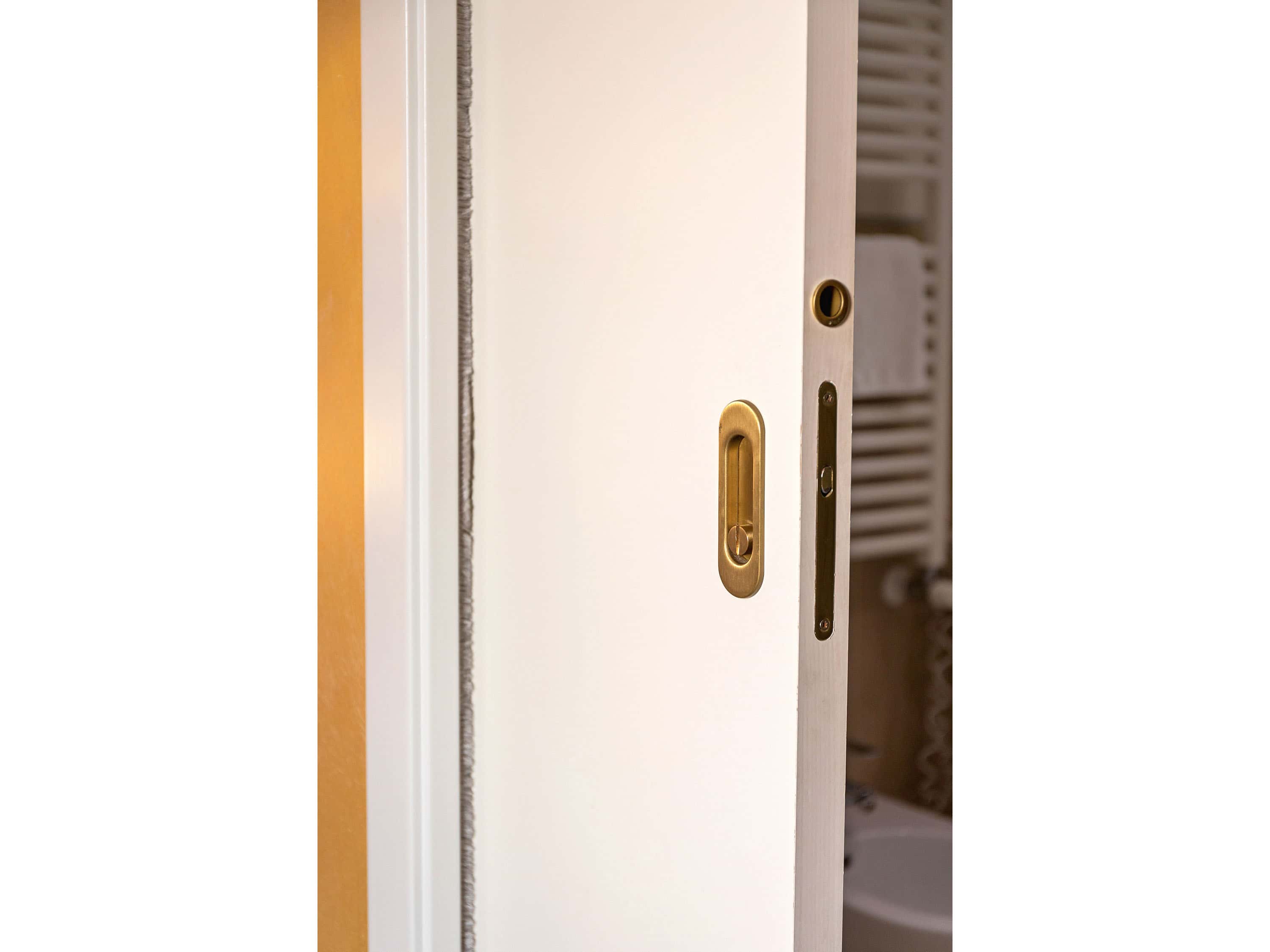
There are bigger interventions: reversing the swing, using a pocket door, changing the opening, replacing the slab, or moving the doorway entirely. Some can transform a difficult bathroom.
They also move the problem into architecture, structure, electrical locations, wall cavities, privacy, hardware and local requirements. A pocket door needs somewhere to go. An outward swing needs somewhere to land without creating a new collision. A changed opening can affect more than the bathroom.
I would not begin there unless the cheap tests have already proved the door is the governing problem. First remove the freestanding clutter. Move the hamper. Relocate towels. Test the wall with the door held open for several days. If the room suddenly works, then a door intervention has evidence behind it instead of hope.
What panic does to the scale of a small bathroom
This is where small bathrooms often lose their nerve. The door creates congestion, so every other object gets smaller. Tiny mirror. Tiny light. Tiny art. Tiny rug. Tiny shelves full of tiny bottles. Eventually the bathroom contains seventeen undersized things and still feels cramped.
Once the door conflict is understood, let the remaining elements have authority. One good mirror can be large. One closed cabinet can be useful. One strong wall color can finish the room without taking up an inch. The bathroom can be compact without visually apologizing for itself.
Scale should respond to the usable wall and the sightline, not to panic.
Watch what the door does for three ordinary days
For three days, keep the bathroom door open whenever privacy is not an issue. Remove anything the swing hits or hides. Put towels where the hand naturally reaches. Move the hamper to the place dirty clothes actually travel. Take one photograph from the doorway and another from inside the room with the door fully open.
Then ask a better question than how do I add storage?
What is the door making everything else do?
If the answer is not much, leave it alone. If the answer is almost everything, you have finally found the real piece of furniture in the room.
Related reading: The Door-Swing Dead Zone Can Still Earn Its Keep
Same problem, elsewhere in the house


