Multi-Use Rooms
The Guest Room Became the Place Where Decisions Went to Wait
A guest room can become storage for postponed decisions long before it becomes visibly unusable. This piece separates clutter from avoidance and gives the room one reversible job.
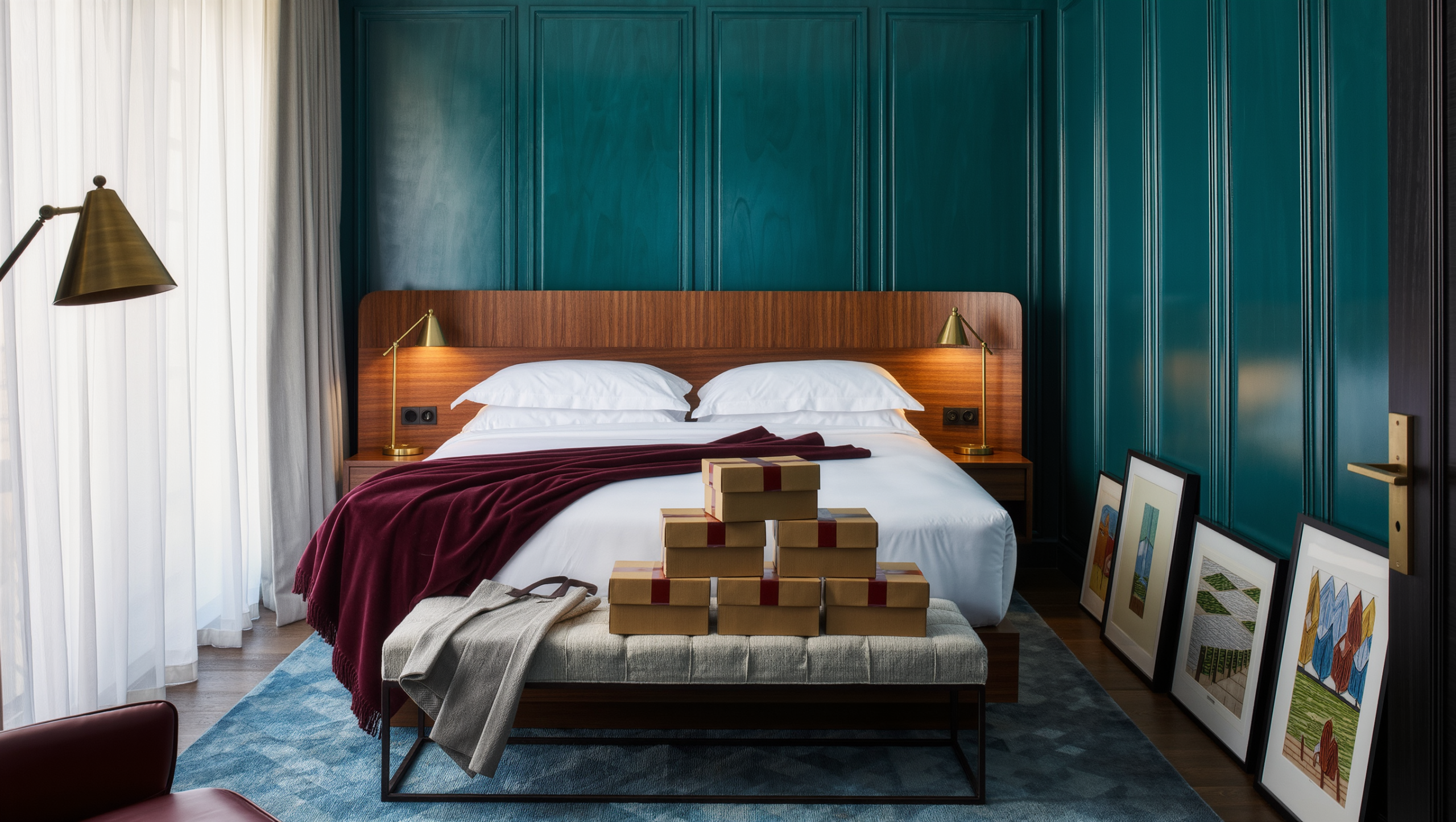
The guest room rarely announces that it has changed careers. It accepts one box, then the returns that missed their window, then the lamp nobody dislikes enough to release. Eventually the room is no longer for guests. It is where unresolved decisions are granted indefinite administrative leave.
The room may still contain a bed. That is not the same thing as remaining guest-ready. A room whose every clear surface is holding a postponed choice is functioning as decision storage.
No dramatic declutter is going to do it. The fix is separating storage from decisions and giving both a limit.
What the room is actually doing
Look at behavior before appearance. Does the door stay closed? Do you move objects only when someone might visit? Does every attempted reset begin by relocating the same pile?
Those are evidence that the room has become a holding system without admission rules, review dates, or an assigned owner.
Notice whether the room is carrying several kinds of unfinished work at once: objects waiting for a destination, purchases waiting for a verdict, projects waiting for time, sentimental items waiting for a conversation, and parts of a former life waiting for a decision.
Treating all of that as one category called clutter guarantees a dramatic weekend and then a room that quietly refills, because nothing that was actually undecided got decided.
Separate “needs a home” from “needs a decision”

An object that clearly belongs in another room has a destination problem. Move it there or create the storage it genuinely needs.
An object you are unsure whether to keep has a decision problem. Put it in a limited, named decision zone rather than allowing uncertainty to spread across the whole room.
These categories require different actions. More shelving does not make an undecided object decided.
Give decision storage a capacity
Use one box, one shelf, or one defined zone for items awaiting a decision. When the capacity is full, no new item enters without something leaving or being decided.
This prevents the room from becoming infinite psychological storage simply because a door can be closed.
The container puts a boundary around the indecision without making it permanent.
Add a review date
Some decisions are genuinely difficult, emotionally loaded, financially consequential, or dependent on another person. They do not need to be forced in one exhausted afternoon.
Give the decision zone a review date. Thirty days, a season, or another realistic interval may be appropriate depending on the item.
A future date converts “not now” from indefinite avoidance into a scheduled decision.
Do not confuse avoidance with laziness
Sometimes the room still represents a version of the home you expected to have: frequent guests, a hobby, a child returning, a business taking off, or enough time to finish everything properly.
Some objects may carry grief, guilt, conflict, identity, or the cost of a purchase you regret. The room cannot solve those feelings by becoming more organized.
The useful question is not “Why can’t I keep this room clean?” It is “Which decisions has this room been asked to hold for me?”
Protect one guest-ready zone immediately
Do not begin with the entire room. Choose one surface, one side of the bed, or one square meter and make it genuinely available.
For seven days, protect that cleared zone from new arrivals. Perfection is not being measured. What you are learning is whether the room feels different when one part of it is no longer carrying deferred judgment.
Often the first clear zone provides enough visual and functional relief to make the next decision easier.
Give actual guest needs priority
A guest room does not need to sit untouched all year, but the guest function should have a clear minimum standard: usable bed, path, light, charging access, a landing surface, and some storage or hanging space appropriate to the stay.
Everything else can be shared if the room’s other use has a fast exit.
Use The Guest Room Office That Can Change Personalities in Ten Minutes if the room has a legitimate second job rather than simply becoming overflow.
Stop moving the same pile
If the same objects travel from bed to chair to floor to hallway every time a guest arrives, the system has learned nothing.
Each recurring item needs one of four outcomes: permanent home, scheduled decision, explicit handoff to another person, or release.
A fifth outcome called “move it somewhere else for now” is how the room got this way in the first place, one reasonable postponement at a time.
Give projects an active limit
Unfinished projects can consume an entire room because each has materials, tools, and an imagined future. Decide how many active projects the room can hold at once.
Archive inactive projects together or release them. Keep current project materials contained enough that the guest function can recover without sorting every component.
The room is allowed to support hobbies. It is not required to store every possible future version of them.
Make shared decisions explicit
Objects belonging to another household member should not leave through stealth disposal or relocation. Create a handoff zone or scheduled review where the owner can make the decision.
This may be slower than unilateral decluttering and considerably better for household trust.
Do not solve emotional inventory with expensive cabinetry
Custom storage can be excellent when the category and volume are known. It is a poor first response when the room’s main inventory consists of things no one has decided to keep.
Make the decisions before buying permanent capacity for them. Otherwise the room becomes more efficient at preserving avoidance.
Use the room for one week before finishing it
Once the main categories are contained, give the guest room one normal secondary function—reading, occasional work, exercise, or another real use—and observe it.
The room may reveal that it does not need a decorative makeover. It may need one lamp, one better storage location, and the confidence to stop serving as the house’s waiting room.
What may remain unresolved
The room may still contain grief, disagreement, limited storage, or a future that has not declared itself. A functional intervention does not have to produce emotional closure.
It only has to stop the room from silently accepting every undecided thing in the house.
Stop storing postponed choices
A guest room can share its life. It cannot become an unlimited warehouse for postponed choices and still be expected to transform gracefully the night before someone arrives.
Keep the two categories apart and put a date on the second one. The pile usually stops growing almost at once, which tells you what it was made of. Storage was never the shortage in that room. Nobody sells a container for an unmade decision, and the guest room has been doing that job for free.
Room Case · the receipts
Job → Friction → Constraint → Hypothesis → Test → Result → What changed.
Seven fields stay fixed here because this is one place where consistency helps. If the ending is missing, it stays missing until the room has lived long enough to answer.
-
01
Job
Be guest-ready without requiring a night-before evacuation: clear bed, path, light, charging, landing surface, and hanging space.
-
02
Friction
Undecided objects migrate from bed to chair to floor every time a guest arrives, so the closed door becomes the storage strategy.
-
03
Constraint
Some objects belong to other people or carry grief, regret, or unresolved decisions that shelving cannot solve.
-
04
Hypothesis
Separating housed objects from undecided objects will restore usable guest function without pretending additional storage makes a decision.
-
05
Test
Split one visible pile into “has a known home” and “needs a decision,” move the first now, contain the second with a review date, and protect one cleared square metre for seven days.
-
06
Result
Still waiting on Recheck. The room has not lived with the change long enough for us to call it a result.
-
07
What changed
Not yet. We are keeping this open until Recheck gives us a reason to keep, change, or reverse the decision.
Same problem, elsewhere in the house
Room notes
Keep the room on the record.
One useful note at a time: what to test, what to ignore, and what changed when the room got another vote.