Function and Flow
The Home Office Is Drowning in Paper Because the Storage Is Too Far Away
Paper clutter is often a distance problem. Put incoming, active, reference, scanning, shredding, and filing zones where the work actually happens so the desk stops becoming the only available holding surface.
On this page
8
A pile of paper on a desk looks like a storage failure. Look closer and it turns out to be a stack of decisions nobody has made, standing upright, waiting. Which is why buying another cabinet so seldom helps — the cabinet accepts the paper without resolving any of it, and six weeks later there is a fresh pile beside a full cabinet.
Paper arrives in states: active, waiting, reference, confidential, archive, scan, recycle. Each one is a different thing needing a different destination, and when none of them has a destination, every flat surface in the room becomes a queue with no owner. It is the most ordinary way any system fails, with nothing broken and everything merely stuck between two steps, and a desk is no exception. What the office needs is a short route and a closing scene, not more capacity.
Begin by evicting archive from the prime real estate. Active paper supports current work and has earned immediate reach; archive exists for retention and can live across the room, or in a different room altogether. It is remarkably common to find the best drawer in the house holding records opened twice a year while this month’s project sits in a heap on the desk. Swapping those two costs nothing at all.
Create one inbox
Paper needs exactly one legal arrival point. Mail, printed documents, forms, notes, anything requiring action — all of it enters one bounded tray, folder or vertical file, and nothing enters anywhere else. The boundary is the whole feature. A tray with sides tells you the moment the system falls behind; a corner of the desk tells you nothing until the paper has reached the chair.
The inbox is a queue, and a queue nobody drains is a museum with worse lighting. Pick a rhythm you will actually keep — twice a week is fine, daily is better, “when it gets bad” is not a rhythm — and take it to empty each time. Everything leaves as a decision rather than as a relocation.
Waiting is a state, and almost nobody gives it one
Documents awaiting a reply, a signature, a payment or somebody else’s action are neither active work nor archive. They are blocked, which is a third thing, and it is the state that produces most of the mess. Filed away, they are forgotten until they become a problem. Left on the desk, they hold surface indefinitely while nothing about them changes.
One clearly labeled waiting tray settles it. The unfinished work stays visible enough to remember without the desk being responsible for the remembering, and there is a useful side effect: you can see at a glance how much of your administrative life is currently sitting with other people.
Reference is the opposite trap. Manuals, notebooks and project material consulted often belong near the desk. Material that might conceivably be useful one day does not, however reassuring it is to have it within reach. The work surface is for work, and keeping every potentially useful document at arm’s length is how a desk becomes a shelf you cannot write on.
Confidential paper gets its own rules
Sensitive personal or work information needs storage, disposal, and access appropriate to its content and organizational requirements.
That is the whole instruction and it does not bend for the room. An open basket holding documents with account numbers in them is not styling, whatever it is doing for the color scheme, and an office sharing a public part of the house raises the stakes rather than lowering them.
Put the whole job on one wall
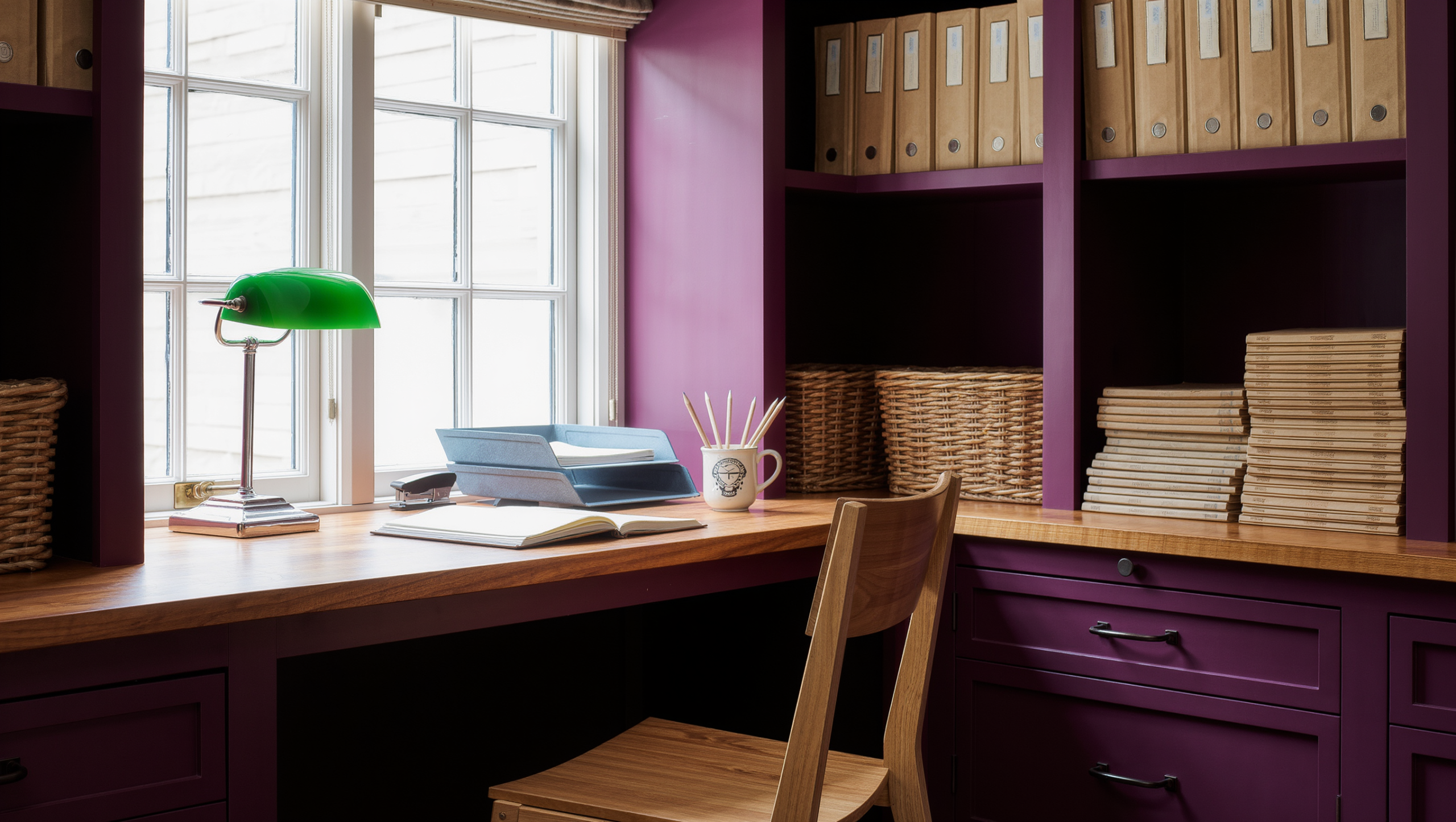
A compact office works best when the desk, the light, the active storage, the power and the shutdown containment all live on a single wall. Enough surface for the real task, and enough closed storage within reach that paper can leave the desk without leaving the room. That last clause is the load-bearing one: most paper does not need to go far, it needs to go somewhere.
Set that against the usual arrangement — desk on one wall, printer on another, files across the room, supplies in a closet. Every task turns into a lap of the room, and laps do not get run. The paper stays out because putting it away carries a travel cost, and that cost gets paid several times an hour until the day someone stops paying it.
The printer obeys the same logic and breaks it most often. Print frequently and it earns easy access, ventilation, paper storage and power near the work zone. Print four times a year and it has no claim on prime surface at all. Put it where occasional use stays practical, and stop letting an object you barely touch be the visual centerpiece of the room.
Go up the wall, then deal with what hangs down
Wall cabinets, shelving, peg systems and vertical files claim the space above the desk, which is the only free floor area a small office has. Daily categories go at the easiest height. Visually noisy supplies go behind doors wherever that is possible, because a room you look at for eight hours should not also be an inventory display.
Do not place heavy items overhead without appropriate support or create storage that requires unsafe reaching.
Then the cables, which are why many compact offices still feel chaotic after the paper is solved. Power, monitors, chargers, printer cords and headphones will arrange themselves into an obstacle course if left to it. Use suitable cable management and keep cords away from walking routes, heat, and pinch points. Permanent electrical changes require qualified help.
Scanning moves the problem unless you decide first
Some paper can leave physically after it has been handled appropriately. Decide what may be scanned, what must remain original, and what can be securely recycled or destroyed.
Make that decision before the scanner is switched on. A scanner running without one is a very efficient machine for building a second archive you also cannot search. Digital files need naming, storage, access, backup, and retention logic too, and skipping that work trades a heap you can see for a folder you will never open. The heap was at least honest about its size.
The office has to close, and closing has to be cheap
At the end of the work period, active paper returns to one current-project location, waiting items go to their queue, confidential material is secured, and the desk regains enough clear surface for the next session. Turn off task light and contain the laptop or peripherals where that supports the room’s other use.
A closing scene is particularly important when the office shares a bedroom, living room, dining area, or guest room. In a dedicated room an open workday is untidy. In a shared one it colonizes the evening — dinner beside a stack of invoices, sleep four feet from tomorrow’s unresolved problems. People live with that arrangement for years without ever putting a name to what it is costing them.
But the sequence has to be short or it will not survive a Friday. If the office takes twenty minutes to close, the system is too complicated. The shutdown should be a few repeatable actions that do not require sorting the entire workday from scratch. Use broad categories rather than an elaborate filing system nobody maintains. An elegant taxonomy abandoned in March is worth considerably less than four ugly folders still in use in November.
Drift is the default, so schedule against it
Daily work creates drift. Once a week, clear the inbox, resolve waiting items that can move, file reference, archive what is complete, and remove what no longer needs to exist. The office stays functional because decisions continue, not because the storage was perfectly labeled once.
The weekly pass catches the slow failure as well as the fast one. If the work has changed, the paper, equipment, and storage needs may have changed too. Use The Home Office Still Belongs to the Job You Left when the entire room is maintaining an older workload. A surprising share of home-office storage crises turn out to be a filing system built for a role that ended two employers ago, still being fed every week by somebody who has forgotten they are feeding it.
Same problem, elsewhere in the house
Room notes
Keep the room on the record.
One useful note at a time: what to test, what to ignore, and what changed when the room got another vote.