Function and Flow
The Media Wall Is Getting Quieter
The 2026 media wall is moving away from stacked gadgets and decorative slat overload toward integrated storage, lighter visual weight, concealed wiring, and a screen that belongs to the wall without swallowing the room.

The media wall has spent several years auditioning for the role of Feature Wall With Opinions. It may finally be calming down.
The version worth borrowing treats the wall as one continuous architectural system: television, storage, wiring, display, and lighting handled together rather than accumulated as a console, soundbar, shelf, plant, basket, router, two mystery remotes, and a heroic amount of cable management.
That is good news. Especially for small rooms.
What actually has to live inside it
List the equipment before anybody draws cabinetry. Television. Soundbar or speakers. Game console. Router. Streaming hardware. Receiver. Controllers. Charging. Books. Closed storage. Display. Then cross out everything that does not need to be there, which is usually about a third of it.
The media wall becomes oppressive when it is designed as a generic storage opportunity instead of a specific equipment system. Generic storage has no shape, so it fills the wall, and a wall that has been filled for no stated reason is what makes a small living room feel like it is storing somebody else’s things.
Open shelving is where this goes wrong fastest, because it reads as free. It is not free. Every open niche is another composition somebody has to maintain, and books, objects, cables, speakers and consoles start competing within two weeks. Use open space where something genuinely deserves to be seen, put the technical clutter and the backup equipment behind doors, and be suspicious of any wall that needs twenty decorative objects to look finished. If it does, the architecture is not carrying its share.
In a small room, the wall is stealing floor

A floating console can make a small room feel less crowded because the eye can read more continuous floor beneath it. That does not mean every cabinet should levitate. It means the lower wall should not become a visual retaining wall unless the storage truly needs that mass.
Wall-mounted or leggy pieces also make cleaning easier. A beautiful shadow gap full of dust is less persuasive up close.
Depth is the number to be strict about, because it is the one the room feels every day and nobody notices on a drawing. Measure door swings, seating clearance, circulation and the depth the actual equipment requires before adding decorative recesses. A shallow cabinet that handles the cables and a few devices will usually beat floor-to-ceiling millwork that shrinks the usable room in order to prove the television has been integrated. That is a trade most people make once, in a drawing, and then live with in a room that is now two feet narrower at exactly the point where people walk.
Heat and cable decide the cabinet before the finish does
Receivers, game consoles, routers, and other electronics generate heat. Closed cabinetry needs to respect equipment clearances and ventilation requirements.
Do not design flush doors first and then drill a few hopeful holes once the cabinet gets warm.
The cable path is the same order of decision. A media wall looks calm because the infrastructure behind it was organized: power, data, speaker wire, HDMI runs, conduit, and a route back in when something fails. Leave a way to replace or upgrade components, because technology changes faster than custom millwork ever will, and a wall built around today’s exact device dimensions has an unnecessarily short life. The most expensive version of this mistake is a beautiful joinery run that has to be partly destroyed to swap a receiver.
Equipment boundary: Follow manufacturer requirements for ventilation, mounting, electrical access, and service clearances. Concealed wiring should remain safe and maintainable.
One strong move, then stop adding
Only now does the face of the wall get decided, and it should be decided with restraint. The television can sit within a painted field, shallow cabinetry, restrained millwork, a broad panel, or a darker section of wall. It does not automatically need vertical slats, stone, backlighting, floating shelves and a linear fireplace. One strong surrounding move is enough. The existing Room for Drama piece Your Living Room Has a Social Life Beyond the Television still applies: the screen gets a role, not the constitution.
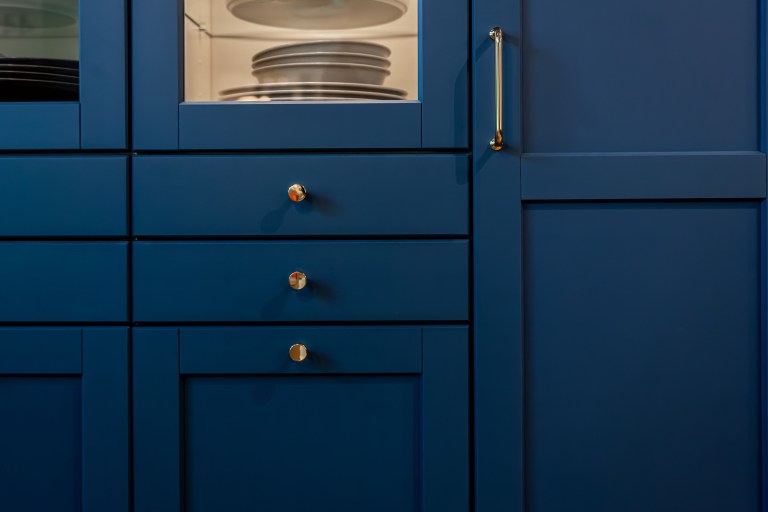
Color will do more work here than another material. Painting the cabinetry the same tone as the wall, or close to it, reduces the visual fragmentation that makes a small room feel busy, and fewer abrupt material changes make a built-in read as architecture rather than as furniture that has been bolted on. This is not an argument for beige. A deep green, a brown, a blue, a charcoal, any saturated color that belongs to the room will do it. Continuity is the useful move. Neutrality is not.
And the fireplace does not automatically belong up here. The stacked television-over-linear-fireplace formula is still common, and common is not the same as correct. If heat, viewing height, room proportion or competing focal points make the combination awkward, separate them. A media wall is allowed to be a media wall without becoming a catalog bundle.
When the television is dark
What remains should be enough on its own: a coherent wall, some storage, perhaps art or books, and enough empty surface for the room to breathe. That is a low bar and most media walls clear it by overshooting — they compensate for one black rectangle by surrounding it with twelve smaller rectangles, and the room is now busier switched off than it was switched on.
None of this makes the quieter media wall a minimalist position. It simply admits that the screen will be black for most of the hours anybody is in the room, and the wall has to be worth looking at then, at close range, in daylight, with nothing playing.
Trend source line: 2026 media-wall coverage is consistently moving toward integrated cabinetry, concealed wiring, floating storage, color continuity, and quieter systems rather than standalone TV furniture. Sources: Homedit and Woman & Home.
Same problem, elsewhere in the house
Room notes
Keep the room on the record.
One useful note at a time: what to test, what to ignore, and what changed when the room got another vote.