Outdoor Rooms
This Yard Has Main-Character Acreage
Give a large yard hierarchy through long views, daily and destination rooms, service routes, maintenance zones, restrained planting, and enough open land that the property can still breathe.
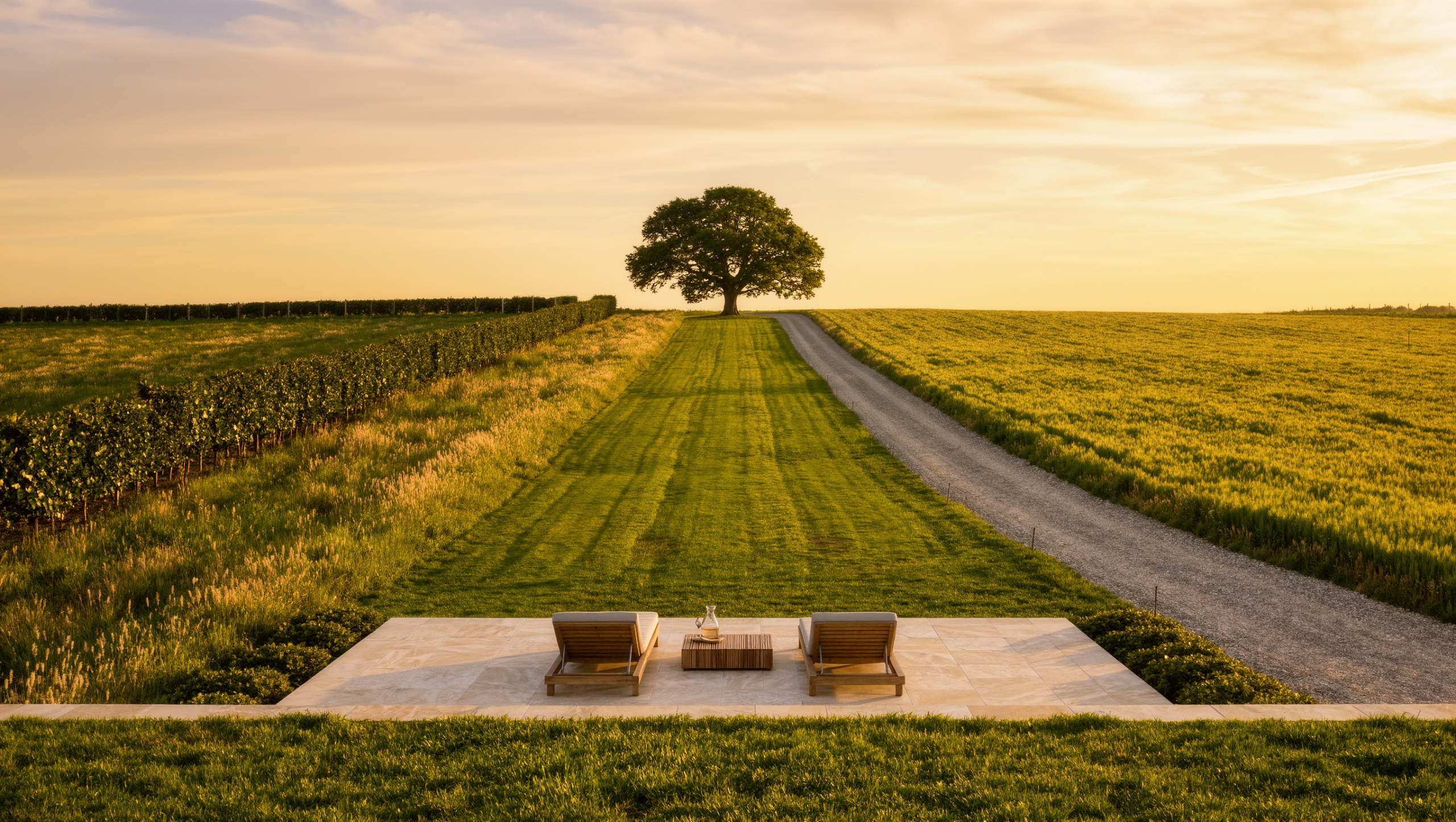
A large yard can hold an astonishing number of things and still feel like nobody made a decision.
That is the strange part about acreage. Space looks like freedom until the patio, fire pit, play area, shed, garden beds, pool, lawn, and six random benches all start behaving like separate properties. Adding features to a yard in this state makes it worse. The missing element is hierarchy.
Big outdoor space wants a plot.
Read it from the house first
The property is not experienced from an aerial plan. It is experienced through windows, doors, daily routes, and the few places people actually stand still.
Start at the most-used interior window. What is the long view? What interrupts it? Where does the eye stop naturally? Then step outside and trace the routes people use every day, not the ceremonial route the landscape plan wishes they used.
Sun, shade, wind, drainage, utilities, mature trees, and service access all matter, and they are the conditions the larger idea has to survive. Promoting each one to its own design theme is how a yard ends up with eight of them.
Choose one governing idea and make the rest answer to it
A large property can organize itself around a long view, a sequence from formal near the house to looser farther out, rooms arranged around a grove, a meadow clearing, repeated masses, or a strong central axis. The exact idea matters less than having one.
Without it, every new project arrives as an independent improvement. The pergola faces one way, the fire pit another, the planting follows a third language, and the shed appears to have been dropped from the sky.
Before adding anything, ask whether it strengthens the governing idea or just occupies available land.
Use three distances instead of twenty destinations
Near the house, build the space that supports ordinary life: coffee, dinner, a chair in the sun, somewhere to put a drink. Farther out, give the property one larger social destination—a fire area, pavilion, pool terrace, or generous table. Then let one quieter place exist beyond that: a bench, grove, garden edge, or view people reach on purpose.
Those three scales are usually more useful than scattering attractions evenly. They create a reason to move through the property and leave enough open land that the yard can breathe.
Unprogrammed space is not failure. Lawn, meadow, orchard spacing, or woodland edge can carry visual scale and absorb changing needs without becoming another maintenance department.
Plant at the scale people actually see
A few tiny mixed borders can disappear on a large property. Repeated masses, larger drifts, trees, and strong structural planting read from a distance. Save intricate planting for entrances, paths, terraces, and places where people get close enough to notice it.
That does not mean making the landscape simplistic. It means giving detail a proper viewing distance. The same principle applies to flowers: a concentrated gesture can do more than hundreds of small decisions spread thinly across the yard. One ridiculous flower move is sometimes exactly the right scale of intervention.
Service has to be able to reach the romance
The farther a destination sits from the house, the more practical questions start following it. How does food get there? Where do dishes return? Where does waste go? How do tools, water, power, cushions, or firewood arrive? What happens after rain?
A beautiful pavilion at the end of the property is only useful if using it does not turn the household into a logistics crew.
Keep guest paths distinct from service where possible, and do not permanently furnish the property for the biggest event it might host once. Temporary infrastructure is perfectly respectable for temporary scale.
The longest view deserves protection
Large yards become calmer when one or two important sightlines stay clean. That may mean moving bins, screening equipment, trimming a visual blockage, or resisting the urge to install a decorative object in every empty patch.
Stand at the house and let the land tell you which view is worth defending. Once that line is clear, the rest of the property gets easier to organize around it.
For the next layer, see The Backyard Needs Destinations, Not More Lawn and The Backyard Does Not Need More Zones. It Needs Better Transitions.
Same problem, elsewhere in the house
Room notes
Keep the room on the record.
One useful note at a time: what to test, what to ignore, and what changed when the room got another vote.